 Birch Bay Exterior
 Storm Damage on a Point Roberts Roof Isn't Like Storm Damage Anywhere Else
Point Roberts sits on a small peninsula at the very edge of Whatcom County, jutting into the Strait of Georgia and cut off from the rest of Washington by water and by the Canadian border. That geography is exactly what makes roofs out there take a beating. Homes get hit with wind coming almost straight off the water, salt-laden air that never really lets up, and driving rain that finds every weak seam in a roof system. Add in a moss season that runs long and wet most of the year, and you've got a combination that ages roofing material faster than it would a few miles inland in Birch Bay or Blaine.
When we say "storm damage repair" for Point Roberts, we're not just talking about the aftermath of one bad windstorm. We're talking about a roof that's under constant low-grade stress from salt, wind, and moisture, punctuated by storm events that expose whatever was already weakened. A correct repair has to account for both — the acute damage from the storm and the underlying condition the storm revealed.
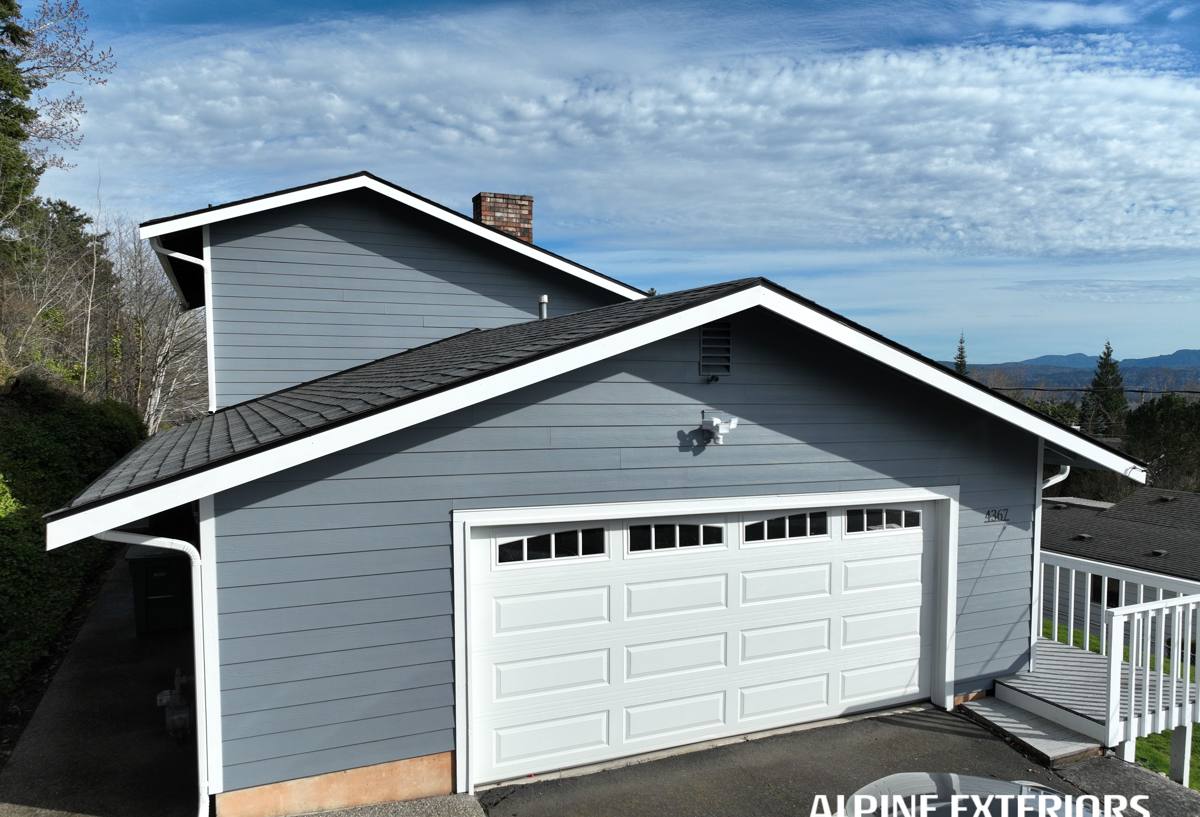
What Actually Counts as Storm Damage
Homeowners often call us after a windstorm assuming the roof is fine because nothing looks obviously wrong from the ground. Other times a roof looks rough but the cause isn't storm-related at all — it's just age and moss doing what age and moss do. Sorting out which is which matters for how we approach the repair and for insurance purposes.
Wind-Related Damage
Lifted, cracked, or missing shingles along ridges, edges, and any place the roofline changes are the classic signs. Wind doesn't have to be extreme to do this — a roof with marginal fastening or aging adhesive strips can lose shingles in gusts that a newer roof shrugs off.
Rain-Driven Damage
Driving rain off the strait doesn't fall straight down — it gets pushed sideways into flashing, vents, and any horizontal seam. Water intrusion from this kind of event often shows up as a stain on an interior ceiling days after the storm has passed, once the moisture has worked its way through the sheathing.
Debris and Impact Damage
Branches, blown debris, and falling limbs from wind events can crack shingles, dent metal flashing, or puncture underlayment in ways that aren't visible unless someone gets up there and looks.
What's Usually NOT Storm Damage
Curling shingles, granule loss across large areas, and moss buildup that's been developing for years are wear-and-tear issues, not storm damage — even if a storm is what finally made a homeowner notice them. We'll tell you plainly which category your roof falls into rather than labeling everything "storm damage" to pad a claim.
The Border Reality: Why Local Logistics Actually Matter Here
Point Roberts is a U.S. exclave — to drive there from Birch Bay or anywhere else in Whatcom County, you cross into Canada and back into the U.S. That's not a footnote, it's a real factor in how storm repair work gets done well or poorly.
A crew unfamiliar with that routine can lose real time to border wait times, ID and paperwork requirements at the crossing, and the logistics of getting materials, ladders, and equipment through customs twice on a single job. On a roof that's actively leaking, that lost time is the difference between a same-week tarp-and-repair and a homeowner watching water damage spread while a contractor figures out crossing logistics for the first time. A crew that already works the peninsula regularly has that routine down — vehicles loaded correctly, timing planned around crossing hours, and no surprises that delay getting a tarp on an exposed roof.
It also affects material staging. We plan Point Roberts jobs so we're not making multiple border crossings mid-repair because we forgot a component — everything needed for the scope of work goes over in one trip.
Our Storm Damage Repair Process
The process is the same discipline every time, adjusted for what the storm actually did:
1. Assessment
We inspect the full roof, not just the spot the homeowner noticed. Storm damage rarely announces itself in only one place — wind that lifted shingles on one slope often stressed flashing or vents elsewhere too.
2. Stabilize First
If there's active water intrusion or exposed decking, the first priority is stopping further damage — tarping, temporary flashing, or sealing an exposed area — before we plan the permanent repair. This matters even more on the peninsula, where a follow-up trip isn't as simple as driving back across town.
3. Scope the Real Repair
We identify what needs to be replaced versus what can be properly resealed or reattached, and we explain the difference so you understand what you're paying for and why.
4. Match Materials and Execute
Repairs get tied into the existing roof system correctly — matching shingle type, maintaining proper flashing laps, and using underlayment appropriate for a high-moisture, high-salt environment — so the repaired section performs as well as the rest of the roof, not as an obvious patch.
5. Document
We document the damage and the repair with photos and notes, which is useful both for your records and for any insurance claim you're filing.
Common Repair Types We Handle
| Damage Type | Typical Cause | Repair Approach | Urgency |
|---|---|---|---|
| Lifted or missing shingles | Wind gusts off the water | Reseat or replace matching shingles, check adjacent fasteners | High — exposed decking risk |
| Flashing separation | Wind-driven rain, thermal cycling | Re-flash with corrosion-resistant material, reseal laps | High if actively leaking |
| Cracked or dented sections | Wind-blown debris | Spot replacement of affected shingles or panels | Moderate |
| Vent boot or pipe collar damage | Wind stress, sun and salt aging | Replace boot/collar, reseal penetration | Moderate to high |
| Gutter and edge detachment | Wind load, ice buildup in cold snaps | Re-secure or replace hardware, check fascia | Moderate |
| Interior water staining | Any of the above, delayed discovery | Trace source, repair roof, assess sheathing condition | High — hidden damage possible |
Salt Air, Moss Season, and Why "Just Patch It" Isn't Enough
A storm repair on a Point Roberts roof has to account for what the environment does to materials over time, not just the immediate damage. Salt air accelerates corrosion on exposed metal fasteners and flashing faster than it would inland, so we use corrosion-resistant hardware and flashing on repairs rather than whatever happens to match visually but won't hold up.
The long moss season across Whatcom County's coastal areas means any repair that traps moisture — a poorly lapped shingle, a flashing seam that doesn't shed water cleanly — becomes a moss magnet within a season or two, and moss holds moisture against the roof surface, which shortens the life of everything around it. A repair that looks fine on installation day but ignores drainage and airflow just becomes next year's problem.
This is also why we're honest about when a "storm damage repair" is really masking a roof that's near the end of its useful life. If the storm exposed one weak spot on a 20-plus-year-old roof, patching that spot might buy a year or two, but we'll tell you that plainly instead of selling a repair we don't think will hold.
What to Do Right After a Storm
What you do in the first day or two after a storm affects both the damage itself and any insurance claim. A basic checklist:
- From the ground, look for obvious signs: missing shingles, debris on the roof, sagging gutters, or displaced flashing. Don't get on the roof yourself.
- Check attic spaces and ceilings for new water stains, damp insulation, or a musty smell — these show up even when the roof looks fine from outside.
- Photograph anything visible before cleanup, both from the ground and from windows if you have a vantage point.
- Note the date and approximate time of the storm for your records and any insurance claim.
- Cover known openings only if you can do so safely from the ground or an accessible area — don't climb onto a wet or damaged roof.
- Call for an inspection promptly. Hidden water intrusion gets worse the longer it sits, especially in a damp coastal climate.
Insurance and Documentation
Most homeowner policies cover sudden storm damage — wind, impact from debris, wind-driven rain intrusion — differently than they cover gradual wear like moss deterioration or age-related shingle failure. Insurers scrutinize the difference closely, which is why an honest, well-documented assessment matters. We provide clear photos and a written description of what we find and what caused it, in language that holds up whether you're filing a claim or just want an accurate record for your own files. We don't inflate a scope of work to maximize a claim — we document what's actually storm-related and let that stand on its own.
Why a Crew That Already Works Point Roberts Matters
Beyond the border-crossing logistics, there's a practical advantage to working with a crew that's regularly on the peninsula: we already understand how the local exposure — salt air, wind off the strait, sustained dampness — affects different roofing materials and details over time, because we've seen it on other roofs out there. That means fewer surprises during assessment and a repair plan built around what actually holds up in this specific environment, not a generic approach transplanted from a drier or more sheltered area.
It also means faster response. A storm-damaged roof with active water intrusion doesn't wait well, and a crew that treats Point Roberts as a regular part of its territory — not a special trip — can get a tarp up or a repair scheduled without the delay of a contractor working out the crossing for the first time.
If your roof took damage in a recent storm, or you're not sure whether what you're seeing is storm-related or just age catching up with a coastal roof, we're happy to take a look. Reach out for a free, no-pressure estimate using the form below — we'll give you a straight answer about what's going on and what it would take to fix it right.