 Birch Bay Exterior
 What Primed Spruce Siding Actually Is
Primed spruce siding is solid-wood lap or panel siding milled from spruce (sometimes sold alongside pine or fir under similar labeling), shipped from the mill with a factory primer coat instead of raw wood. The primer is meant to give installers and painters a head start and to protect the wood from moisture during transport and storage. It's a real, legitimate building material — it's been used on homes in Whatcom County for generations, and a lot of the older farmhouses and craftsman-style homes around Birch Bay still wear it.
We get asked about it often, usually by homeowners who like the idea of real wood grain, a traditional look, or who are trying to match existing trim and siding on an older home. This page explains why, after years of doing exterior work in this specific climate, we stopped installing it — and why every full re-side we quote today uses James Hardie fiber cement instead.
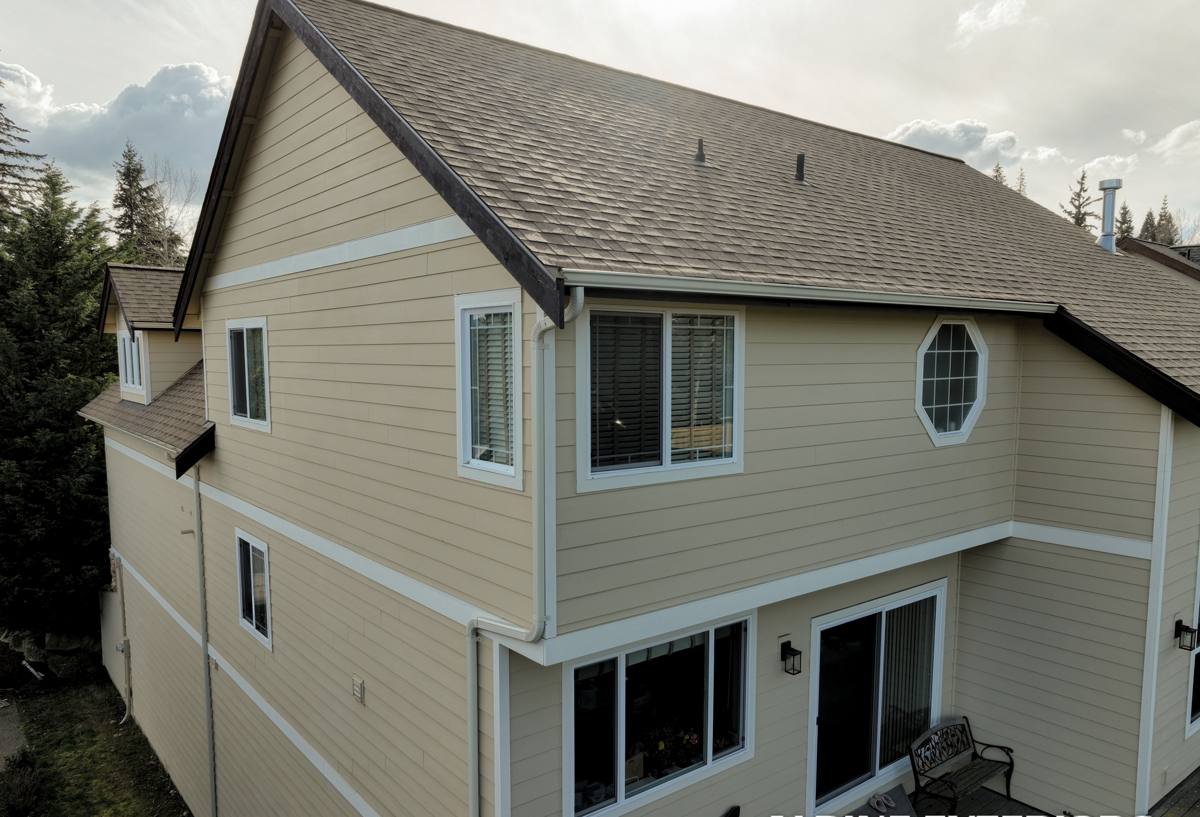
What Primed Spruce Gets Right
To be fair to the product, primed spruce has real strengths:
- Authentic wood grain and texture that fiber cement and vinyl can only approximate
- Lighter weight than fiber cement, which can simplify handling on some retrofit jobs
- Can be field-cut and shaped easily with standard woodworking tools
- Familiar to painters and trim carpenters who've worked with it for decades
- Lower material cost per board than premium fiber cement in some markets
None of that is marketing spin — it's why the product still sells. The issues show up later, and they show up faster here than they would in a dry inland climate.
The Birch Bay Climate Problem
Whatcom County's coastline, and Birch Bay in particular, is a tough environment for anything made of wood. Three things stack on top of each other here in a way that doesn't happen in most of the country:
Salt Air
Homes within a mile or two of Birch Bay's shoreline get a steady drift of salt-laden air. Salt is hygroscopic — it pulls moisture out of the atmosphere and holds it against whatever surface it lands on. On painted wood, that means the paint film stays damp longer after every weather event, which accelerates peeling, chalking, and the breakdown of the wood fibers underneath.
Driving Rain
Storms coming off the Strait of Georgia and the Salish Sea don't just fall straight down — wind-driven rain hits siding at an angle, working its way behind laps, into end-grain cuts, and around fasteners. Wood siding depends on an intact paint film to keep that water out. Any breach, even a hairline crack, gives water a path into the board.
Long Moss Season
Cool, damp, shaded conditions for much of the year mean moss and algae get a long runway to establish themselves on north-facing walls, under eaves, and anywhere airflow is limited. Moss holds moisture against the siding surface for weeks at a time, which is exactly the condition wood decay fungi need to take hold.
How Wood Siding Actually Fails
Primed spruce doesn't fail all at once — it fails in a predictable sequence, and understanding that sequence is the real argument for or against it:
- Paint film breakdown. UV exposure, salt, and moisture cycling cause the paint to chalk and crack, usually starting at butt joints, nail heads, and board edges — the spots primer coverage is thinnest to begin with.
- Water intrusion at end grain. Spruce is far more absorbent at a cut end than along its face grain. Every field cut made during installation is a raw, unsealed entry point unless it's back-primed and caulked correctly — and that step gets skipped more often than homeowners realize.
- Swelling and cupping. Once water gets into the board, it swells unevenly, which telegraphs through the paint as cupping or cracking, opening new points of entry.
- Fungal decay. Sustained moisture plus moderate temperatures — Birch Bay's normal winter and spring conditions — is the recipe fungi need. Soft, punky wood at the bottom edges of boards is the classic sign.
This isn't a defect in the product. It's the nature of an organic, absorbent material in a marine climate. It's manageable with diligent maintenance — but "manageable with diligent maintenance" is exactly the trade-off we stopped being willing to sell homeowners.
The Maintenance Reality, Compared
Here's how the ongoing maintenance burden actually compares once a wood-based siding is a few years into a Whatcom County exterior:
| Factor | Primed Spruce (site or shop painted) | James Hardie Fiber Cement (ColorPlus) |
|---|---|---|
| Repaint interval near saltwater | Typically 5-8 years, sooner on sun/salt-exposed elevations | ColorPlus finish is baked on and warrantied; no repaint needed for the life of the finish warranty |
| Caulk joint inspection | Annual, especially at butt joints and trim | Still recommended, but the substrate underneath isn't absorbing water the way wood does |
| Moss/algae cleaning | Needed to protect the paint film and prevent decay underneath | Needed for appearance only; doesn't threaten the substrate |
| End-grain vulnerability | High — every field cut is a risk point | Low — fiber cement doesn't swell or wick water the way wood does |
| Combustibility | Combustible, standard wood fire rating | Non-combustible core material |
None of this means wood siding is "bad." It means the ongoing cost of ownership is higher, and the consequences of deferred maintenance are more serious, in exactly the kind of climate Birch Bay sits in.
Installation Sensitivity Is the Hidden Cost
Primed spruce is more forgiving to cut and shape than fiber cement, but it's far less forgiving of installation shortcuts. To hold up in a coastal environment, it needs:
- Back-priming on every board before it goes up, not just the visible face
- Sealed or primed end cuts at every single field cut, on every course
- Correct fastener placement to avoid splitting and to keep nail heads from becoming water entry points
- Proper lap and flashing details so water sheds rather than wicks upward behind the board
- A finish-quality paint or solid-color stain system applied at the right mil thickness, not just "a couple coats"
Every one of those steps takes time and costs labor. Skipping any of them doesn't show up as a problem in year one — it shows up in year four or five, as peeling, staining, or soft spots, right around the time a homeowner has stopped thinking about their siding installer. We'd rather not install a product where the difference between a 10-year result and a 20-year result comes down to how careful the crew was on a Tuesday afternoon.
The Warranty Gap
Primed spruce siding typically carries a limited warranty on the board itself — often covering manufacturing defects, not weathering, moisture damage, or paint failure. The paint or stain system usually carries its own separate warranty from whoever applied it, with its own exclusions for coastal or high-moisture exposure. That splits responsibility across the mill, the painter, and the installer, which makes a real warranty claim complicated in practice.
James Hardie backs its ColorPlus finish and substrate with a long, transferable warranty structure that stays with one manufacturer. That matters more than it sounds like it should — when something does go wrong, there's one company standing behind the product, not three parties pointing at each other.
Why We Standardized on James Hardie Instead
We made a decision as a company to only install James Hardie fiber cement siding, and this is the reasoning behind it, in plain terms:
- Non-combustible core — a real safety consideration, not a marketing point
- Factory-applied ColorPlus finish — cured under controlled conditions, not dependent on field weather or a painter's technique on installation day
- HZ5 product engineering — Hardie's HZ5 line is built for exactly the freeze-thaw, moisture-cycling conditions the Pacific Northwest coast delivers
- Doesn't absorb water like wood — dramatically reduces the swelling, cupping, and rot pathway that defines wood siding failure
- Strong transferable warranty — one manufacturer, one set of terms, follows the house if it's sold
We're not claiming fiber cement is maintenance-free forever, or that every wood-sided home in Birch Bay is falling apart. Plenty of well-maintained wood exteriors are still standing after decades of attentive repainting. What we're saying is that we'd rather install the product that performs well under normal homeowner maintenance habits than the one that requires near-perfect upkeep to hit the same lifespan, in a climate that actively works against it.
Questions to Ask Before Choosing Wood Siding
If you're still weighing primed spruce against fiber cement for a Birch Bay or greater Whatcom County home, these are the questions worth getting straight answers to before signing a contract:
- Will every board be back-primed before installation, not just the visible face?
- What happens to end cuts made on-site — are they sealed before or after they go up?
- What's the realistic repaint interval for this specific house, given its exposure to wind and salt air?
- Who warranties the paint or stain finish, and does that warranty exclude coastal or high-moisture damage?
- What's the plan for moss and algae control on shaded, north-facing walls?
- How does the siding warranty work if the house changes hands in ten years?
If a contractor can't answer these clearly and specifically, that's worth noting — regardless of which siding product you end up choosing.
Our Honest Recommendation
If you love the look of real wood grain and you're committed to a repaint cycle every several years, primed spruce isn't a scam or a mistake — it's a maintenance commitment. But if you want an exterior that holds its finish, resists the moisture cycle that defines this coastline, and comes with a warranty that doesn't get complicated by finger-pointing between three different companies, that's the case for fiber cement, and it's the reason it's the only product we put on homes.
If you're planning a re-side in Birch Bay or anywhere else in Whatcom County and want a straight answer about what will actually hold up on your specific house, we're happy to take a look and give you a free, no-pressure estimate.