 Birch Bay Exterior
 Why Two Siding Quotes Can Look Nothing Alike
If you've collected a couple of estimates for siding work in Birch Bay and they came back thousands of dollars apart, you're not imagining things, and neither contractor is necessarily wrong. Siding replacement isn't a single product with a single price — it's a combination of material, labor, prep work, and site conditions, and any one of those can swing a bid by a large margin. Homeowners often start the process looking for "the price of siding" when the more useful question is "what is actually driving my price."
This page walks through the real cost factors in plain terms, so you can look at a quote and understand what you're paying for instead of just comparing bottom-line numbers.
The Core Cost Drivers
Every siding job is priced from the same handful of variables. The material you choose sets a baseline, but the other factors below often matter more to your final number than the siding brand itself.
| Cost Factor | What It Affects |
|---|---|
| Siding material | Baseline cost per square foot, trim and accessory pricing, expected lifespan |
| Home size and shape | Total square footage, number of corners, gables, and cutouts |
| Tear-off vs. overlay | Labor hours, disposal costs, whether hidden damage gets found early |
| Sheathing and framing condition | Whether repairs are needed before new siding can go on at all |
| Trim, fascia, and window detail work | Labor-intensive areas that take far longer per square foot than flat wall runs |
| Story height and access | Scaffolding or lift rental, crew safety setup time |
| Paint or factory finish | Whether color is baked in at the factory or applied on-site |
| Local permitting and disposal | Whatcom County permit fees and landfill/tipping costs for old material |
Material Costs: A Line-Item View
Siding materials are usually priced per square foot installed, and that number includes the board itself, fasteners, house wrap or weather barrier, trim, and labor. Broad ranges below are typical for the Pacific Northwest market and will move based on your home's complexity.
Vinyl Siding
Vinyl is usually the lowest up-front cost per square foot. It's lightweight, fast to install, and widely available. The trade-off is that it's a thin, flexible plastic product — it can warp in direct heat, crack in cold snaps, and it doesn't hold up to impact the way a rigid material does. In a coastal, wind-driven-rain climate like Birch Bay's, vinyl's seams and J-channels are also where water intrusion tends to start if installation isn't precise.
Engineered Wood (LP SmartSide and similar)
Engineered wood products sit in a mid-range price bracket and give a more traditional wood-plank look than vinyl. They're wood-based, which means moisture management at every seam, cut edge, and fastener point is critical — any breach in the factory coating exposes the substrate to swelling and rot. In a region with a long wet season and a real moss season, that ongoing moisture exposure is a maintenance factor worth weighing against the lower material cost.
Cedar
Real cedar costs more than either of the above and has a genuine appeal — it's a natural material with a classic look. But it's also organic material sitting on the outside of your house in a marine climate: it needs regular refinishing, is a food source for moss and mildew in shaded, damp areas, and its lifespan depends heavily on how well it's maintained year after year.
Fiber Cement (James Hardie)
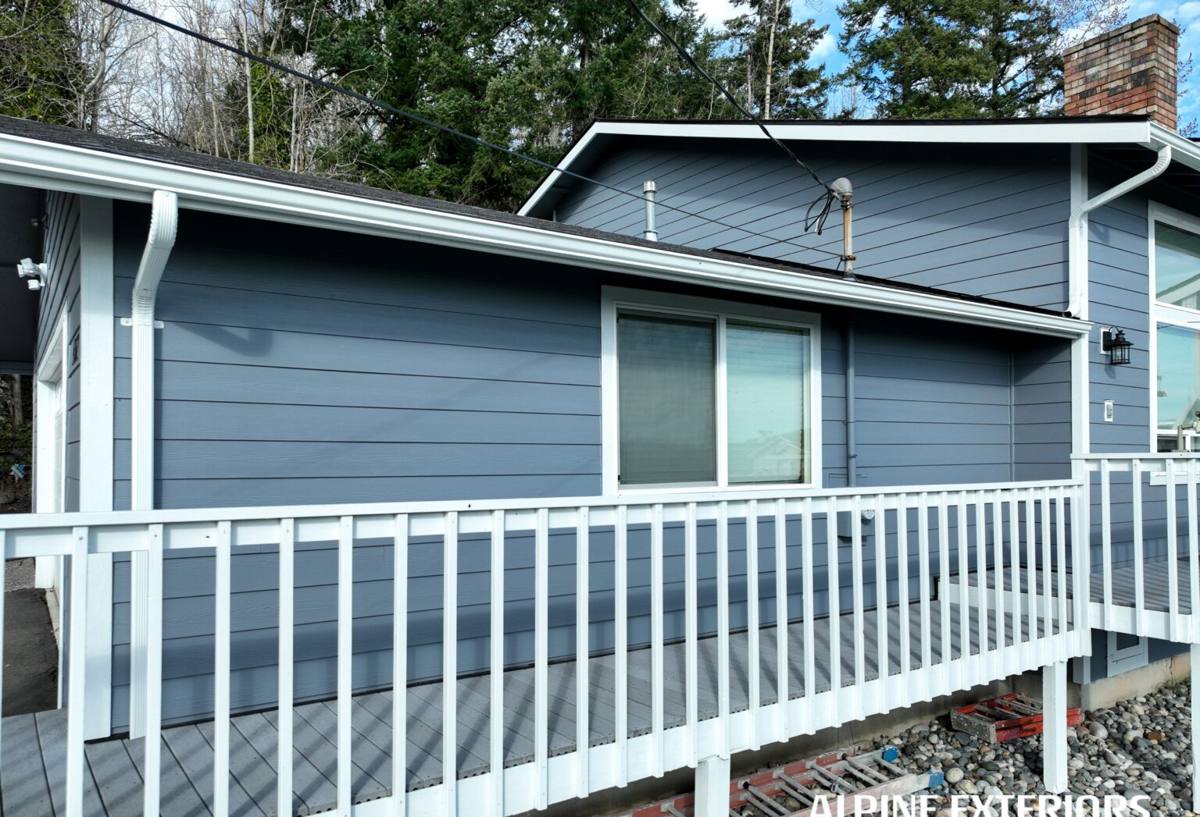
Fiber cement sits at a higher material cost than vinyl and is generally comparable to or above engineered wood and mid-grade cedar. It's a cement, sand, and cellulose composite — non-combustible, dimensionally stable, and resistant to the swelling and rot that plague wood-based products. This is the only siding material we install, and the reason comes down to what happens ten and twenty years out, not what the invoice says on day one. James Hardie's ColorPlus finish is baked on at the factory under conditions no job-site paint job can match, and it carries a strong transferable warranty that reflects the manufacturer's confidence in the product's long-term performance.
We're not going to pretend fiber cement is the cheapest option — it isn't. But "cheapest to install" and "cheapest over the life of the siding" are two different numbers, and in a climate like ours, the gap between them tends to widen.
Labor: The Part Homeowners Underestimate
Material is often less than half of a siding job's total cost. Labor covers removal of the old siding, repair of anything found underneath, installation of a proper weather-resistive barrier, precise flashing at every window and door, and the actual fastening and finishing of the new siding — plus all the trim, corners, and transitions that don't show up in a per-square-foot number.
Fiber cement in particular is a material where installation quality has an outsized effect on performance. It requires correct fastener patterns, proper clearances, and manufacturer-specified flashing details. Skipping those steps to save labor hours is exactly how a good material ends up with a bad outcome, which is why we treat installation spec as non-negotiable rather than a place to cut corners.
Complexity Multipliers
- Multiple roof lines, dormers, and gables mean more cuts, more trim, and more time per square foot than a simple rectangular wall.
- Two-story and three-story sections require scaffolding or lift rental, which adds cost before a single board is installed.
- Homes with a lot of window and door trim take longer per square foot than homes with large, uninterrupted wall sections.
- Tight lot lines or limited driveway access can slow material staging and require extra handling.
What's Underneath Matters More Than People Expect
You can't accurately price a siding job until the old siding comes off and the sheathing underneath is visible. This is the single biggest source of "why did my final price change" conversations in the industry. If a home has had water intrusion behind the old siding — common around old flashing, poorly caulked trim, or failed seams — the sheathing or framing underneath may need repair before new siding can be installed correctly.
A contractor who gives you a firm, all-in number before ever removing the old siding is either padding the bid heavily to cover the unknown, or planning to hit you with change orders once the walls are open. Neither is great. The more honest approach is a clear base estimate plus a disclosed per-unit rate for any sheathing or framing repair, so you know what you're paying for if hidden damage turns up.
Regional Factors: Why Birch Bay Adds Its Own Line Items
Whatcom County's coastal position brings salt air, driving rain off the Strait of Georgia, and a long moss season that keeps north-facing and shaded walls damp for months at a time. That combination affects a siding project in a few concrete ways:
- Salt air accelerates corrosion on exposed fasteners and metal flashing, which is why corrosion-resistant fastener specs and properly detailed flashing matter more here than in a dry inland climate.
- Driving rain pushes water sideways into seams and trim joints that a calmer climate might never stress-test, making weather-resistive barrier installation and seam sealing a real performance factor, not a formality.
- Moss and mildew growth thrive on organic, moisture-retentive siding materials in the shaded, damp conditions common on wooded Birch Bay lots — this is a maintenance factor worth weighing against any material's up-front price.
- Homes closer to the water often see faster wear on siding and trim than homes a few miles inland, which is worth mentioning to your contractor when you're comparing quotes.
None of this means every home needs the most expensive material available. It does mean that a price-only comparison, without factoring in how a material performs in this specific climate, can be misleading.
Where Homeowners Get Surprised
Most complaints about siding pricing don't come from the estimate itself — they come from what wasn't in it. Before you sign anything, walk through this list with your contractor:
- Is tear-off and disposal of the old siding included, or billed separately?
- What's the disclosed rate for sheathing or framing repair if damage is found once the old siding is off?
- Does the quote include new house wrap or weather-resistive barrier, or reuse of the existing one?
- Are windows and doors being re-flashed as part of the job, or just sided around?
- Is the color a factory finish, or will it be field-painted after installation?
- What's covered under warranty, and is it transferable if you sell the home?
- Does the bid include permit fees, or are those billed as a pass-through cost?
Getting a Number You Can Actually Trust
The most reliable siding quotes come from a contractor who walks your specific home, looks at your specific trim detail, roofline, and wall exposure, and prices the job you actually have — not a generic per-square-foot rule of thumb. Ask for a written breakdown that separates material, labor, tear-off, and any contingency for hidden repair, so you can compare quotes apples-to-apples instead of just comparing one total number against another.
If you're planning a siding project in Birch Bay or elsewhere in Whatcom County, we're happy to walk the exterior with you, point out anything we see that could affect the price, and put together a clear, itemized estimate — no pressure, no obligation.