 Birch Bay Exterior
 Why Roofs Wear Out Faster in Birch Bay
A roof in Birch Bay does a different job than a roof forty miles inland. Sitting right on the Strait of Georgia, homes here take on salt-laden air that accelerates corrosion on metal fasteners, flashing, and gutter hardware. Add Whatcom County's long, wet winters — months of driving rain pushed sideways by wind off the water — and you have a roofing system that's under near-constant moisture load for half the year. Then there's moss. Our mild, damp shoulder seasons are close to ideal growing conditions for it, and moss doesn't just look bad — it holds water against shingles and creeps under tabs and flashing, which is exactly where roof leaks start.
None of this means Birch Bay roofs fail early by default. It means the margin for shortcuts is smaller here than in a drier climate. A roof installed correctly, with the right materials and details, holds up fine. One installed to a generic spec written for a different region tends to show its weaknesses within a few years, not a few decades.
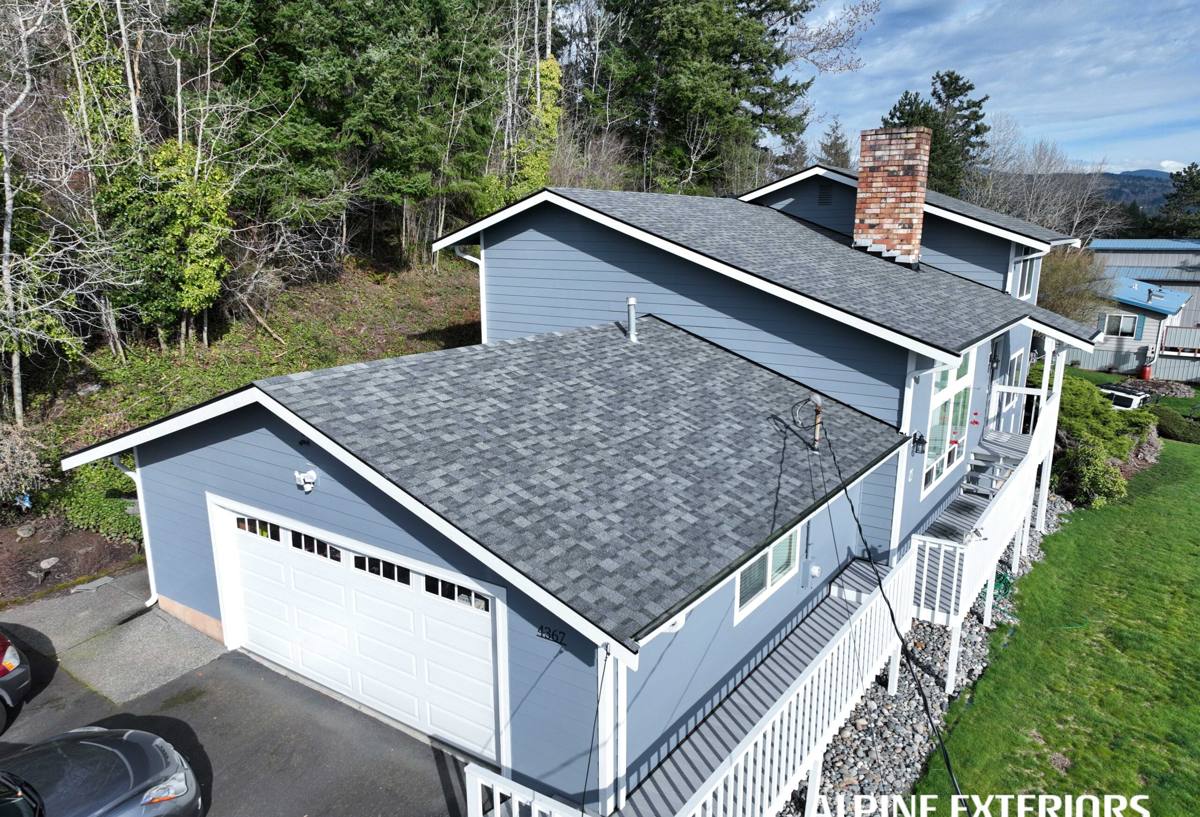
Repair or Replace? Reading the Signs
Most homeowners don't wake up one day and decide to replace a roof — they notice a problem and have to figure out whether it's a patch job or the start of something bigger. A few guidelines:
- Granule loss in the gutters: Some granule shedding is normal in year one. Heavy, ongoing loss later on means the shingles are past their protective life.
- Curling or cupping shingle edges: Usually a sign of age, heat cycling, or ventilation problems — often not fixable with a spot repair.
- Moss buildup on north-facing slopes: Common here, and not itself an emergency, but left unmanaged it traps moisture against the roof deck over time.
- Dark streaking or staining: Usually algae, cosmetic more than structural, but worth noting alongside other symptoms.
- Soft spots or sagging when walked on: This points to deck damage underneath and almost always means replacement, not repair.
- Leaks that show up in a new spot each storm: A sign that water is finding its way under the whole system, not just one bad seal.
A single missing shingle or one damaged flashing detail is usually a repair. Widespread wear across the whole roof, or a roof already past 18-20 years for asphalt, is usually a replacement conversation.
Age Is a Guideline, Not a Rule
Manufacturer-rated shingle life assumes average conditions. In a marine climate with heavy moss pressure, a roof that's rated for 25 years may show real wear at 15-18 if ventilation was marginal or moss wasn't managed. Conversely, a well-ventilated, well-flashed roof that's kept reasonably clean can outlast its rating. Age tells you when to start paying attention, not when to automatically replace.
Roofing Material Options for This Climate
There's no single "best" roofing material — there's a best fit for your home, budget, and how much long-term maintenance you want to take on. Here's how the common options stack up for a coastal Whatcom County home:
| Material | Typical Lifespan | How It Handles This Climate |
|---|---|---|
| Asphalt composition shingle | 20-30 years (architectural) | Good value, wide color range; moss and algae resistance varies by product line — look for algae-resistant granules |
| Standing seam metal | 40-60 years | Sheds moss and water well due to slope and smooth surface; needs marine-grade fasteners and coatings near salt air |
| Cedar shake | 20-30 years with upkeep | Traditional look, but wood and constant damp moss conditions are a demanding combination; needs regular treatment |
| Synthetic/composite shingle | 30-50 years | Resists moisture and moss better than wood; higher upfront cost, low maintenance |
For most Birch Bay homes, a quality architectural asphalt shingle with algae-resistant granules is the practical middle ground — reasonable cost, solid performance, and a good match for how long most people plan to stay in a home. Metal and composite make more sense when a homeowner is planning to stay long-term and wants to minimize maintenance calls over the decades.
It's a System, Not Just Shingles
The material on top gets all the attention, but it's the layers underneath that actually determine whether a roof performs in driving rain. A roof replacement done right addresses:
Underlayment
Synthetic underlayment is the moisture barrier between the shingles and the deck. In a region with sideways rain, self-adhered ice-and-water shield at eaves, valleys, and roof penetrations matters more than it would in a drier climate — those are the spots wind-driven rain tends to find its way in.
Flashing
Flashing around chimneys, skylights, vent pipes, and where the roof meets a wall is where the majority of leaks originate — not in the open field of shingles. Salt air accelerates corrosion on cheaper galvanized flashing; better-grade flashing metals last longer here.
Ventilation
Balanced intake and exhaust ventilation keeps the attic dry and temperature-stable. Poor ventilation traps moisture, which shortens shingle life from underneath and can contribute to premature deck rot — a problem that often isn't visible until the next tear-off.
The Moss Problem, Specifically
Moss deserves its own section because it's the complaint we hear most often from homeowners in this area. A few practical points:
- Moss thrives on shaded, north-facing slopes and anywhere debris collects — valleys, behind chimneys, along the eaves.
- Zinc or copper strips installed near the ridge release trace metal ions with rainfall that inhibit moss growth on the slopes below — a reasonable preventive measure on a new roof.
- Moss should be removed by gentle rinsing or brushing, never pressure-washed directly against the shingles, which can strip granules and shorten shingle life faster than the moss itself would.
- Trimming overhanging branches to let more light and airflow reach the roof reduces regrowth significantly.
Moss on its own rarely causes a roof to fail. Moss combined with clogged gutters, and both left unaddressed through a wet Birch Bay winter, is a much more common path to interior water damage.
What a Proper Roof Replacement Involves
A roof replacement is more than swapping old shingles for new ones. A thorough job includes:
- Full tear-off to the deck — not a layover on top of old shingles
- Deck inspection and replacement of any damaged or soft sheathing
- New self-adhered ice-and-water shield at eaves, valleys, and penetrations
- New synthetic underlayment across the full roof
- Corrosion-resistant flashing at all walls, chimneys, and penetrations
- Balanced ridge and soffit ventilation, corrected if the old system was inadequate
- New shingles or roofing material installed to manufacturer spec, including proper nailing pattern
- Gutter and downspout check to confirm water is actually being carried away from the foundation
Skipping any of these steps is usually invisible on installation day and becomes obvious three, five, or ten years later — often as a leak that seems to come from nowhere.
What Roof Replacement Costs Depend On
Exact pricing depends on your specific roof, but the main cost drivers are consistent across most projects:
| Factor | Why It Matters |
|---|---|
| Roof size and number of stories | More square footage and steeper access both add labor time |
| Roof pitch and complexity | Steep slopes, multiple valleys, and dormers slow installation and increase material waste |
| Deck condition | Rotted or soft sheathing discovered during tear-off adds material and labor not visible from the ground |
| Material choice | Asphalt, metal, and composite carry different material costs per square |
| Tear-off layers | Removing multiple existing layers costs more than a single-layer tear-off |
| Access and disposal | Difficult site access or extra disposal fees can add to the total |
Be cautious of quotes that are dramatically lower than others for the same scope — the difference is usually in what's being skipped underneath the shingles, not in the crew being more efficient.
Vetting a Roofing Contractor
Washington requires roofing contractors to carry a state contractor license and bond, and reputable ones carry liability insurance well above the state minimum. Before signing anything:
- Confirm the contractor's Washington state license is active and verify it directly with L&I, not just by taking their word for it
- Ask what underlayment, ice-and-water shield, and flashing materials are included — get it in writing, not just "we'll match what's there"
- Ask how deck repair is priced if rot is found during tear-off, before the crew is on your roof
- Get the manufacturer warranty terms in writing, and understand what workmanship warranty the contractor themselves stands behind separately from the material warranty
- Ask for a start-to-finish timeline and how weather delays are handled — relevant for anyone scheduling around a Whatcom County winter
Manufacturer Warranty vs. Workmanship Warranty
These are two different things and homeowners often assume one covers the other. The manufacturer's warranty covers material defects in the shingles themselves. It typically does not cover a leak caused by poor flashing work or incorrect installation. The contractor's own workmanship warranty is what covers installation errors — ask specifically how long it runs and what it includes before you commit.
When a Roof Project Turns Into an Exterior Project
Roof replacement is often the moment homeowners take a harder look at the rest of the exterior, since scaffolding, ladders, and crews are already on site. If your siding is also aging out — showing rot, repeated repainting needs, or moisture damage at trim and butt joints — it's worth having both assessed together rather than as two separate future projects. We install James Hardie fiber cement siding exclusively, for the same reason we take roofing details seriously: in a marine climate with this much sustained moisture exposure, the material and the installation both need to be built for the conditions, not just for the sales brochure. If a full exterior refresh is on your radar, it's a conversation worth having at the same time as your roof estimate.
If you're weighing repair against replacement, or just want a straight answer on what your roof actually needs, we're happy to take a look and walk you through it. There's no cost and no pressure to a roof estimate — just a clear picture of where things stand.