 Birch Bay Exterior
 A Deliberate Decision, Not a Sales Pitch
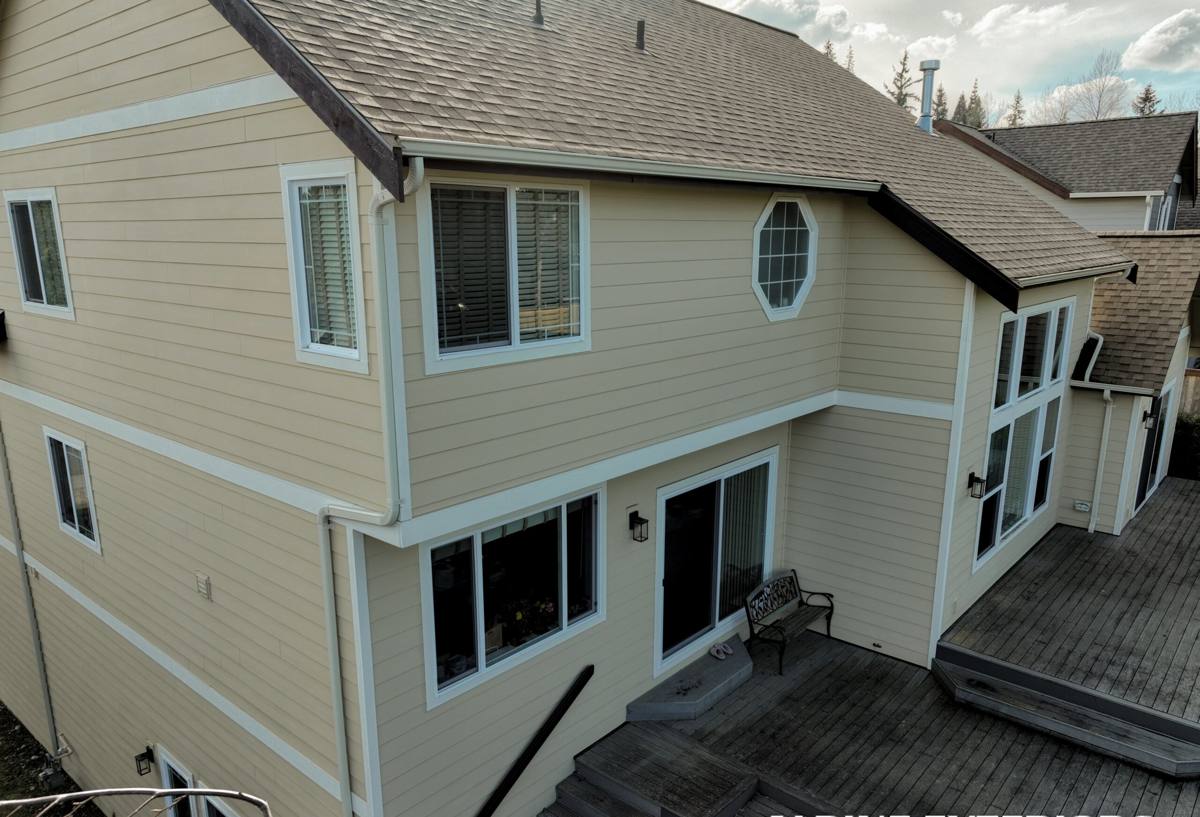
Every siding contractor in Whatcom County can install more than one product. We can too — but we don't. Birch Bay Exterior Co installs James Hardie fiber cement siding exclusively. No vinyl, no LP SmartSide, no Cemplank or Allura fiber cement, no primed spruce, no cedar. That's not a marketing gimmick. It's a standard we set after years of tear-off work on this stretch of coastline, where we've pulled failed siding off homes and seen firsthand which products hold up to salt air and driving rain and which ones don't.
This page explains the reasoning plainly. We're not going to tell you every other product is junk — most of them perform reasonably well in the right climate, installed correctly, maintained on schedule. Our point is narrower: for homes in Birch Bay, facing this specific combination of salt spray, wind-driven rain, and a moss season that can run eight months out of the year, one product category has consistently held up better than the rest, and we'd rather stand behind one system we know cold than offer five we install occasionally.
What Birch Bay's Climate Actually Does to Siding
Birch Bay sits right on the water, which means siding here deals with three things most inland Whatcom County homes don't face at the same intensity:
Salt Air
Airborne salt from Birch Bay and the Strait of Georgia settles on exterior surfaces year-round. It accelerates corrosion on fasteners and trim, and it can degrade certain coatings and finishes faster than manufacturer test data (usually generated in drier, inland conditions) would suggest.
Driving Rain
Wind off the water doesn't just drop rain straight down — it drives it sideways into wall assemblies, seams, and butt joints. Any siding product with a manufacturer-rated moisture tolerance that's marginal to begin with gets pushed harder here than in a sheltered inland neighborhood.
Moss and Sustained Dampness
Western Whatcom County's moss season is long. Moss and algae hold moisture against a wall surface for extended periods, which matters enormously depending on what the siding is made of and how it responds to prolonged wetting.
None of this means every other product fails here. It means the margin for error is thinner, and the products that depend on perfect caulking, perfect paint maintenance, or a forgiving climate to perform as advertised are the ones we've stopped installing.
Why We Don't Install Vinyl
Vinyl siding is affordable, low-maintenance in the sense that it doesn't need painting, and it's a reasonable product for a lot of climates. Its limitations in a place like Birch Bay come down to physical behavior, not defects:
- Vinyl expands and contracts significantly with temperature swings, and over time that movement can loosen fastening and open gaps at seams — exactly where wind-driven rain wants to get in.
- It has no meaningful fire resistance rating; it softens and deforms at relatively low heat.
- Color is baked into the material, so fading over years of UV and salt exposure can't be corrected with a repaint — the whole piece has to be replaced, and matching faded panels years later is often impossible.
- Impact damage (branches, hail, a ladder bump) cracks it, and again, matching replacement panels to sun-faded originals is a real problem.
These are honest trade-offs, not failures. But when we're standing behind our installation for the long haul, we'd rather not build on a product whose weak points line up so directly with Birch Bay's weather.
Why We Don't Install LP SmartSide
LP SmartSide is an engineered wood strand product — wood fiber bonded with resin, coated for moisture resistance. It has genuine advantages: it's lighter than fiber cement, easier on installers, and holds paint well when properly maintained.
The trade-off is that it's still wood at its core. Its entire performance record depends on the factory treatment and coating staying fully intact at every cut edge and fastener penetration, forever. In a marine, high-moisture environment, any breach in that coating — an unsealed field cut, a nail that wasn't sealed, a joint that opens up — gives moisture a path into a wood-based substrate. Wood strand products can swell, and swelling at edges and joints is a known failure pattern industry-wide when moisture gets past the coating. In a drier inland climate, that risk is manageable with routine maintenance. On the water in Birch Bay, with sustained dampness and moss cover for much of the year, we don't think it's the right bet for a 30-plus year siding decision.
Why We Don't Install Cedar or Primed Spruce
Real wood siding is beautiful, and there's a reason it's been used on Pacific Northwest homes for a century. But solid wood siding requires a maintenance commitment most homeowners underestimate when they choose it: repainting or restaining on a strict cycle, caulk inspection every year, and prompt attention to any spot where the finish has worn through. Skip a cycle in a moss-prone, high-moisture area like Birch Bay and rot can set in faster than most homeowners expect. We've done tear-offs on wood siding that looked fine from the street and was soft and compromised underneath. We'd rather not put a product on a home that punishes a missed maintenance year this severely.
Why We Don't Install Other Fiber Cement Brands
This one is less about material science — Cemplank and Allura are both real fiber cement products, made from the same basic cement-and-cellulose formula as James Hardie. The differences we care about are practical:
| Factor | James Hardie | Other fiber cement brands |
|---|---|---|
| Factory finish system | ColorPlus baked-on finish with a specific matched caulk and touch-up system | Varies by brand; factory finish options and touch-up systems are less standardized |
| Climate-specific engineering | HZ5 product line engineered for wet, freeze-prone, high-moisture regions | Fewer brands publish region-specific engineering the way Hardie does |
| Installer training network | Established Preferred Contractor program with installation standards and accountability | Contractor certification programs are less widespread |
| Warranty transferability | Long, clearly documented transferable warranty | Warranty terms and transfer processes vary and are often less documented |
We're not saying the alternative brands are poor products. We're saying that when we standardized on one system, we chose the one with the most complete climate engineering, the clearest warranty documentation, and the deepest installer training infrastructure — because that's what lets us guarantee our own work with confidence.
What James Hardie Gets Right for This Specific Climate
It's Non-Combustible
Fiber cement doesn't burn. In a region where wildfire smoke and ember exposure have become a more regular late-summer concern across Washington, that's a real, quantifiable advantage over vinyl or wood-based products.
It Doesn't Feed Moisture the Way Wood Products Can
Cement and cellulose fiber don't swell and rot the way solid or engineered wood can when moisture gets past a coating. That matters directly in a moss-season climate where a wall surface can stay damp for extended stretches.
HZ5 Is Engineered for Exactly This
Hardie's HZ5 product line is formulated for regions with sustained moisture, freeze-thaw cycling, and high humidity — which describes Birch Bay's winter and shoulder-season conditions well. It's not a generic product pushed into every market; it's the version of the product line built for this kind of weather.
ColorPlus Finish Reduces the Maintenance Burden
The factory-applied ColorPlus finish is baked on and backed by its own finish warranty, and it holds up to UV and salt air significantly longer than field-applied paint. That doesn't mean zero maintenance — no exterior product is maintenance-free — but it moves the repaint clock out considerably compared to site-painted wood siding.
The Warranty Is Actually Transferable
If you sell your home, a documented transferable warranty is worth something concrete to a buyer and their inspector. That's a real closing-table asset, not a soft benefit.
What "Only Installing One Product" Means for You
Standardizing on one product means our crews aren't relearning a different installation method for every job. Fastener patterns, clearances, flashing details, and caulk joints for Hardie's HZ5 line are what our crew does, repeatedly, on every job in this climate — not one of five systems juggled across a season. That consistency is where a lot of siding failures actually originate: not bad material, but installation shortcuts on a product the crew doesn't install often enough to get right every time.
Correct installation of fiber cement siding involves specific, non-negotiable details:
- Proper clearance from grade, roof lines, and decks to keep the bottom edge out of standing water and splash-back
- Correct fastener type, spacing, and depth — Hardie is unforgiving of overdriven nails
- Manufacturer-specified caulk and sealant at all joints and penetrations, not a general-purpose substitute
- Proper flashing integration at windows, doors, and any wall penetration
- Field-cut edge sealing wherever a factory-finished edge is cut on site
Get any one of those wrong and you can undercut the performance of even the best product on the market. That's the real argument for standardizing: it's not just about which siding, it's about a crew that installs it correctly every single time because it's the only thing they do.
Being Honest About Cost
James Hardie fiber cement costs more up front than vinyl, and it's typically in a similar range to or somewhat above other fiber cement brands and engineered wood products. It's a legitimate consideration, especially on a larger home. What we'd ask you to weigh against the upfront number is the maintenance cost over the life of the siding — repainting cycles, caulk touch-ups, and the risk of moisture-related repairs — plus the value of a warranty that actually transfers if you sell. For a home exposed to Birch Bay's salt air and rain, we think that math tends to favor Hardie over a full ownership cycle, but it's a real trade-off worth thinking through, not a foregone conclusion.
Get an Honest Estimate
If you're weighing a siding replacement in Birch Bay or elsewhere in Whatcom County, we're happy to walk your home, look at what's on it now, and give you a straight answer about condition and options — even if that conversation includes us explaining, in person, why we'd only bid the job in Hardie. Reach out for a free, no-pressure estimate using the form below.