 Birch Bay Exterior
 New-Construction Windows for Point Roberts Homes
Point Roberts sits on its own peninsula at the southern tip of the Tsawwassen lands, cut off from the rest of Whatcom County by the international border. If you're framing a new home or an addition out there, the windows you choose and how they're installed matter more than they would almost anywhere else in the county. New-construction window installation means the window unit goes in before or during siding and finish work, with the flashing and water management built into the wall assembly from the studs out — not retrofitted around an existing opening. Done right, it's the best chance you'll ever have to get moisture control correct for the life of the house. Done wrong, you're opening up finished walls in five years to fix rot nobody could see coming.
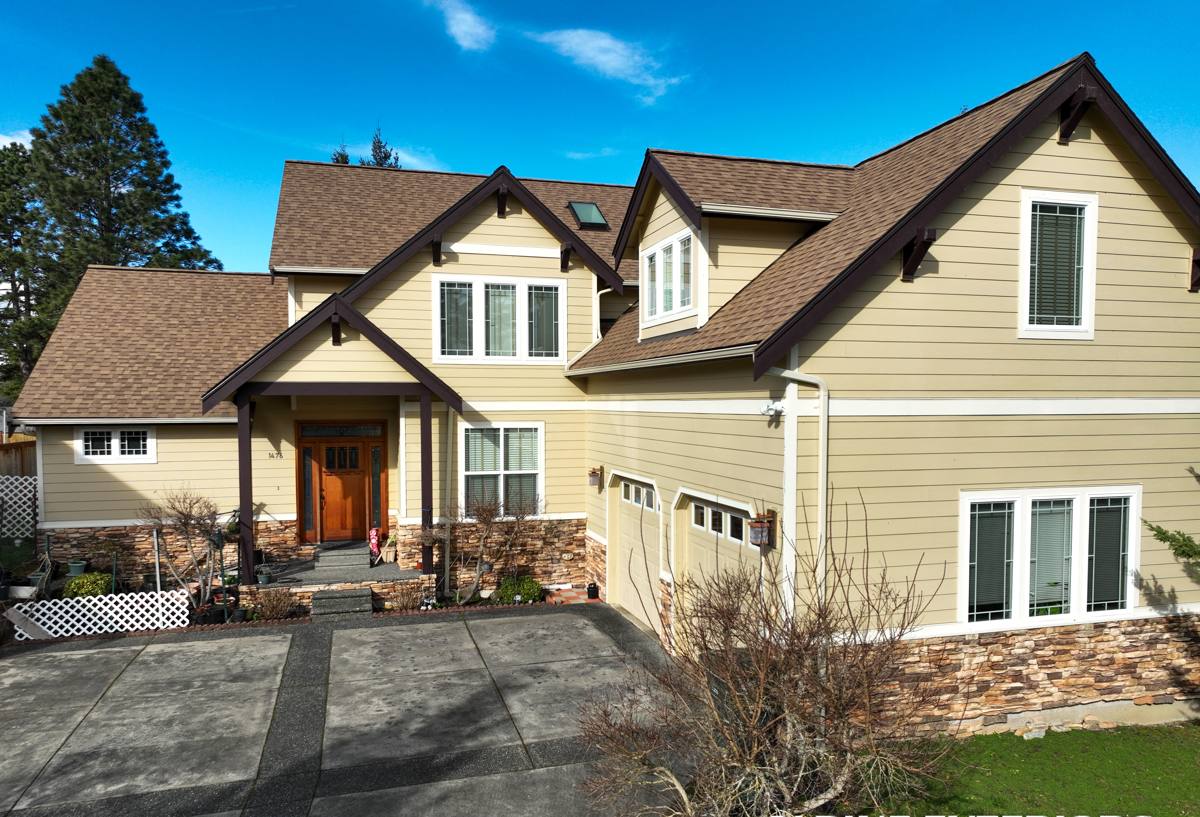
Why the Point Roberts Climate Is Tougher on Windows
Point Roberts and Birch Bay share the same general Whatcom County marine climate, but the exposure out on that peninsula is its own animal. Wind comes off open water from more directions with less tree break, which means driving rain gets pushed sideways into wall assemblies and window openings that a more sheltered lot wouldn't see. Add in near-constant salt air off Boundary Bay and the Strait of Georgia, and you've got a corrosion problem most inland Whatcom homes never deal with — fasteners, flashing metal, and hardware finishes all age faster here.
Then there's moss season, which in this part of Western Washington runs long — realistically most of the fall through spring. Constant damp shade on north and west elevations keeps sills and trim wet for weeks at a stretch, and moss holds moisture against wood and caulk joints that would otherwise dry out between rains. A window installed with marginal flashing or a skipped sill pan might not show a problem the first year. By year three or four, you're looking at soft framing under the sill and stained drywall that traces back to a two-minute step someone skipped during install.
What This Means for Your Build
- Flashing details need to assume wind-driven rain, not just gravity-fed water
- Fasteners and flashing tape need to hold up to sustained salt exposure, not just look right on day one
- Sills need a real drainage path — moss and standing moisture will find any weak point
- Product selection should favor materials that don't depend on perfect paint or caulk maintenance to stay watertight
What a Correct New-Construction Install Actually Involves
"New-construction window" describes the unit — it has a nailing fin instead of the flange-less design used in pocket replacements — but the install quality comes down to sequence and materials, not just the window itself.
Sill Pan First
Before the window ever goes in the opening, the rough sill should get a sloped, sealed pan — either a manufactured flexible flashing pan or a properly lapped and sealed field-built one. This is the single most important step for a wet climate like this one. Any water that gets past the window itself, whether from wind-driven rain or a future caulk failure, needs somewhere to go besides straight into your framing.
Flashing Sequence
Flashing tape and building paper (or house wrap) need to be layered shingle-style — each layer lapping over the one below it — so water sheds outward at every seam. The jambs get taped after the window is set and before the head flashing goes on last, always overlapping the layer beneath. Skip the order and you've built a funnel instead of a barrier.
Fastening and Air Sealing
The nailing fin gets fastened per the manufacturer's schedule — enough fasteners, in the right pattern, without over-driving them and warping the frame. Inside, the gap between the window frame and rough opening gets sealed with a proper low-expansion foam or backer rod and sealant, not packed solid, which can bow the frame and cause the sash to bind.
Final Weatherproofing
Exterior trim and siding get integrated with the flashing so nothing relies on caulk alone as the primary water barrier. Caulk is a second line of defense in this climate, not the first.
Choosing Window Materials for a Salt-Air, High-Moisture Site
Every window material has trade-offs. For a Point Roberts new build, we weigh how each one handles sustained salt exposure and moisture, not just upfront cost.
| Material | Salt Air / Corrosion | Moisture Behavior | Maintenance |
|---|---|---|---|
| Vinyl | Doesn't corrode; hardware and screws are the weak point over time | Won't rot, but poor installs trap moisture behind the frame | Low — occasional cleaning, hardware checks |
| Fiberglass | Very stable in salt air; dimensionally stiff even with temperature swings | Excellent — doesn't absorb moisture or swell | Low |
| Wood-clad | Cladding protects the exterior face; any breach exposes wood to rot risk | Interior wood needs the cladding and flashing to be perfect, indefinitely | Higher — depends entirely on flashing integrity holding up |
| Aluminum | Prone to corrosion and pitting in sustained salt exposure unless heavily coated | Conducts cold and can condense moisture at the frame | Moderate to high in this environment |
We don't push one brand or line — the right call depends on your budget, the home's style, and how much long-term maintenance you want to sign up for. What we will say plainly: in a salt-air, high-moisture exposure like Point Roberts, we lean toward vinyl or fiberglass units with factory-finished hardware, because they take the least amount of ongoing upkeep to stay watertight. Wood-clad can absolutely work, but it raises the stakes on the installer getting the flashing perfect, since there's no forgiving that detail later without opening the wall.
Our Process for Point Roberts New-Construction Jobs
1. Site Assessment and Exposure Review
We look at which elevations take the most wind-driven rain, which sides sit in shade long enough to grow moss, and how the framing plan handles water at sills, headers, and rough openings before a single window is ordered.
2. Product Selection and Ordering
We help you pick units sized and specified for the openings, with glass packages (typically dual-pane, low-E, argon-filled) that make sense for the exposure and your energy goals. Lead times matter more here than on the mainland — logistics for Point Roberts deliveries need to be planned around border crossings, so we order early and confirm everything before it's needed on site.
3. Install
Sill pans, shingle-lapped flashing, correct fastening, and sealed rough openings — the sequence described above, done the same way on every unit, not just the ones someone's watching.
4. Inspection Before Siding Closes It Up
This is the point where a mistake is still cheap to fix. We walk every opening before siding goes on, because once the wall is closed up, a flashing error becomes a multi-thousand-dollar repair instead of a five-minute correction.
Why It Matters That We Already Work Point Roberts
Point Roberts is a U.S. exclave — the only way in by land is through Canada, crossing the border twice each way. That's not a minor detail for a construction project. It affects how materials get delivered, how a crew schedules a full work day versus a partial one, and how quickly anyone can get back out to the site if something needs a second look. A contractor unfamiliar with that reality can blow a schedule badly, or worse, treat the border crossing as a reason to rush the flashing details to get back across sooner.
Our crew works out of Birch Bay and already routes jobs through Point Roberts regularly. We know to plan material orders and crew days around the crossing, not discover the problem mid-project. That logistics experience is separate from — but just as important as — knowing how to flash a window correctly for this climate.
What New-Construction Windows Typically Cost
Costs vary by opening size, product line, glass package, and how many openings are on the job, but these are the factors that move the number most:
| Factor | Effect on Cost |
|---|---|
| Material (vinyl vs. fiberglass vs. wood-clad) | Fiberglass and wood-clad generally cost more than vinyl for the same size and glass package |
| Glass package (standard vs. upgraded low-E, argon) | Upgraded glass packages add cost per unit but improve comfort and reduce energy loss |
| Opening size and shape | Larger units and custom shapes (arched, oversized) cost more than standard rectangular sizes |
| Number of units on the job | Per-unit pricing typically drops with larger orders |
| Site logistics (Point Roberts delivery and crew scheduling) | Border-crossing logistics can affect scheduling more than they affect the base price |
We'll always give you a written, itemized estimate before work starts — no surprise line items after the fact.
Maintaining New-Construction Windows in This Climate
A correctly installed window still needs a little seasonal attention out here, especially with moss season running as long as it does.
- Rinse salt residue off frames and glass a few times a year, more often on wind-exposed elevations
- Keep gutters and downspouts clear so runoff isn't sheeting down over window heads
- Trim back vegetation that keeps sills and trim in constant shade and dampness
- Check exterior caulk lines each spring and fall for cracking or separation — remember caulk is the second line of defense, not the first, but it still needs to be intact
- Operate and lubricate hardware periodically so locks and rollers don't seize from salt exposure
- Watch for soft spots or discoloration at interior sills, which can signal a flashing issue worth catching early
If you're planning new construction or an addition in Point Roberts, we're happy to walk the site, talk through window options for your exposure, and put together a free, no-pressure estimate. There's a form below — reach out and we'll get back to you.