 Birch Bay Exterior
 Why Decks Wear Out Faster in the Nooksack Area
If you live in or around Nooksack and the greater Birch Bay area of Whatcom County, you already know the weather here is harder on outdoor structures than most homeowners expect. It isn't one dramatic event that takes a deck down — it's the slow, repeated cycle of salt-tinged marine air, long stretches of driving rain, and a moss season that can run from fall clear through spring. A deck built without that cycle in mind will show problems years before a properly built one does.
Salt air moving inland off the bay accelerates corrosion on fasteners, joist hangers, and any exposed metal hardware. Combine that with near-constant moisture and you get a slow breakdown of wood fiber, softened ledger connections, and fastener heads that rust and weep stains into the decking above them. Add in moss and algae, which thrive in the shaded, damp conditions common on north-facing decks and covered porches, and you have surfaces that stay wet longer, get slicker, and trap moisture against the boards instead of letting it dry out between storms.
None of this means a deck in Nooksack can't last. It means the build has to account for these specific conditions from the ground up — not get patched around them after the fact.
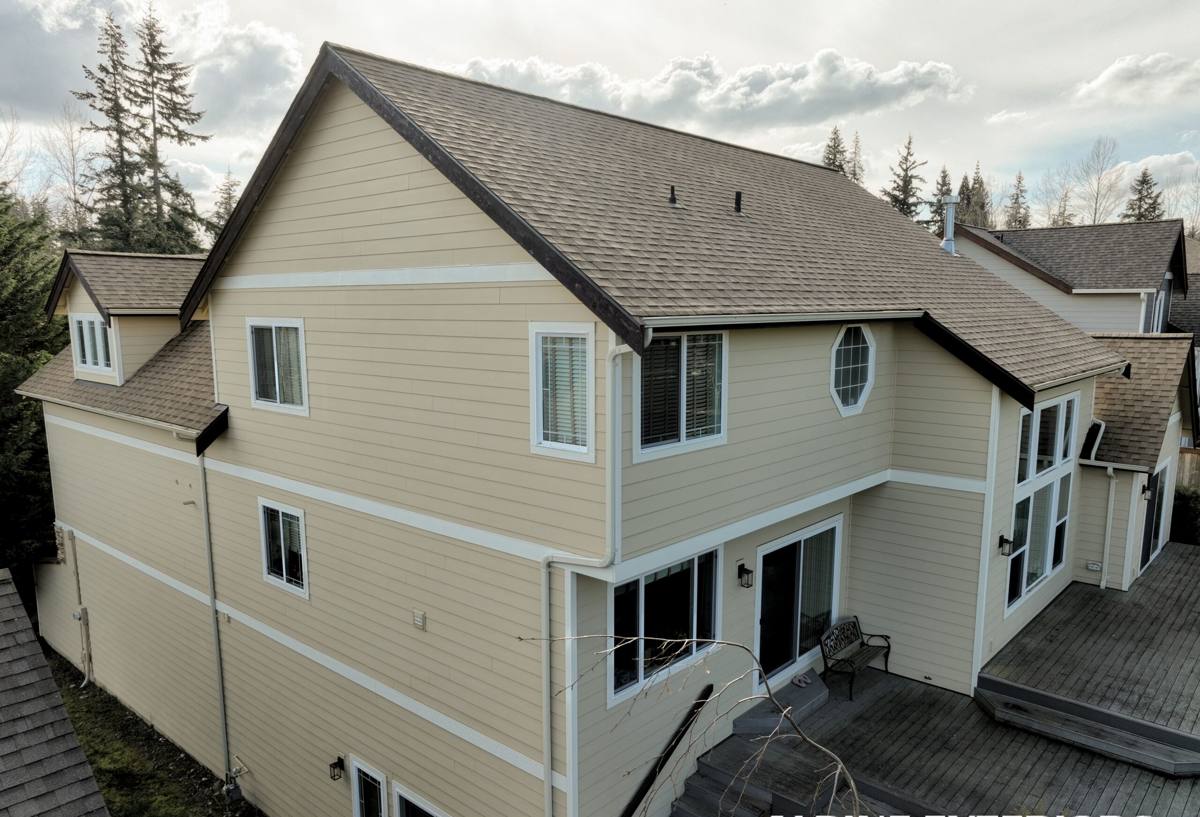
Signs a Deck Needs Replacement, Not Another Repair
We get calls every year from homeowners who've had a deck patched two or three times and are tired of doing it again. Repairs make sense when the problem is isolated. Replacement makes sense when the problems are structural, repeated, or spreading. Here's what tells us it's time to stop patching:
- Soft, spongy, or spring-loaded decking boards, especially near the house or along the perimeter
- Rust streaks or dark staining radiating out from screws, nails, or bolt heads
- A ledger board (where the deck attaches to the house) that's soft, discolored, or pulling away
- Persistent moss or algae growth that returns within weeks of cleaning
- Visible gaps opening between boards, or boards cupping and warping
- Posts or footings that feel loose, or a deck that has a noticeable bounce or sway
- Repeated repairs to the same section over the past two or three years
If you're only seeing one or two of these, a repair might genuinely be enough. If you're seeing several at once, that's usually a sign the whole system — framing, flashing, and decking — has been absorbing moisture for a long time, and a repair will just be the next in a series.
What a Correct Deck Replacement Actually Involves
Ledger and Structural Connection
The ledger board is the single most important connection on most decks, and it's also the point most exposed to water intrusion where the deck meets the house. A correct replacement means removing the old ledger entirely, checking the rim joist and sheathing behind it for rot, and installing proper ledger flashing that directs water away from the house rather than behind the siding. This is the step that gets skipped most often on a quick patch job, and it's the one that causes the most expensive hidden damage later.
Framing and Joist Layout
Joist spacing needs to match the decking material you're installing — composite and PVC boards often call for tighter spacing than solid wood to prevent sagging over time. We also use joist tape or an equivalent moisture barrier on top of the framing, which is inexpensive insurance against the exact kind of slow water absorption that's common in a climate like ours.
Flashing and Moisture Management
Beyond the ledger, this includes post base connectors that keep posts off standing water, proper drainage grading beneath the deck, and gapping between boards that allows airflow so wood or composite decking can actually dry out between rain events instead of staying saturated.
Fasteners and Hardware
Given the salt air moving through the region, we use stainless steel or high-grade coated fasteners and connectors rated for coastal exposure, not standard galvanized hardware that's fine inland but corrodes faster here. This is a small line-item cost difference that prevents the rust-streaking and hardware failure that shows up in five to seven years with cheaper fasteners.
Decking Material Options for This Climate
There's no single "best" decking material — there's a best fit for your budget, your maintenance appetite, and how much sun or shade the deck actually gets. Here's how the common options compare for a home dealing with regular rain, salt air, and moss pressure:
| Material | Moisture Behavior | Maintenance | Typical Lifespan |
|---|---|---|---|
| Pressure-treated wood | Absorbs and releases moisture; needs to breathe and dry | Annual cleaning and re-sealing recommended | 10-15 years with upkeep |
| Cedar | Naturally moisture and insect resistant, but still organic | Periodic cleaning and oil/stain | 15-20 years with upkeep |
| Composite decking | Doesn't absorb water like wood, but surface moss/algae can still grow if not cleaned | Occasional washing, no staining or sealing | 25-30 years |
| PVC/capped polymer | Fully sealed surface, best resistance to moisture and staining | Lowest maintenance of the group | 25-30+ years |
In a lot of shaded, moss-prone yards around Whatcom County, we steer homeowners toward composite or capped polymer boards for exactly that reason — not because wood is a bad product, but because a low-maintenance surface makes more sense when moss season lasts half the year and you don't want to be power-washing and re-staining every spring.
How Our Deck Replacement Process Works
- On-site assessment — we look at the existing deck, ledger condition, framing, and drainage before quoting anything, since what's underneath often matters more than what you can see.
- Material and layout discussion — we walk through decking options, railing, and any structural changes based on your budget and how the space gets used.
- Removal and structural inspection — full demo of the old deck surface and framing, checking the rim joist and ledger area for hidden rot before anything new goes up.
- Rebuild — new ledger flashing, framing, post connections, and moisture barrier installed to current standards, not just matched to what was there before.
- Decking and railing installation — installed with proper board gapping and fastening for the material chosen.
- Final walkthrough — we go over the finished deck with you, including what maintenance (if any) the material needs going forward.
Permits and Local Considerations
Whatcom County and local jurisdictions generally require a permit for deck replacement work, particularly when it involves structural changes, a deck built above a certain height, or new footings. Requirements can vary depending on whether your property falls under county jurisdiction or a specific municipal code, and whether the deck is attached to the home. We handle the permit process as part of the job so you're not stuck untangling it yourself, and so the finished structure is signed off and documented — which matters if you ever sell the home.
Maintenance After Replacement
Even a well-built deck needs some seasonal attention here, especially heading into the wetter months. A few habits go a long way toward protecting the investment:
- Sweep debris out of board gaps regularly so water and organic matter don't sit and feed moss growth
- Rinse or lightly wash the surface a few times a year, more often in heavily shaded areas
- Check railings and stair connections annually for looseness, especially after a hard winter
- Keep gutters and downspouts near the deck clear so runoff isn't dumping directly onto the structure
- For wood decks, plan on re-sealing or re-staining on the schedule the product calls for — skipping a cycle is when moisture starts winning
None of this is complicated, but it's the difference between a deck that looks and performs well for decades and one that starts showing the same soft spots and staining within a few years.
Why Hiring a Crew That Already Works in Nooksack Matters
A lot of deck problems we get called out for weren't built badly on purpose — they were built to a generic standard that works fine in a drier climate and doesn't hold up against sustained coastal moisture and salt air. A crew that regularly works the Birch Bay and greater Whatcom County area already knows which fastener grades hold up, where moss pressure tends to be worst based on sun exposure and tree cover, and how local permitting actually works in practice, not just on paper. That familiarity shows up in fewer surprises during the project and a deck that's actually built for the conditions it has to survive, not just the conditions on a spec sheet.
If your deck in the Nooksack area is showing soft boards, rust staining, or a moss problem that keeps coming back, we're happy to take a look and give you an honest read on repair versus replacement. Reach out for a free, no-pressure estimate — there's a form below to get started.