 Birch Bay Exterior
 Building Decks for Ferndale's Coastal Climate
Ferndale sits close enough to the water that a deck here lives a different life than a deck fifty miles inland. Salt-laden air off Birch Bay and the Strait works into metal fasteners and connectors year-round. Driving rain off Pacific storms doesn't fall straight down — it drives sideways into ledger boards, rail posts, and any joint that isn't properly flashed. And Whatcom County's long, damp shoulder seasons mean moss and algae get a real foothold on any deck surface that stays shaded or doesn't drain fast. None of this is exotic knowledge to a crew that works this area every week, but it matters enormously to how a deck should be designed, fastened, and finished.
A deck built to a generic national spec — the kind you'd see in a big-box how-to guide — will often look fine for the first year or two in Ferndale. The problems show up in year three or four: rust bleeding from screw heads, a soft spot forming where the ledger meets the house, black-green film on the boards every February. We build to account for those failure points from the start, not patch them later.
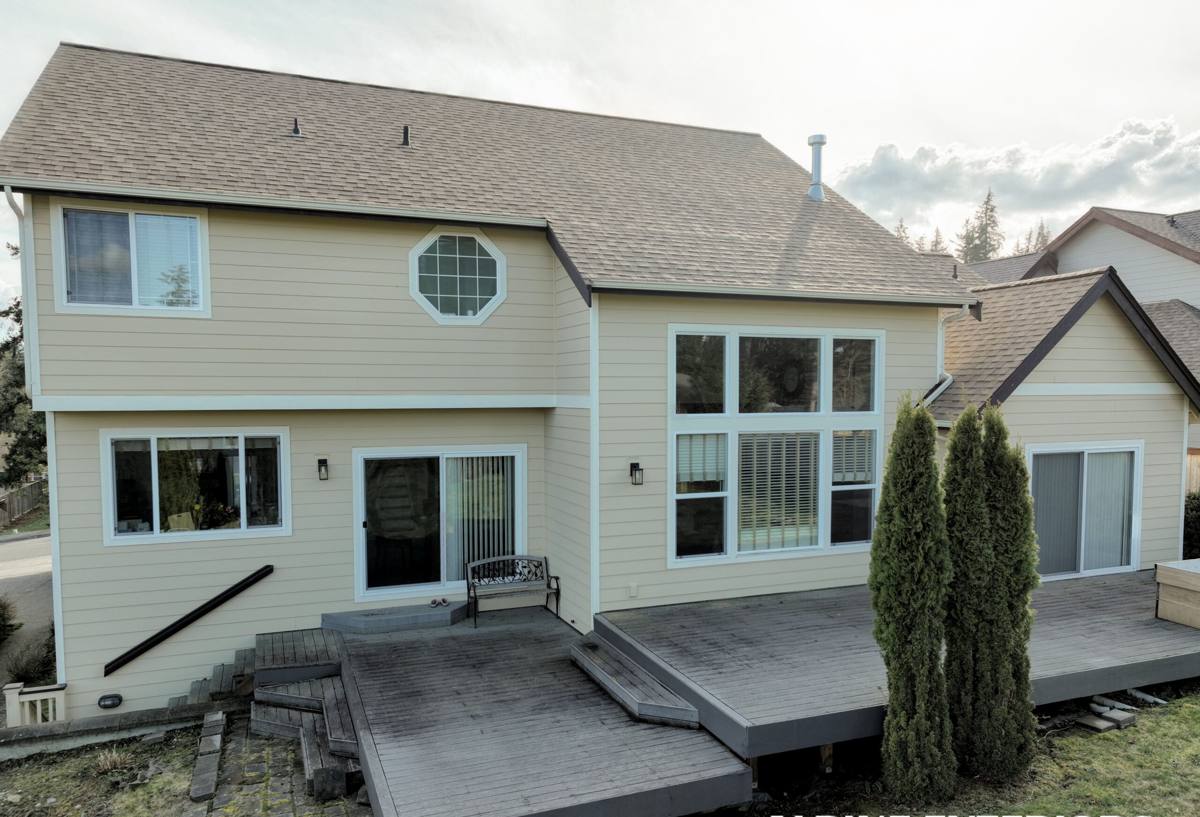
What Local Homes Actually Need From a Deck
Most of the deck work we do around Ferndale and Birch Bay falls into a few categories: new decks on homes that never had one, full replacements of decks built 15-25 years ago with undersized framing or the wrong fasteners, and structural repairs where a deck is sound in places but failing at the ledger or footings. Across all three, the same regional pressures apply.
Moisture Management First
The single biggest driver of deck failure in this climate isn't foot traffic or sun — it's water that gets trapped and can't leave. That means every design decision, from board spacing to ledger flashing to how the structure ventilates underneath, gets evaluated on how well it sheds and dries, not just how it looks on day one.
Corrosion-Resistant Everything
Salt air accelerates galvanic corrosion in fasteners and hardware at a rate homeowners inland don't have to think about. Standard zinc-coated deck screws that would last two decades in a dry inland climate can start showing rust streaks within a few years this close to the water.
Moss and Algae Resistance
Whatcom County's wet fall-through-spring stretch gives moss months to establish itself on any surface that holds moisture. Deck surface choice, gap spacing, and airflow underneath all affect how much of a moss problem a homeowner ends up scrubbing every spring.
Decking Material Options: How They Hold Up Here
There's no single "right" material for every deck — it depends on budget, maintenance appetite, and how exposed the deck is to weather. Here's how the common options actually perform in a Ferndale/Birch Bay setting:
| Material | Moisture & Moss Behavior | Maintenance | Realistic Lifespan Here |
|---|---|---|---|
| Pressure-treated pine/fir | Absorbs and releases moisture readily; prone to moss in shaded, damp spots without regular cleaning | Needs re-staining or sealing every 2-3 years to stay protected | 15-25 years with upkeep |
| Cedar | Naturally more rot-resistant than pine, but still needs sealing to resist moss staining and graying | Annual or biennial cleaning and refinishing recommended | 20-25 years with upkeep |
| Composite decking | Doesn't absorb moisture into the board itself; still needs airflow underneath so surface film doesn't build up | Periodic washing, no staining or sealing | 25-30+ years, manufacturer-dependent |
| PVC/capped polymer | Fully moisture-sealed surface; best resistance to staining and moss | Lowest maintenance of the group | 25-30+ years, manufacturer-dependent |
We'll walk through these trade-offs honestly during an estimate — composite and PVC cost more up front but save real time and money on maintenance over a coastal deck's life. Wood costs less initially but only performs well if someone actually keeps up with sealing and cleaning on schedule. Neither choice is wrong; it depends on what a homeowner wants to be doing every spring.
The Details That Actually Prevent Rot and Rust
Most deck failures we get called out to inspect trace back to a handful of recurring issues, all of them preventable at build time.
Ledger Board Flashing
Where a deck attaches to the house, water intrusion behind the ledger board is the most common source of hidden rot — and it's invisible until the damage is advanced. A correct ledger installation includes proper flashing that directs water away from the house sheathing, not just caulk sealing the gap. Caulk alone fails within a few seasons in this climate; flashing is a mechanical solution, not a chemical one.
Fastener Grade
We use stainless steel or high-grade coated fasteners rated for coastal/marine exposure on structural connections, not standard interior-grade hardware. It costs more per fastener but it's a one-time decision that avoids years of rust streaking and weakened connections.
Board Gapping and Airflow
Decking boards need enough gap between them to let water drain through rather than pool on the surface, and the structure underneath needs enough clearance and airflow to actually dry out between rain events. A deck built low to the ground with poor underside ventilation stays damp longer, which is exactly what moss and rot need.
Post Bases and Ground Contact
Any post that touches or sits near grade needs a base that keeps the wood off standing water and out of direct soil contact. Ground-contact rated lumber and proper post bases matter more here than in drier climates because the ground itself stays saturated for months at a stretch.
Footings and Structural Basics
Whatcom County's frost depth and soil conditions determine how deep footings need to go to stay stable. Undersized or shallow footings are a common issue we find on older decks — they may have passed inspection decades ago under looser standards, but they shift and settle over time, which shows up as a deck that's started to feel bouncy or slightly out of level.
Joist spacing and beam sizing also need to match the actual span and the decking material chosen — composite and PVC boards generally require tighter joist spacing than solid wood to avoid flexing between fasteners. This is one of the more common corners cut on lower-bid deck jobs: framing built to a wood-decking spec, then composite boards installed on top of it, which can lead to a spongy feel and premature fastener stress over time.
Structural Checklist We Verify on Every Deck
- Footings sized and set to proper depth for the soil and load
- Ledger board flashed correctly, not just caulked
- Fasteners and structural hardware rated for coastal exposure
- Joist spacing matched to the actual decking material, not a generic spec
- Post bases keeping all wood off grade and standing water
- Railing posts anchored to blocking, not just face-screwed to rim joists
- Adequate gap spacing and underside clearance for drainage and airflow
Our Process From First Call to Finished Deck
We keep the process straightforward because most homeowners have been through at least one contractor experience that felt anything but.
1. On-Site Look and Honest Assessment
For a replacement or repair, we start by actually getting under the existing deck and checking the ledger, footings, and framing — not just eyeballing the surface boards. For new construction, we look at the site, grade, sun/shade exposure, and how the deck will tie into the house.
2. Straightforward Estimate
We walk through material options and what they cost, including the maintenance trade-offs described above, so the decision is informed rather than driven purely by the lowest number on a page.
3. Permitting Where Required
Depending on the deck's size, height, and attachment to the structure, local permitting may apply. We handle that process as part of the job rather than leaving it for the homeowner to sort out.
4. Build
Footings, framing, flashing, decking, and railing — built in that order, with the moisture-management and corrosion-resistance details above applied at every stage, not just where they're visible.
5. Walkthrough
We go over the finished deck together, including what maintenance (if any) the chosen material needs going forward.
Maintenance: What Ferndale Decks Actually Need
A well-built deck in this climate isn't maintenance-free unless it's PVC or capped composite — and even those benefit from occasional cleaning. Here's a realistic seasonal rhythm for the Whatcom County coast:
- Clear leaves and debris from board gaps before fall rains set in, so water has a clear path to drain
- Rinse or scrub moss and algae film off the surface at least once a year, more often in shaded areas
- Check and re-seal wood decking every 2-3 years (cedar and pressure-treated both need this)
- Inspect the ledger flashing and fastener heads annually for early signs of rust or gap separation
- Keep planters and furniture legs off standing puddles on the deck surface after storms
- Confirm underside airflow isn't blocked by stored items, skirting without vents, or overgrown landscaping
Why Hiring a Crew That Already Works Ferndale Matters
A lot of what separates a deck that lasts 25 years from one that starts failing at year seven isn't the brand of lumber or composite — it's whether the person building it actually accounts for this specific coastline's conditions. A crew that mostly builds decks in drier inland climates may not default to marine-grade fasteners, may not flash a ledger as aggressively, and may not think about moss-prone shade patterns the way a crew that deals with it constantly does. We're based in Birch Bay and work this stretch of Whatcom County regularly, so these aren't special add-ons we upsell — they're just how we build a deck by default.
If you're considering a new deck, a replacement, or want an honest look at whether an existing deck's framing is sound, we're glad to come take a look. The estimate is free and there's no pressure — just a straight assessment and clear numbers, using the form below.