 Birch Bay Exterior
 Why Siding Fails Faster Near Cottonwood Beach
Cottonwood Beach sits close enough to the water that its homes take a different kind of beating than houses just a few miles inland in Whatcom County. Salt-laden air corrodes fasteners and finishes faster than plain moisture does. Wind-driven rain off the strait doesn't fall straight down — it hits siding sideways, working its way behind laps, around trim, and into any gap that wasn't sealed correctly the first time. Add a long, damp moss season that runs from fall through spring, and you have a climate that tests every seam, joint, and fastener in a home's exterior year-round.
None of that means siding repair in Cottonwood Beach is a lost cause — it means the diagnosis and the repair method matter more here than they would in a drier part of the county. A patch that ignores what's happening behind the surface just buys a homeowner a year or two before the same spot fails again.
Signs Your Siding Needs Attention
Most siding damage doesn't announce itself with a hole in the wall. It shows up as small, easy-to-dismiss changes that add up. Homeowners near Cottonwood Beach should watch for:
- Soft or spongy spots when you press on the siding, especially near the bottom courses or under windows
- Cracking, buckling, or warping panels, particularly on walls that face prevailing wind and rain
- Persistent green or black staining that keeps returning within weeks of cleaning
- Peeling or bubbling paint, which often points to trapped moisture rather than a bad paint job
- Gaps opening up at seams, corners, or where siding meets window and door trim
- Visible fastener corrosion — rust streaks bleeding down from nail or screw heads
- Small holes or pecked areas from woodpeckers, common on older wood-based siding near tree lines
Any one of these on its own might be minor. Several together, especially on the same wall, usually mean moisture has been getting behind the siding for a while.
What's Actually Causing the Damage
Moisture Intrusion Behind the Cladding
This is the root cause behind most of the repairs we get called out for. Siding is the visible layer, but it's the water-resistive barrier, flashing, and caulking behind it that actually keep a house dry. When one of those fails — often at a window head, a butt joint, or a spot where old caulk has shrunk and cracked — water gets in and stays in, because it can't evaporate as fast in a marine climate as it can in drier regions. The siding above the leak often looks fine while the sheathing behind it is already compromised.
Material Fatigue
Older siding materials react to the local climate differently. Untreated or primed wood swells and shrinks with every wet-dry cycle until it splits. Older fiber cement products without a factory finish absorb moisture at cut edges and fastener holes. Vinyl can crack in cold snaps and warp under direct sun exposure. Each material has its own failure pattern, which is why a correct repair starts with identifying exactly what's installed, not just patching what's visible.
Impact and Wildlife Damage
Storm debris, falling branches, and woodpecker activity are common causes of isolated damage that don't relate to moisture at all. These repairs are usually simpler, but matching the replacement piece to weathered, existing siding is its own challenge — one more reason a rushed patch job often looks worse than the damage it fixed.
Repair or Replace? How We Make That Call
Not every damaged section needs a full re-side, and we don't sell replacements homeowners don't need. But there's a point where patching stops making financial sense. Here's how we walk through that decision on site:
| Factor | Favors Repair | Favors Replacement |
|---|---|---|
| Extent of damage | Isolated to one or two sections | Spread across multiple walls |
| Moisture behind siding | None found on inspection | Sheathing or framing already wet or soft |
| Age of existing siding | Under 10-15 years, sound overall | Original material near or past its service life |
| Material type | Still manufactured or reasonably matchable | Discontinued, or a product we don't stand behind |
| Cause of damage | One-time event (impact, wildlife) | Ongoing systemic issue (chronic moisture, failed original install) |
When the damage is contained and the wall behind it is dry, a targeted repair is the right, honest answer. When we find rot, saturated sheathing, or a pattern of failures across the exterior, we'll tell you that plainly and explain why a repair there would just be a temporary cover-up.
How We Approach a Repair
Inspection Before Anything Else
Every repair starts with pulling back enough siding to see what's actually happening underneath — not just patching over the visible symptom. We check the water-resistive barrier, flashing at windows and penetrations, and the condition of the sheathing itself. This is the step that gets skipped when a repair is rushed, and it's the step that determines whether the fix lasts.
Fixing the Cause, Not Just the Symptom
If the damage traces back to failed flashing or a gap in the weather barrier, we correct that before any new siding goes back on. Reinstalling siding over an unresolved moisture path just hides the problem for another season.
Matching Material and Finish
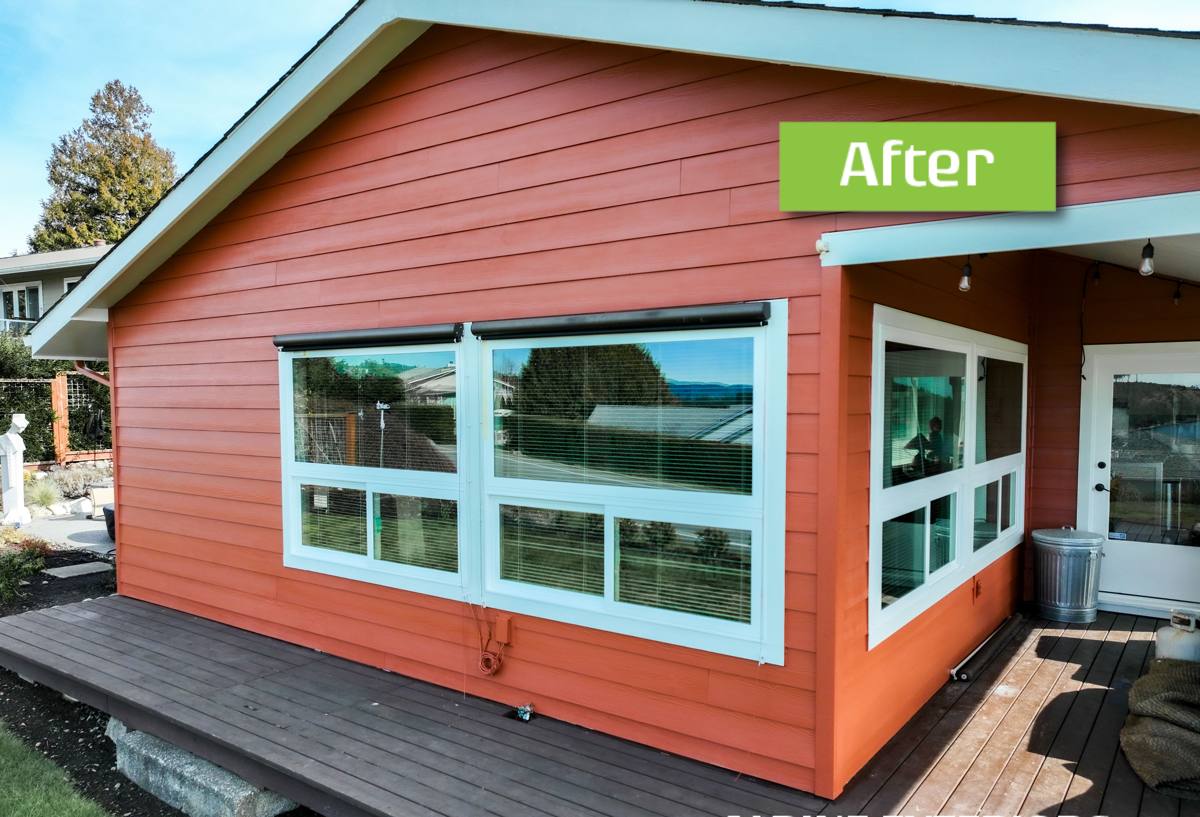
For sections where we're replacing damaged siding with James Hardie fiber cement, we work from the same product line and, where the existing exterior is Hardie with ColorPlus factory finish, the same color match — so the repair blends in rather than reading as an obvious patch. For homes with other existing siding materials, we'll always tell you honestly what a compatible repair looks like versus what we'd actually recommend going forward.
Sealing and Detailing the Edges
Cut edges, fastener penetrations, and joints are where repairs typically fail first in a wet climate. We treat and seal these correctly rather than leaving raw edges exposed, which matters even more given how much moisture Cottonwood Beach sees over a typical year.
Why We Only Install James Hardie for Replacement Sections
When a repair calls for new siding material rather than a patch, we install James Hardie fiber cement — not vinyl, not LP SmartSide, not cedar or primed spruce. That's a standard we hold across every job, not just here. Fiber cement is non-combustible and dimensionally stable, so it doesn't swell, crack, or warp the way wood-based products can when they cycle through wet and dry conditions for months at a time. Hardie's HZ5 product line is engineered specifically for climates like ours, with moisture and freeze-thaw performance that matters on a property exposed to salt air and driving rain.
The ColorPlus factory finish also matters for repair work specifically: it's baked on at the factory rather than field-applied, which means a new section holds its color and resists fading in a way that keeps a patched wall looking uniform for years, not just at installation. And Hardie's transferable warranty gives homeowners real backing behind the material itself, on top of our labor.
Why Local Experience in Cottonwood Beach Matters
A contractor who mostly works inland jobs may not think twice about caulking specs or fastener choice — details that matter far less thirty miles from the water. Crews who regularly work Cottonwood Beach and the rest of the Birch Bay area know which walls take the worst of the wind-driven rain, how aggressively moss and algae grow back here, and which failure points show up again and again on homes exposed to salt air. That local pattern recognition shortens the diagnosis and helps us catch problems a generic inspection might miss.
After the Repair: Keeping It That Way
A correct repair should hold up, but a little upkeep extends its life further:
- Rinse siding once or twice a year to keep salt residue and moss spores from building up
- Keep gutters clear so runoff doesn't sheet down over siding and trim
- Trim back vegetation that keeps a wall shaded and damp longer than it should be
- Have caulking at trim and penetrations checked every few years — it's cheap insurance against the next leak
- Address small issues (a loose piece, a cracked corner) promptly rather than letting them sit through another wet season
Get an Honest Look at Your Siding
If you're seeing soft spots, staining, cracking, or gaps on your Cottonwood Beach home, it's worth having someone look before the next storm season adds to the damage. We'll tell you plainly whether you're looking at a straightforward repair or something bigger — no pressure, no upsell. Reach out for a free estimate using the form below.