 Birch Bay Exterior
 Board & Batten Siding in Birch Bay Village
Birch Bay Village sits close enough to the water that the weather off the bay shapes almost every exterior decision a homeowner makes here, siding included. Board and batten is one of the most requested looks in this part of Whatcom County — the vertical lines read clean against the tree line, it suits both older cottages and newer builds, and it has a straightforward, honest profile that doesn't try too hard. But the look is only half the job. The other half is making sure the material and the installation can actually stand up to what this coastline throws at a house year after year.
This page is specifically about board and batten siding for homes in and around Birch Bay Village. If you're comparing siding profiles in general, that's a different conversation — here we're talking about what this specific style needs to perform correctly on a home exposed to salt air, driving rain, and a long moss season.
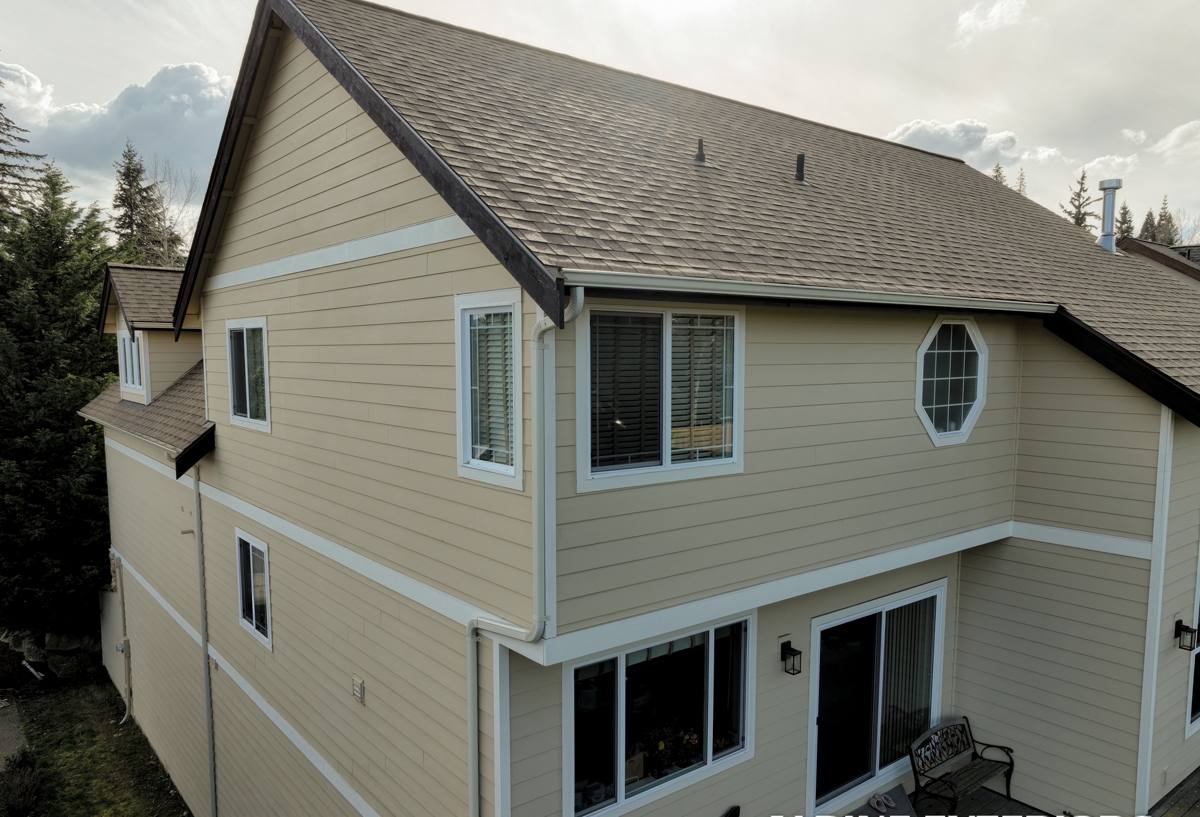
The Climate Problem Board & Batten Has to Solve Here
Three things define exterior wear in Birch Bay: salt-laden air coming off the water, rain that gets driven sideways during winter storms, and a moss and algae season that runs far longer than it does even twenty miles inland. Any siding product can look good in a showroom. Whether it holds up on a Birch Bay Village home depends on how it handles these three conditions specifically.
Salt Air
Airborne salt accelerates corrosion on fasteners, trim flashing, and any metal accessories tied into the siding system. It also degrades cheap paint films faster than inland exposure, which is why homes near the water tend to show chalking, fading, and peel years ahead of the same product installed a few miles east.
Driving Rain
Wind off Georgia Strait and the bay doesn't just drop rain straight down — it pushes it sideways into vertical seams, corner boards, and butt joints. A board and batten system is only as good as its ability to shed that water rather than let it track behind the panel and sit against the sheathing.
Moss and Algae
The Pacific Northwest's moisture and shade combination gives moss a long growing window, and Birch Bay's proximity to the water keeps humidity levels up even when it's not actively raining. Siding that stays damp longer grows moss faster, and moss holds moisture against the surface, which compounds the problem over time.
Why Board & Batten Fits Birch Bay Village Homes
Beyond the look, board and batten has a few practical advantages in a wet coastal climate when it's built and installed correctly. The vertical orientation sheds water differently than horizontal lap siding, and the batten strips, when properly flashed, cover the seams where water intrusion is most likely to start. It also tends to show less streaking and staining pattern than flat panel siding, because the vertical lines break up the path water takes as it runs down the wall.
None of that is automatic, though. A board and batten job is more detail-sensitive than standard lap siding — there are more seams, more fastening points, and more places where a shortcut during installation turns into a callback two winters later.
What a Correct Board & Batten Installation Actually Involves
This is where most of the difference between a siding job that lasts and one that doesn't gets decided — not in the material choice, but in the details underneath it.
Water-Resistive Barrier and Flashing First
Before a single board goes up, the wall needs a continuous water-resistive barrier with properly lapped seams, correctly integrated window and door flashing, and flashing at every horizontal transition — roof lines, deck ledgers, and trim bands. Board and batten does not forgive a weak barrier underneath it, because the vertical seams give water a more direct path down to any gap in the underlayment.
Fastening Pattern and Spacing
Boards and battens need to be fastened per the manufacturer's specified pattern, with correct edge distance and fastener spacing — not "close enough." Overdriven or underdriven fasteners are one of the most common defects we find when we're called out to look at another contractor's work, and on a vertical profile, a poorly seated fastener becomes a direct water entry point.
Batten Placement Over Seams
The battens have to land squarely over the panel joints with enough overlap to shed water outward, not funnel it inward. Batten spacing also has to account for expansion and contraction — fiber cement moves less than wood, but it still moves, and gaps that are too tight will telegraph as cracking at the seams within a few seasons.
Corners, Trim, and Penetrations
Every outside corner, inside corner, and wall penetration (hose bibs, vents, light fixtures) is a place where water wants to get behind the siding. These need dedicated flashing and sealant details — not just siding butted up against trim and caulked.
James Hardie Board & Batten: The Only System We Install
We install James Hardie fiber cement exclusively — not vinyl, not LP SmartSide, not Cemplank, not Allura, not primed spruce or cedar. For board and batten specifically, that means Hardie's vertical siding panels paired with matching battens, engineered as a system rather than assembled from mismatched parts.
Why We Don't Install the Alternatives
Vinyl board and batten is affordable and low-maintenance, but it's a thin, flexible material that can warp in direct sun and doesn't hold paint if a color change is ever wanted — and in a climate with this much moisture, seams and J-channels give water more opportunities to collect. Wood board and batten (cedar or primed spruce) has real curb appeal but demands ongoing painting, caulking, and moisture vigilance that most homeowners don't want to sign up for on a coastal property. Engineered wood products like LP SmartSide perform reasonably well when detailed correctly, but they're still wood-based at the core, which means they're more sensitive to sustained moisture exposure than fiber cement. We made the call to standardize on one product because we'd rather stand behind a system we know performs than juggle five products with five different failure modes.
What Hardie Gets Right for This Climate
James Hardie fiber cement is non-combustible, doesn't rot, and is manufactured in climate-specific formulations — homes here fall under Hardie's HZ5 engineered zone, built for regions with freeze-thaw cycles and sustained moisture rather than the extreme humidity zones further south. The factory-applied ColorPlus finish is baked on under controlled conditions, which holds color and resists the chalking and fading that salt air accelerates on field-applied paint. It also carries a strong transferable warranty, which matters more on a coastal property that sees harder weather exposure than the regional average.
Board & Batten Product Comparison
| Material | Moisture Behavior | Maintenance in Salt Air | Long-Term Fit for Birch Bay |
|---|---|---|---|
| James Hardie Fiber Cement | Does not rot; engineered for freeze-thaw and moisture exposure | Low — factory finish resists fading and chalking | Strong |
| Vinyl | Doesn't absorb water, but seams allow moisture behind panels | Low, but can warp and fade in direct sun | Moderate |
| Wood (Cedar/Primed Spruce) | Absorbs moisture; prone to rot without diligent upkeep | High — repainting and sealing on a recurring cycle | Weak without heavy maintenance |
| Engineered Wood (LP SmartSide) | Treated to resist moisture, but wood-based core | Moderate — installation quality is critical | Moderate |
Our Process for Birch Bay Village Projects
Because we already work in this area, a Birch Bay Village project starts with information we don't have to relearn on every visit — how the wind typically hits a given exposure, what the moss growth pattern usually looks like on a north-facing wall near the water, and how much rain-driving wind a west-facing elevation needs to be detailed for.
- On-site assessment of the existing siding, sheathing, and any moisture damage, with particular attention to walls facing the water and prevailing wind
- Tear-off and inspection of the sheathing underneath — this is often where hidden damage from a prior installation shows up
- Correction of any water-resistive barrier or flashing issues before new siding goes up, not just siding over a compromised wall
- Installation of James Hardie board and batten panels per manufacturer specification for fastening, spacing, and batten overlap
- Detailing of all corners, trim, and penetrations with proper flashing and sealant
- Final walk-through so you understand what was done and what maintenance, if any, is expected going forward
What We Commonly Find on Local Homes
Called out to look at siding in this area, a handful of issues show up repeatedly:
- Moss buildup concentrated on shaded, north-facing walls that stay damp longer between rain events
- Caulk failure at seams and trim joints, letting water track behind the siding before it's visible from outside
- Corroded or rust-staining fasteners on older installations that used the wrong fastener type for a coastal environment
- Soft or delaminating sheathing discovered only once old siding is removed, usually from years of slow, unnoticed moisture intrusion
- Battens installed without enough overlap or with gaps that let wind-driven rain track directly to the seam below
None of these are dramatic failures on day one — they're slow problems that compound over several wet seasons, which is exactly why board and batten installed correctly the first time matters more here than in a drier inland climate.
Cost Factors for Board & Batten in Birch Bay Village
Pricing depends on the specifics of your home, but a few factors consistently move the number more than others in this area:
| Factor | Why It Matters Here |
|---|---|
| Existing sheathing condition | Coastal moisture exposure makes hidden rot or delamination more likely, and repairs are priced once uncovered |
| Wall exposure to wind and water | West and north-facing walls facing the bay typically need more thorough flashing detail |
| Home height and access | Multi-story homes and difficult site access add labor time |
| Trim and corner complexity | More corners, windows, and penetrations mean more flashing and detail work per square foot |
| Color and finish selection | Factory ColorPlus finishes vs. field-applied paint carry different material costs |
We won't quote a number without seeing the home — anyone who does is guessing, and a guess that's wrong in either direction doesn't help you.
Why a Crew That Already Works Birch Bay Village Matters
Siding contractors who only pass through this area occasionally tend to detail every job the same way, regardless of exposure. A crew that regularly works Birch Bay Village has already seen which walls take the worst of the wind-driven rain, which orientations grow moss fastest, and how much flashing detail a given exposure actually needs versus the manufacturer's minimum spec. That local pattern recognition doesn't replace doing the installation correctly — it just means fewer surprises and fewer corrections mid-project. If your property falls under an HOA or community design guideline, we can also work within those requirements rather than defaulting to a generic spec and hoping it clears review.
Maintenance Checklist for Board & Batten Owners Near the Water
- Rinse siding annually to remove salt residue, particularly on walls facing the bay
- Inspect caulking at trim, corners, and penetrations every year or two and re-seal as needed
- Address moss on shaded walls before it spreads, rather than letting it accumulate over a full season
- Check for fastener staining or corrosion, which can signal the wrong fastener type was originally used
- Walk the exterior after major storms to look for loosened battens or trim
If you're weighing board and batten for a home in Birch Bay Village, we're glad to come take a look and give you an honest read on what your walls actually need — no pressure, no generic quote pulled from a square-footage calculator. Use the form below to request a free estimate.