 Birch Bay Exterior
 Siding Replacement Built for Custer's Weather, Not Just Its Curb Appeal
Custer sits inland just enough from Birch Bay and the Strait of Georgia to feel like it should be sheltered from the worst of the coastal weather — but it isn't. Salt-laden air still moves through on the prevailing westerlies, driving rain still comes in sideways off the water for days at a stretch, and the shaded, damp pockets around mature trees and north-facing walls stay wet long enough each winter to grow a healthy crop of moss and algae. Siding in this part of Whatcom County isn't just a cosmetic layer. It's the one thing standing between your framing and a climate that spends half the year trying to get past it.
When we replace siding in Custer, we're not installing the same product we'd put on a house in eastern Washington or a dry inland market. We're accounting for a specific, predictable set of stresses this area throws at a wall assembly year after year, and we're installing the one product we've found holds up to that combination without turning into a maintenance project.
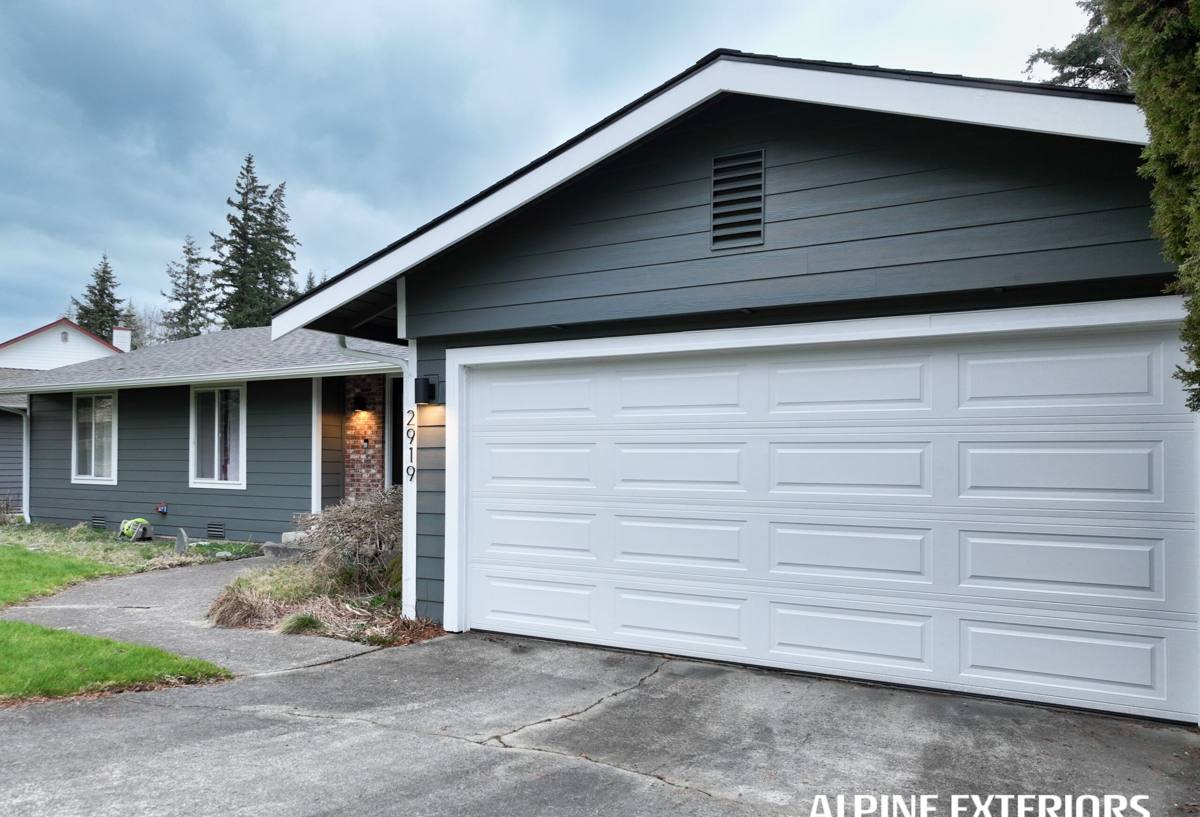
What Custer's Climate Actually Does to Siding
Salt Air
Homes closer to the Birch Bay shoreline get it worst, but Custer isn't far enough inland to be exempt. Airborne salt accelerates corrosion on fasteners and metal trim, and it degrades certain paint and coating systems faster than manufacturers' standard warranties assume. Siding that isn't engineered with a marine-aware finish will chalk, fade, or fail at the coating level well ahead of schedule in this environment.
Driving Rain
Whatcom County's rain doesn't just fall — a good portion of the year it arrives horizontally, driven by wind off the water. That matters because it pushes moisture into laps, seams, and butt joints that would stay dry in a calmer climate. Products that rely on face-sealed joints or that swell and distort when saturated are working against the local weather pattern from day one.
Moss Season
Between the rainfall totals and the tree cover common around Custer properties, moss and algae growth on north- and west-facing walls is close to unavoidable without the right siding material and the right amount of clearance and airflow at installation. Porous or wood-based siding gives moss something to hold onto; a dense, factory-finished fiber cement surface gives it far less.
Why We Only Install James Hardie Fiber Cement Here
We standardized on James Hardie siding for every home we work on in the Birch Bay and Custer area, and it's not a brand preference — it's a decision based on what actually performs in this climate over the long haul.
- Non-combustible core: Hardie's fiber cement doesn't feed a fire the way wood-based products can, which matters for insurance and peace of mind alike.
- ColorPlus factory finish: Baked-on in a controlled environment rather than field-applied, it resists the fading and chalking that salt air and UV accelerate, and it holds color more consistently than most site-painted or primed products.
- Climate-engineered HZ product lines: Hardie's HZ10 formulation is built specifically for wetter, harsher climates like ours, with moisture and freeze-thaw performance tuned for the Pacific Northwest rather than a national average.
- Dense, low-porosity surface: Fiber cement doesn't absorb water the way wood or wood-composite products do, which directly reduces the swelling, cupping, and rot risk that drives most siding failures we see in this area.
- Strong transferable warranty: A meaningful warranty that follows the house through a sale, not just the original owner.
We don't install LP SmartSide, vinyl, Cemplank, Allura, primed spruce, or cedar. Some of those are reasonable products in the right application, but none of them hold up to Custer's salt exposure, rain load, and moss pressure as consistently as Hardie does over a 20-plus-year window, and we'd rather stand behind one system we trust completely than offer a menu of products with different long-term outcomes.
Signs a Custer Home Needs Siding Replacement, Not Another Repair
Not every siding problem means a full tear-off. But in a climate this demanding, patch jobs on failing siding tend to be short-term fixes. Watch for these signs that replacement is the more honest answer:
- Soft or spongy spots when you press on the siding, especially near the bottom courses or around window trim
- Visible cupping, warping, or delamination on wood or composite siding
- Persistent moss or algae staining that comes back within a season of cleaning
- Paint that's failing (peeling, bubbling, or chalking heavily) across large sections rather than isolated spots
- Gaps opening up at seams, corners, or trim as the material has moved or shrunk over time
- Visible fastener corrosion or rust streaking down the wall
- Rising energy bills that track with drafts or cold walls, suggesting the water-resistive barrier behind the siding has failed
What a Correct Siding Replacement Involves
Siding replacement done right in this climate is as much about what's behind the siding as the siding itself. A new product installed over a compromised weather barrier or rotten sheathing just hides the problem for a while.
Tear-Off and Inspection
We remove the existing siding and inspect the sheathing and framing underneath for moisture damage, which is common on homes that have been fighting driving rain for years with an underperforming product. Any soft or damaged sheathing gets replaced before anything new goes back up — no shortcuts here, because it's the one step you can't fix later without tearing everything off again.
Weather-Resistive Barrier
A properly lapped and sealed water-resistive barrier goes on next, detailed carefully around windows, doors, and penetrations. In a driving-rain climate, the quality of this layer matters as much as the siding itself.
Rainscreen and Drainage Gap
Where conditions call for it, we install furring or a drainage mat to create a gap behind the siding. That gap lets any moisture that does get past the outer layer drain and dry out instead of sitting against the wall — one of the most effective things we can do to fight moss growth and long-term rot risk in a wet climate like Whatcom County's.
Hardie Installation to Manufacturer Spec
Correct fastener spacing, proper clearances from grade, decks, and roofing, and correctly caulked or flashed joints all matter more here than in a milder climate, because any shortcut becomes an entry point for the rain this area gets. We install to Hardie's published specifications, not to whatever's fastest.
Trim, Flashing, and Final Detailing
The last layer of protection is often the small stuff — window and door flashing, kickout flashing where rooflines meet walls, and properly sealed penetrations for vents and fixtures. These details are where most siding failures actually start.
Comparing Siding Options for a Custer Home
| Factor | James Hardie Fiber Cement | Vinyl | Untreated Wood / Primed Spruce |
|---|---|---|---|
| Moisture absorption | Very low — dense, engineered material | Low, but seams and panels can flex and gap | High — prone to swelling and rot |
| Salt air resistance | Strong with ColorPlus factory finish | Moderate — can fade and become brittle | Weak — coatings degrade quickly, moisture gets in |
| Moss/algae resistance | Good — dense, low-porosity surface | Fair — surface texture can hold moisture | Poor — porous surface is easy for moss to grip |
| Fire performance | Non-combustible | Combustible, can melt/deform under heat | Combustible |
| Typical repaint/refinish cycle | Long — factory finish holds color for years | Doesn't repaint well; replace when faded | Frequent — every few years in this climate |
Why Hiring a Crew That Already Works Custer Matters
Siding installation isn't a one-size-fits-all process, and a crew that mostly works drier inland markets can miss the details that matter here. A contractor already familiar with Custer and the broader Birch Bay area understands:
- Which sides of a house typically take the worst of the wind-driven rain based on lot orientation and tree cover
- Where moss pressure tends to concentrate and how to detail drainage and clearance to reduce it
- How salt exposure varies even within a few miles of the shoreline, and when extra attention to fasteners and finishes is worth it
- Local permitting and inspection expectations in Whatcom County
- What existing siding and sheathing conditions are common on homes of a given age in this specific area
That familiarity shows up in fewer surprises during tear-off, fewer callbacks, and a finished product that's actually built for the conditions it has to survive, not a generic installation done the same way everywhere.
Our Process for a Custer Siding Replacement
- Free on-site estimate — we walk the exterior, assess the existing siding and any visible moisture damage, and talk through scope and options
- Written proposal covering material, prep work, drainage strategy, and timeline
- Tear-off and sheathing inspection, with any necessary repairs addressed before moving forward
- Weather-resistive barrier and drainage detailing installed to spec
- James Hardie siding installed per manufacturer requirements, with trim and flashing detailed carefully around every penetration
- Final walkthrough so you know exactly what was done and why
What Affects the Cost of a Siding Replacement
Every home is different, but a few factors consistently drive the scope and cost of a project in this area:
- The condition of the sheathing and framing once the old siding comes off
- Whether a drainage gap or rainscreen system is being added, which is often worth the investment on shaded or rain-exposed walls
- The size and complexity of the home's exterior — corners, trim details, window and door count
- Which Hardie product line and profile you choose, since lap siding, shingle-style panels, and board-and-batten all price differently
- Access and site conditions, including how close the home is to landscaping, decks, or other structures that need protection during the work
We'll never give you a number over the phone with confidence — an accurate estimate requires seeing the house, especially with older siding where hidden moisture damage is common.
If your Custer home's siding is showing its age — moss that keeps coming back, paint that won't hold, or soft spots you'd rather not think too hard about — we're happy to take a look. The estimate is free, there's no pressure, and you'll walk away with a clear picture of what your home actually needs.