 Birch Bay Exterior
 Why Cherry Point Siding Wears Differently Than Inland Homes
Cherry Point sits close enough to the water that homes here deal with a combination most inland Whatcom County properties never see: salt-laden marine air, driving wind-blown rain off the Strait, and a moss season that can stretch for most of the year in shaded, north-facing exposures. Any one of these is manageable on its own. Together, they accelerate the failure of siding systems that were never engineered for a coastal climate.
Salt air is corrosive to fasteners and accelerates the breakdown of many paint and coating systems. Driving rain doesn't just wet the surface of a wall — it tests every seam, joint, and piece of trim, pushing moisture sideways in a way that vertical rain never does. And moss doesn't just look bad; it holds moisture against the siding surface for weeks at a time, which is exactly the condition that rots wood-based products and de-laminates poorly bonded engineered panels.
If your Cherry Point home's siding is original or approaching 15-20 years old, it's worth having someone who understands this specific combination of stressors take a real look, rather than assuming the manufacturer's general lifespan numbers apply here the same way they would in a drier, inland part of the state.
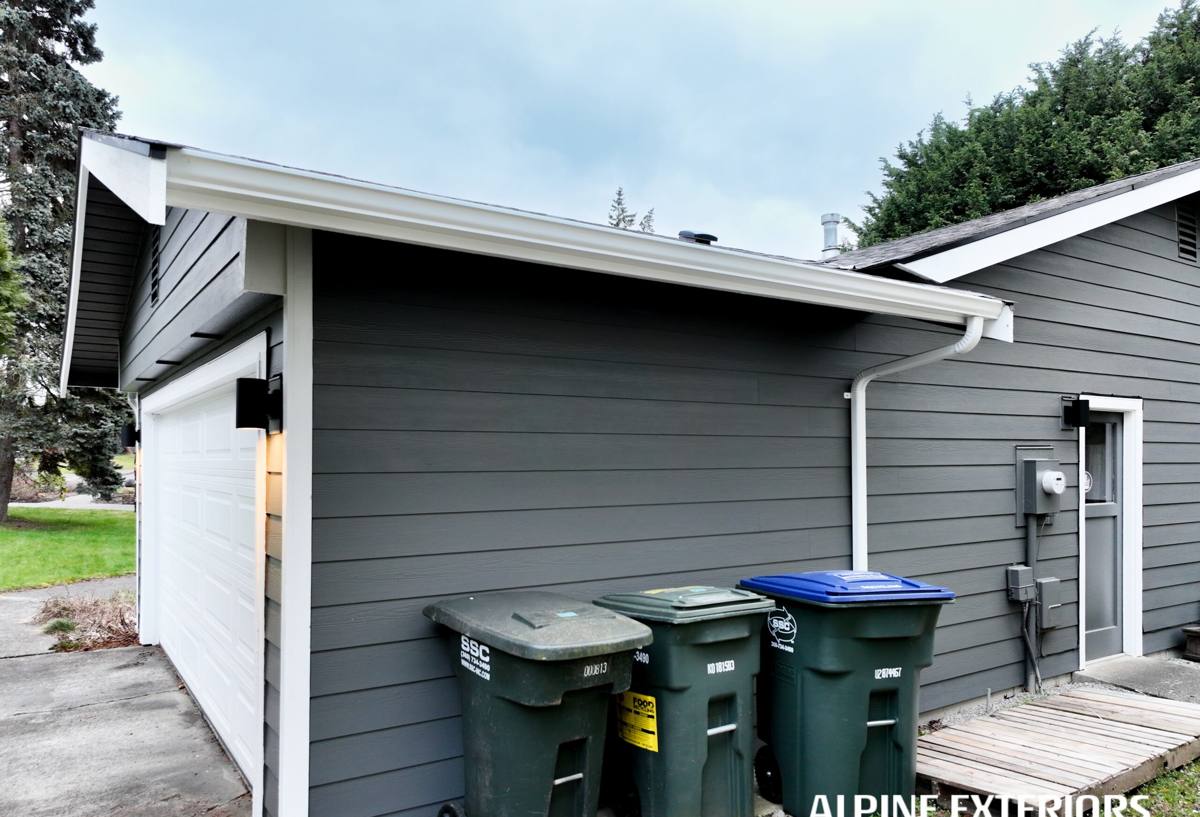
What "Correct" Siding Replacement Actually Involves
Siding replacement is often sold as a cosmetic upgrade. In a climate like this one, it's really a moisture-management project with a finish layer on top. Doing it right means paying as much attention to what's underneath the siding as to the siding itself.
Tear-Off and Inspection
Full removal of the old siding, not overlay installation, so the sheathing and framing underneath can actually be inspected. This is the point where hidden rot, soft sheathing, or failed old flashing gets found — and it's far cheaper to fix while the wall is already open than to discover it five years later through a bubbling wall.
Water-Resistive Barrier and Flashing
A correctly lapped water-resistive barrier, with proper flashing at every window, door, and penetration, is what actually keeps driving rain out of the wall assembly. Siding sheds most of the water, but the barrier and flashing behind it are the real defense against wind-driven moisture finding a way in — which matters more here than almost anywhere else in the county.
Fastening and Fit
Correct nailing patterns, proper gapping at joints and trim, and manufacturer-specified clearances at grade and roof lines. Fiber cement in particular is unforgiving of shortcuts here — installed to spec it performs for decades; installed loosely or with the wrong fasteners, it can fail well before its rated life.
Why We Install Only James Hardie Fiber Cement
We standardized on James Hardie fiber cement siding for every job we do, including here in Cherry Point, and we don't install vinyl, LP SmartSide, Cemplank, Allura, primed spruce, or cedar. That's not a marketing position — it's a reflection of what holds up under salt air, sustained moisture, and moss exposure without turning into a maintenance burden for the homeowner.
Fiber cement is non-combustible and dimensionally stable, meaning it doesn't expand and contract with moisture the way wood-based products do. That stability matters directly here: a product that swells and shrinks with every wet season eventually opens gaps at joints and fasteners, which is exactly where driving rain gets in. Hardie's ColorPlus factory finish is baked on and warrantied against peeling and cracking, which counts for more on a coastline where paint failure is one of the most common complaints we hear about older siding.
James Hardie also engineers specific product lines for different climate zones — their HZ5 and HZ10 systems address moisture and temperature conditions regionally rather than using one formulation everywhere. For a property exposed to this much marine moisture, that climate-specific engineering is worth more than a lower up-front price on a product that isn't built for it.
Why We Don't Install the Alternatives
Vinyl siding is inexpensive and low-maintenance in mild climates, but it's also more prone to warping under sustained UV and thermal cycling, and its seams and J-channels give wind-driven coastal rain more opportunities to find a path behind the panel. LP SmartSide and other wood-strand products perform reasonably well when detailing is perfect and maintenance never lapses, but they're wood at their core — meaning sustained moisture and moss cover are precisely the conditions that shorten their life. Primed spruce and cedar require the most ongoing maintenance of all: regular refinishing, vigilant caulking, and active moss control, which is a lot to ask of a coastal property that already sees more moisture exposure than most.
None of these products are "bad" in every application. They're just not the right match for a Cherry Point exposure, and we'd rather tell homeowners that honestly up front than install something we know will need premature attention.
Signs Your Cherry Point Home May Need Siding Replacement
Some of these show up gradually enough that homeowners get used to them before recognizing it as a siding problem rather than a cosmetic one.
- Persistent moss or algae staining that returns within a season of cleaning, especially on north- or shaded-side walls
- Paint that's bubbling, peeling, or chalking rather than just fading evenly
- Soft or spongy spots when pressed, particularly near the bottom courses and around window trim
- Visible gaps or separation at panel joints, corners, or where siding meets trim
- Warping, buckling, or panels that no longer sit flat against the wall
- Rust streaking from fasteners bleeding through the finish
- A musty smell or visible staining on interior walls that share an exterior with older siding
Any one of these on its own might just need a repair. Several together, especially on a home that's had the original siding for close to two decades, usually means the assembly underneath is compromised and full replacement is the more honest recommendation.
Our Process for a Cherry Point Siding Replacement
- On-site assessment — we walk the exterior, check problem areas you've noticed, and look at exposure, drainage, and existing damage before recommending anything.
- Scope and product selection — we walk through the relevant Hardie product line, color options, and trim details so you know exactly what's being installed and why it fits your exposure.
- Tear-off — full removal of existing siding and trim, with sheathing inspected as it's exposed.
- Repair as needed — any rotted sheathing, framing, or old flashing issues found during tear-off get addressed before anything new goes up, not covered over.
- Barrier and flashing installation — water-resistive barrier and flashing at every window, door, and penetration, installed to shed water the way it's designed to.
- Hardie installation — installed to manufacturer specification for fastening, clearance, and gapping, which is what actually protects the warranty and the performance.
- Final walkthrough — we go over the finished work with you directly before calling the job done.
What Drives the Cost of a Siding Replacement
Every home is different, but the same handful of factors drive most of the cost variation we see on projects in this area.
| Factor | Why It Matters |
|---|---|
| Home size and wall complexity | More linear footage, corners, and roof lines mean more material, cutting, and flashing detail work |
| Condition of the sheathing underneath | Rot or moisture damage found during tear-off adds repair scope before new siding can go on |
| Hardie product line and profile | Lap, shingle, and panel styles, plus climate-engineered HZ selections, carry different material costs |
| Trim and accessory work | Window and door trim, corner boards, and fascia detailing add labor beyond the flat wall area |
| Site access | Tight lots, elevation changes, or limited equipment access affect labor time |
| Color and finish selection | Factory ColorPlus finishes vary in price by line but eliminate on-site painting costs |
We give a real, itemized number after seeing the property and the existing siding condition — not a phone estimate based on square footage alone, since the hidden condition of the wall assembly is often the biggest variable.
Why Hiring a Crew That Already Works This Area Matters
Coastal Whatcom County exposures aren't uniform — a wall facing the water takes different punishment than one tucked behind a windbreak a quarter mile inland, and a crew that's worked a range of Cherry Point and Birch Bay properties has already seen how that plays out on actual homes. That experience shows up in small decisions: where to add extra flashing attention, which trim details need more clearance, and how aggressively to plan for moss and moisture in the finish selection. It also means a crew that's used to weather-dependent scheduling in a marine climate, rather than treating rain delays as a surprise.
Just as important is sticking to one product installed correctly, rather than offering whatever's cheapest that week. Consistency in what we install and how we install it means we know exactly how it performs in this specific environment, year after year, on the homes we've already done.
Maintenance After Replacement
Correctly installed Hardie siding with a factory finish is genuinely low-maintenance, but "low" isn't "none," especially this close to the water.
- Rinse the exterior periodically to clear salt residue and organic buildup before it becomes embedded staining
- Keep gutters clear and downspouts directed away from the wall so water doesn't sheet down the siding face
- Trim back vegetation and landscaping that shades walls and traps moisture, which is what invites moss in the first place
- Have caulking at trim and penetrations checked periodically, since sealant is the one component that does wear over time
- Address any impact damage or fastener issues promptly rather than letting a small gap sit through a wet season
None of this requires the sanding, re-caulking, and repainting cycle that wood-based siding demands — it's closer to occasional upkeep than active maintenance.
Get an Honest Look at Your Siding
If your Cherry Point home is showing moss buildup, paint failure, or soft spots that keep coming back no matter how often you clean or patch, it's worth having someone look at what's actually happening underneath the surface before deciding what to do next. We're happy to walk the exterior with you, point out what we see, and give you a straightforward, no-pressure estimate — use the form below to get started.