 Birch Bay Exterior
 Point Whitehorn's Exposure Is Different From Inland Birch Bay
Point Whitehorn sits right against the Strait of Georgia, and that shoreline position changes what siding has to survive. Homes a mile or two inland in Birch Bay get some shelter from tree lines and terrain. Out here, houses take wind-driven rain straight off the water, salt-laden air that doesn't let up between storms, and a shaded, damp understory in the wooded lots that keeps moss and algae going for most of the year. Whatcom County's marine climate is mild in temperature, but it's relentless in moisture — and moisture, not cold, is what actually wears siding out.
Siding installed here has to do three jobs at once: shed wind-blown rain that hits it at an angle instead of straight down, resist the slow corrosive effect of salt air on fasteners and finishes, and keep its surface from becoming a growing medium for moss during the long wet season that runs roughly October through May. A siding job that would hold up fine in a drier part of the state can fail early on a Point Whitehorn lot facing the water.
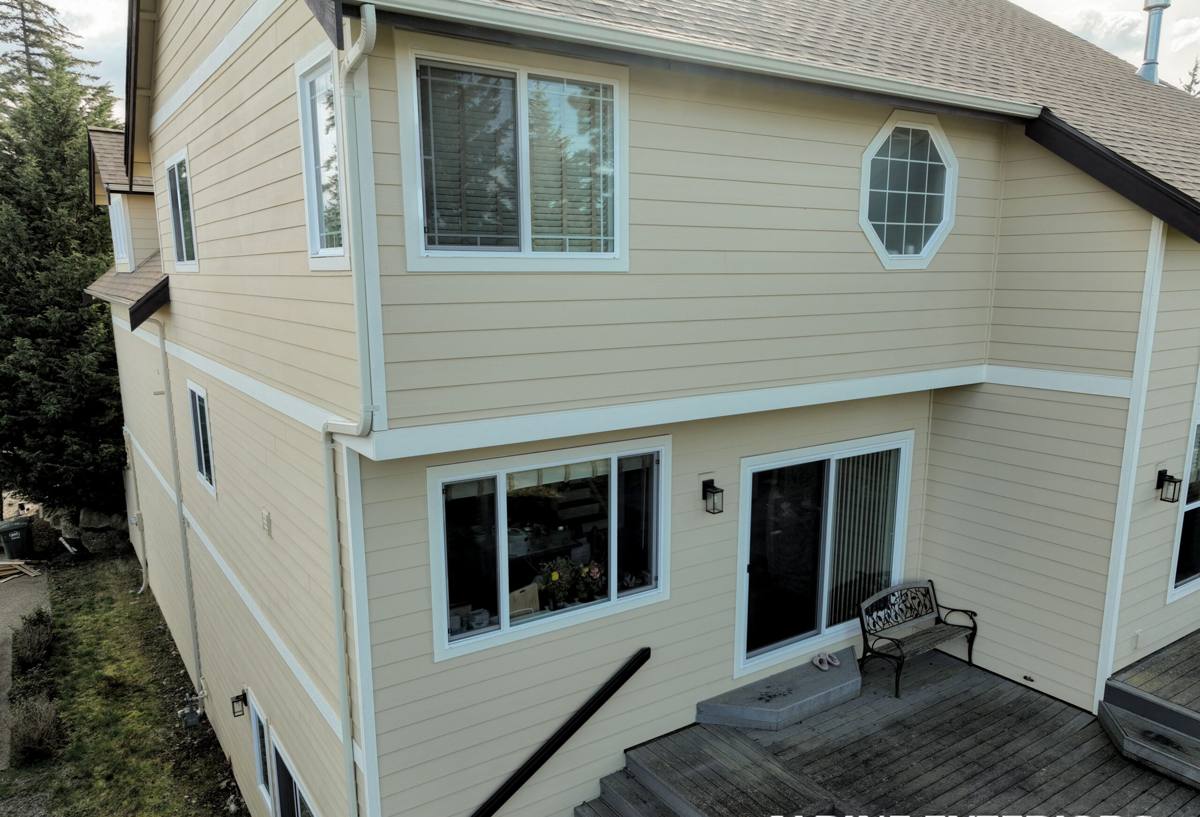
What Salt Air and Moss Actually Do to a House
Salt Air
Airborne salt accelerates corrosion on exposed metal — nail heads, flashing seams, and any fastener that isn't properly protected or set below the surface. It also breaks down cheaper paint films faster than inland exposure would, leading to chalking, fading, and early repaint cycles on materials that rely on field-applied paint rather than a factory finish.
Moss and Algae
Shaded, north-facing walls and anything under overhanging trees stay damp far longer after a rain event. Organic growth needs exactly that — sustained moisture and shade. Left alone, moss holds water against the siding surface, which is a problem for any product that can absorb or wick moisture at seams, cut edges, or fastener penetrations.
Driving Rain
Wind off the water pushes rain sideways into wall assemblies, which puts far more stress on flashing details, siding laps, and butt joints than rain falling straight down. This is where installation quality matters more than the material itself — a good product installed with sloppy flashing will still let water in.
How Common Siding Materials Hold Up in This Climate
We get asked to compare options fairly, so here's a straightforward look at how the materials commonly used in Whatcom County perform against Point Whitehorn's specific conditions.
| Material | Salt Air / Corrosion | Moisture & Moss Resistance | Finish Durability |
|---|---|---|---|
| Vinyl siding | Doesn't corrode, but can warp or crack in temperature swings and wind | Sheds surface water but traps moisture behind panels if installed loose | Color is baked in but fades and chalks over time; can't be repainted easily |
| Cedar (wood) | No metal corrosion issue on the material itself, but fasteners still exposed | Absorbs moisture, needs consistent sealing/staining to resist rot and moss | Requires ongoing refinishing; highest maintenance of the group |
| Primed spruce/engineered wood | Depends heavily on field paint quality and maintenance schedule | Vulnerable at cut edges and joints if caulking or paint fails | Field-applied paint wears faster in salt air; repaint cycles come sooner |
| James Hardie fiber cement | Non-combustible, dimensionally stable; factory-baked ColorPlus finish resists chalking | Engineered HZ formulations for wet marine climates; won't rot | Factory finish holds color far longer than field-applied paint, with a warranty behind it |
This is why we install James Hardie exclusively. It's not that other materials are junk — vinyl and wood both have legitimate uses — it's that the maintenance burden and moisture behavior of the alternatives don't match what a Point Whitehorn exterior actually needs to hold up with minimal upkeep.
What a Correct Installation Involves
The Water-Resistive Barrier Comes First
Before any siding goes up, the wall needs a continuous weather-resistive barrier with properly lapped seams, correctly integrated window and door flashing, and flashing at every horizontal transition — trim boards, band boards, roof-to-wall intersections. In a driving-rain environment like this one, this layer is what actually keeps water out of the wall assembly if it gets past the siding surface. Skipping or rushing this step is the single most common cause of hidden rot behind siding that looks fine from the yard.
Fastening and Clearances
James Hardie has specific fastening patterns, nail penetration depth requirements, and minimum clearances from grade, roof lines, and decks — all designed around keeping the bottom edge of the siding from sitting in standing water or constant splash-back. Correct clearance also keeps the lowest courses out of the zone where moss and algae take hold fastest.
Joint and Butt Seam Treatment
Every horizontal butt joint and every point where siding meets trim is a potential entry point for wind-driven rain. Correct installation means proper caulking at trim transitions, tight and properly backed butt joints, and attention to how water is meant to shed at every transition — not just where it's visible from the ground.
James Hardie Product Lines That Fit This Site
James Hardie engineers its HZ5 product line specifically for cooler, wetter climate zones, which describes Whatcom County and especially an exposed shoreline lot like Point Whitehorn. The ColorPlus factory finish is baked on and cured in a controlled setting, rather than sprayed on-site, which means better adhesion and a longer color life in a climate that would otherwise chalk and fade a field-applied paint job faster than it should. For homes with more direct exposure to wind and salt, we'll talk through lap siding versus panel systems and trim details as part of the estimate, based on how the specific lot sits relative to the water and tree cover.
Our Installation Process
- Site walk and assessment — we look at wall orientation, tree cover, drainage, and existing moisture damage before quoting anything.
- Tear-off and substrate check — remove existing siding, inspect sheathing for hidden rot, and repair any compromised framing before covering it back up.
- Weather barrier and flashing — install or verify a continuous, correctly lapped barrier with flashing at every penetration and transition.
- Hardie installation to spec — correct fastener type, spacing, and clearance, following James Hardie's published installation requirements for this climate zone.
- Trim, caulking, and detail work — the finish details that determine how the house handles the next twenty years of wind-driven rain.
- Final walk-through — we go over the work with the homeowner before calling it done.
Cost Factors for a Point Whitehorn Siding Job
Every home is different, but the same handful of factors move the price on most jobs out here.
| Factor | Why It Matters Here |
|---|---|
| Existing wall condition | Hidden rot from years of wind-driven rain sometimes isn't visible until tear-off; sheathing repair adds cost but shouldn't be skipped |
| Wall exposure and access | Shoreline-facing walls, second stories, and tight lot access all affect labor time |
| Trim and detail complexity | Homes with more corners, windows, and transitions need more flashing and caulking work |
| Siding profile and finish choice | Lap width, panel style, and ColorPlus color selection affect material cost |
| Tear-off vs. new construction | Removing and disposing of old siding adds a step that new-build siding doesn't require |
We won't give a number without seeing the house — anyone who quotes a full siding job over the phone without a site visit is guessing.
Living With Hardie Siding Through Moss Season
No siding material makes moss and algae disappear entirely on a shaded, damp lot — that's a function of sun exposure and moisture, not just the wall material. What correct Hardie installation does is remove the moisture traps that let organic growth take hold at seams and fastener points, and give you a factory finish that's easy to rinse off without stripping paint in the process. A yearly rinse-down before the wet season sets in, and a check of gutters and downspouts to keep water moving away from the walls, is generally all a well-installed Hardie exterior needs.
Why the Crew Matters as Much as the Product
Point Whitehorn homes aren't a generic install. A crew that hasn't worked shoreline-exposed lots in Whatcom County can put up perfectly good material with the wrong flashing detail or the wrong clearance, and the failure won't show up for a few wet seasons — by which point it's a moisture problem inside the wall, not a cosmetic one. Working this area regularly means we already know what a house facing the Strait needs that an inland install doesn't, and we build that into the job from the first day, not after something goes wrong.
- Ask whether the crew has installed siding on shoreline-exposed homes in Whatcom County specifically, not just inland jobs.
- Ask what weather-resistive barrier and flashing details they use, and why.
- Ask whether they install one siding brand or several — and why they made that call.
- Confirm the fastening pattern and clearances match the manufacturer's published spec for this climate zone.
- Get the warranty terms in writing, including what's covered on the material versus the labor.
If your Point Whitehorn home is due for new siding, we're happy to take a look and walk you through what we're seeing — no pressure, no obligation. The form below gets you a free estimate from a crew that already knows this stretch of coastline.