 Birch Bay Exterior
 Siding Built for Ferndale's Corner of Whatcom County
Ferndale sits close enough to Birch Bay and the Strait of Georgia that homes here deal with the same coastal weather pattern we see across our whole service area — salt-laden air moving in off the water, long stretches of driving rain through fall and winter, and a moss season that can run from October well into spring. Add in the mix of older farmhouses, newer subdivisions, and everything in between that makes up Ferndale's housing stock, and you get a wide range of siding conditions: homes with original wood siding that's finally failing, homes with vinyl that's chalked and cracked, and homes with fiber cement that was installed without proper flashing and is starting to show it.
A siding installation in this area isn't just a cosmetic upgrade. It's the single biggest factor in how well your walls handle the next twenty or thirty years of Whatcom County weather. Get it wrong — wrong product, wrong flashing details, wrong fastening — and you're looking at moisture problems, moss and mildew staining, and premature failure. Get it right, and the siding becomes one less thing you think about.
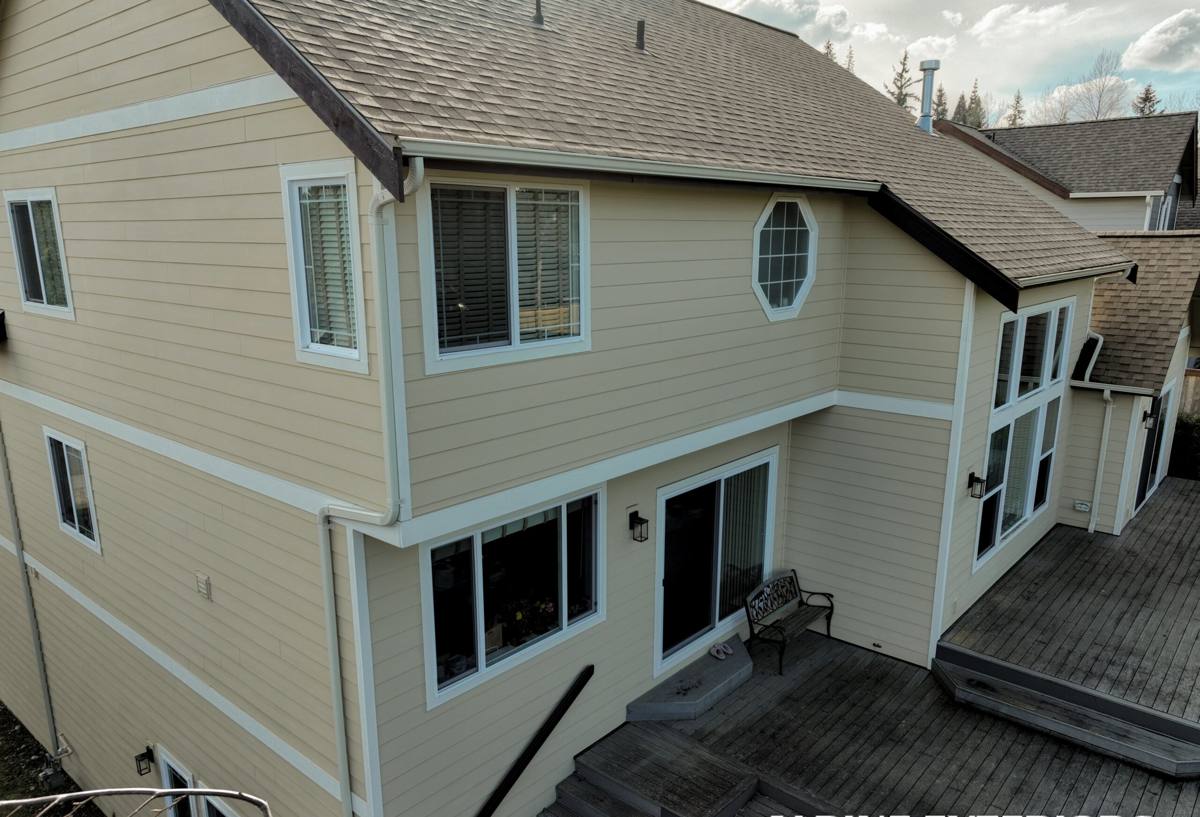
What Ferndale's Climate Actually Does to Siding
Salt Air
Ferndale isn't right on the water the way some Birch Bay properties are, but it's close enough that airborne salt still reaches exterior surfaces, especially on homes with west or northwest exposure. Salt air accelerates corrosion on fasteners, trim flashing, and any metal accents, and it's harder on paint films and coatings than inland air. Materials and finishes that aren't rated for coastal exposure age faster here than the same product would fifty miles inland.
Driving Rain
Storms moving through this part of the county frequently come with wind-driven rain that hits walls at an angle instead of falling straight down. That means water gets forced up under laps, into seams, and behind trim in ways that vertical rain never would. Every horizontal joint, corner, and penetration on a Ferndale home is a spot where wind-driven rain will test the installation, not just the material.
Long Moss Season
Cool, damp, shaded conditions for much of the year make Whatcom County prime territory for moss and algae growth on exterior surfaces. North-facing walls, areas under mature trees, and anywhere airflow is restricted are especially prone to green and black staining. Siding that holds moisture at the surface — or that has a finish that doesn't resist organic growth — will show streaking and staining years before a properly engineered, factory-finished product will.
Why We Install Only James Hardie Fiber Cement
We made a deliberate decision to install one siding system across every job we take on: James Hardie fiber cement. We don't install vinyl, LP SmartSide, primed spruce, cedar, or other fiber cement brands like Cemplank or Allura. That's not a marketing position — it's a practical one, based on how these materials actually perform under the exact conditions Ferndale and Birch Bay homes deal with every year.
Fiber cement is non-combustible, which matters both for insurance considerations and for peace of mind. It doesn't rot, delaminate, or attract insects the way wood-based products can. And James Hardie's ColorPlus factory finish is baked on under controlled conditions, which gives it more consistent resistance to fading, chalking, and moisture intrusion than field-applied paint on wood or primed products. For a region with this much rain and this much salt air, that finish durability is the difference between repainting every five to seven years and going a decade or more before you need to think about it.
James Hardie also engineers specific product lines for different climate zones — the HZ5 line used in our region is formulated for wetter, cooler conditions, which is a meaningful advantage over a one-size-fits-all product.
What a Correct Siding Installation Actually Involves
The siding board itself is only part of the story. Most siding failures we get called out to inspect aren't failures of the material — they're failures of the installation underneath it. A correct install includes:
- A weather-resistant barrier installed with proper overlaps and sealed penetrations
- Correctly flashed windows, doors, and any wall penetrations so water is directed out, not in
- Rainscreen or proper drainage gap where conditions call for it, so moisture that does get behind the siding can drain and dry
- Manufacturer-specified fastener type, spacing, and placement — not shortcuts that void the warranty
- Correct clearances at grade, decks, and roof lines so siding isn't sitting in standing water or snow load
- Caulking and sealant only where James Hardie's installation instructions call for it — over-caulking traps moisture
Every one of these details matters more in a climate like ours than it would somewhere dry. Skipping or rushing any of them is how you end up with moisture damage behind siding that still looks fine from the curb.
Our Process for a Ferndale Siding Job
1. On-Site Assessment
We walk the property, check the condition of the existing siding and sheathing, look at drainage and grading around the foundation, and identify problem areas — north-facing walls prone to moss, sections exposed to prevailing wind-driven rain, and any spots where past repairs or flashing were done incorrectly.
2. Tear-Off and Sheathing Check
Once old siding comes off, we inspect the sheathing underneath for rot or moisture damage before anything new goes up. This is often the point where hidden problems from a previous installation surface — and it's much cheaper to address them now than after new siding is closed up over them.
3. Weather Barrier and Flashing
We install and detail the weather-resistant barrier and flashing to manage water at every window, door, and penetration, with attention to the wind-driven rain patterns typical of this area.
4. James Hardie Installation to Spec
Boards, fasteners, and clearances are installed to James Hardie's published specifications — the requirements that keep the manufacturer's warranty intact and that give you the performance the product is actually engineered for.
5. Final Walkthrough
We review the finished work with you, point out anything you should know for long-term care, and make sure you understand what's covered under warranty.
Comparing Siding Options for a Ferndale Home
| Factor | Vinyl | Wood / Primed Spruce | James Hardie Fiber Cement |
|---|---|---|---|
| Salt air resistance | Moderate — can chalk and become brittle | Poor without diligent upkeep | Strong with ColorPlus factory finish |
| Wind-driven rain tolerance | Depends heavily on installation | Prone to water intrusion at joints over time | Strong when installed with proper flashing detail |
| Moss/algae resistance | Surface can host growth in shaded areas | Absorbs moisture, more prone to staining and rot | Better resistance; less moisture retention at surface |
| Fire resistance | Combustible | Combustible | Non-combustible |
| Typical repaint interval | N/A (color molded in, but fades/chalks) | 5-7 years | Well beyond a decade with factory finish |
This isn't a claim that vinyl or wood siding is a bad product everywhere — plenty of homes around the country are sided in both. It's a statement about what we've found works best for the specific conditions Ferndale and the rest of our coastal service area deal with, and why we've chosen to put our labor and our warranty behind one system instead of several.
What Ferndale Homeowners Should Ask Before Hiring
Siding installation is one of those projects where the quality of the crew matters as much as the quality of the material. Before hiring anyone for a siding job in this area, it's worth asking:
- Are you certified or specifically trained to install the product you're proposing?
- How do you handle flashing at windows, doors, and other penetrations?
- Will you inspect and address sheathing issues before new siding goes up, or just cover them?
- What does the manufacturer's warranty require to stay valid, and will your installation meet it?
- Do you have experience with homes in this specific coastal climate, not just siding in general?
A crew that already works regularly in Whatcom County's coastal conditions is going to catch the details that matter here — the flashing at a wind-exposed corner, the drainage gap on a shaded north wall, the fastener spacing that keeps a warranty intact through decades of rain. That local familiarity is worth more than a lower bid from a crew that mostly works inland.
Signs Your Ferndale Home May Need New Siding
Not every siding problem is obvious from the street. Some of the more common signs we see on local homes include soft or spongy spots when you press on siding near the bottom of walls, persistent moss or dark staining that keeps returning even after cleaning, visible cracking or warping on wood-based siding, and cupping, buckling, or gaps at seams on aging vinyl. Any of these can point to moisture that's already working its way behind the surface — worth having looked at before it spreads.
If you're in Ferndale or elsewhere around Birch Bay and want an honest look at your siding — whether it needs full replacement, targeted repair, or just some time before it's a real problem — we're happy to walk the property with you. Reach out below for a free, no-pressure estimate.