 Birch Bay Exterior
 Point Whitehorn's Shoreline Climate Is Hard on Siding
Point Whitehorn sits along the Strait of Georgia at the northern edge of Birch Bay, in the far northwest corner of Whatcom County. Homes here face weather that's a step harder on exterior materials than what you'd see a few miles inland: steady marine air carrying salt, rain that comes in sideways off the water during winter storms, and a long stretch of the year where shaded, damp siding never gets enough sun or airflow to fully dry out. That combination is why siding failures we see in this pocket of Birch Bay often look different from failures inland — more moss and algae staining, more swelling and soft spots at butt joints and lower courses, more paint failure on the weather-facing walls.
None of that is unusual for this stretch of coastline. It's simply what marine-exposed siding has to survive here, year after year. The right material and the right installation details matter more in Point Whitehorn than they do a few miles inland, because the margin for error is smaller.
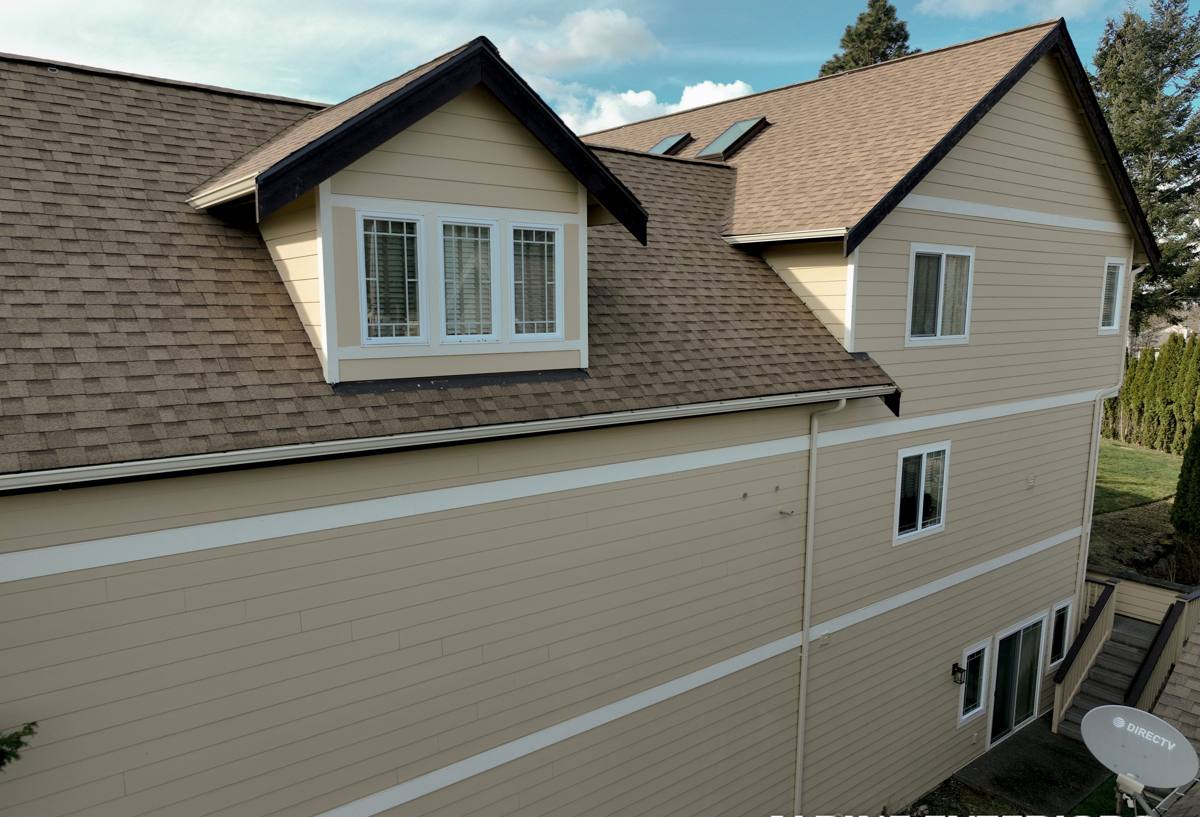
What Salt Air, Driving Rain, and Moss Actually Do to Siding
Salt Air
Airborne salt from the Strait settles on exterior surfaces and speeds up the breakdown of paint films and caulk. On wood-based sidings it accelerates moisture uptake at any point the surface coating has thinned or cracked. On fasteners and trim hardware, it accelerates corrosion if the wrong fastener type was used to begin with.
Driving Rain
Wind-driven rain off the water doesn't just wet the face of the siding — it pushes water sideways and upward into laps, joints, and penetrations that would stay dry in a calmer rain event. Siding systems that rely on gravity alone to shed water, or that have tight or missing gaps at butt joints, are the first to show leaks under these conditions.
Moss Season
Shaded north- and west-facing walls near tree lines stay damp for long stretches of the fall, winter, and spring. Moss and algae need exactly that combination — shade plus moisture — and once established they hold water against the siding surface far longer than open air would. On absorbent or poorly sealed materials, that's a direct path to rot and delamination.
Signs a Point Whitehorn Home Needs Replacement, Not Repair
Not every siding problem calls for a full tear-off. But in this climate, certain signs mean patching is just delaying a bigger job:
- Soft, spongy, or crumbling siding when pressed, especially near the bottom courses and around window sills
- Persistent moss or dark staining that returns within a season or two of cleaning
- Paint that's bubbling, peeling, or won't hold on the weather-facing walls
- Visible gaps, warping, or buckling at seams and butt joints
- Interior signs — a musty smell, staining on interior walls, or soft drywall near exterior corners
- Siding that's original to a home built more than 20-25 years ago, especially older wood or first-generation composite products
If you're seeing two or more of these signs, it's worth a full inspection before deciding between repair and replacement. Patchwork on a wall that's already failing underneath usually costs more over a few years than doing the job right once.
Why We Use James Hardie Fiber Cement Here — and Not the Alternatives
We install James Hardie fiber cement siding exclusively. We don't install vinyl, LP SmartSide, or primed wood siding, and in a climate like Point Whitehorn's, that's not a marketing position — it's what actually holds up.
Vinyl siding is affordable and low-maintenance in mild weather, but it's a poor match for driving coastal rain: its horizontal laps rely on loose overlap rather than a sealed system, it can crack in cold snaps, and it offers no real fire resistance. Wood-based and engineered-wood sidings, including LP SmartSide, perform reasonably in drier inland climates, but they're organic products — moisture that gets past the coating has something to feed on. In a spot with this much wind-driven rain and this long a moss season, that's the exact failure path we see most often.
James Hardie fiber cement is cement, sand, and cellulose fiber — there's no wood core to rot and nothing for moss or mildew to consume. It's engineered specifically for wet climates: the HZ5 product line is formulated for the Pacific Northwest's moisture and freeze-thaw cycle, and the factory-applied ColorPlus finish is baked on under controlled conditions, which holds up to salt air and UV far longer than field-applied paint typically does. It's also non-combustible, which matters for insurance considerations and for peace of mind given the wildfire smoke seasons the region has seen in recent summers.
Fiber cement isn't magic on its own, though — it performs the way it's rated to perform only when the water-resistive barrier, flashing, and joint details behind it are done correctly. That's the part that actually determines whether a Point Whitehorn installation lasts 30-plus years or starts showing problems in eight.
What a Correct Installation Involves
Most siding failures we're called to evaluate in this area aren't failures of the siding material itself — they're failures of what's behind it or how it was fastened. A correct Hardie installation on a Point Whitehorn home includes:
- A continuous, correctly lapped water-resistive barrier installed shingle-style so every seam sheds water downward
- Properly integrated flashing at every window, door, and penetration, installed before the siding goes on rather than caulked over afterward
- Rain-screen furring or a drainage gap on the highest-exposure walls, so any water that gets behind the siding has somewhere to drain and air-dry
- Correct fastener spacing, type, and material — stainless or hot-dip galvanized fasteners driven to Hardie's specified depth, not overdriven or underdriven
- Proper gapping at every butt joint and around trim, sealed with a flexible sealant rated for the seasonal movement fiber cement panels go through
- Factory-primed cut edges re-sealed on site wherever a panel is field-cut
Skip any one of these details and a wall can look right for a few years, then fail from behind — which turns into a far more expensive repair than doing the job correctly the first time.
Our Process for Point Whitehorn Projects
| Step | What Happens |
|---|---|
| Inspection & estimate | We walk the exterior, check for moisture damage, moss buildup, and soft spots, and give you a written scope and price — no pressure, no obligation |
| Tear-off & sheathing check | Old siding comes off and we inspect the sheathing underneath for rot before anything new goes up |
| WRB & flashing | New water-resistive barrier and flashing installed at every opening, lapped correctly for this area's direction of weather exposure |
| Drainage plane | Rain-screen gap added on high-exposure walls facing the water and prevailing weather |
| Hardie installation | Panels fastened to spec, joints gapped and sealed, trim and corners finished |
| Final walkthrough | We review the finished work with you and cover basic care before closing out the job |
What Affects Cost on a Point Whitehorn Home
Every home is different, so we won't quote a number without seeing the house — but these are the main factors that move price up or down:
| Factor | Why It Matters |
|---|---|
| Extent of hidden damage | Rotted sheathing found during tear-off adds material and labor before new siding can go up |
| Home size and wall complexity | More corners, dormers, and trim details mean more cutting, fitting, and labor time |
| Siding profile chosen | Lap width, board-and-batten, and shingle-style Hardie products carry different material and install costs |
| Access and site conditions | Steep grades, limited driveway access, or tight lot lines near the shoreline can add setup time |
| Trim and accessory work | New trim, fascia, or soffit work done alongside siding is more efficient than a separate future project |
Why a Crew That Already Works This Area Matters
A contractor who works Birch Bay and Point Whitehorn regularly already knows which walls on a shoreline-facing home take the worst of the weather, where moss tends to establish first, and how much drainage detail a given exposure actually needs — versus a crew driving in from outside the area and applying the same generic approach everywhere. That local pattern recognition is what catches problems during tear-off before they become a callback, and it's why the flashing and drainage details on a Point Whitehorn job deserve more attention than the same job would need a few miles inland.
It also matters for scheduling and follow-up. A local crew can get back out to a job site quickly if a question comes up after the work is finished, rather than being long gone to the next region once the invoice is paid.
Caring for Hardie Siding After Installation
James Hardie siding is low-maintenance compared to wood, but low-maintenance isn't the same as no-maintenance in a climate like this one. A short annual routine keeps it performing the way it's rated to:
- Rinse the exterior once or twice a year, focusing on shaded and north-facing walls where moss and algae take hold first
- Trim back vegetation and tree limbs that keep a wall shaded and damp longer than it needs to be
- Walk the caulk lines around windows, doors, and trim once a year and have any cracked or missing sealant redone before winter
- Check gutters and downspouts each fall so roof runoff isn't dumping extra water onto the siding below
- Repaint ColorPlus finishes only if and when needed — the factory finish is engineered to outlast field-applied paint by years, so premature repainting isn't necessary
If your Point Whitehorn home is showing moss buildup, soft spots, or siding that's simply reached the end of its service life, we'd rather walk the house with you and tell you honestly what we see than sell you a job you don't need. Reach out for a free, no-pressure estimate — we'll take a look at what's actually going on and lay out your options.