 Birch Bay Exterior
 Decking Built for the Nooksack Area's Particular Kind of Wear
Homes in and around Nooksack deal with a specific combination of conditions: damp air carried in off Birch Bay and the Salish Sea, long stretches of driving rain from fall through spring, and a moss and algae season that can run most of the year in shaded yards. None of that is unusual for Whatcom County. But it does mean a deck built here has to handle more sustained moisture exposure than a deck in a drier inland climate, and the materials and details that work fine elsewhere sometimes fall short here.
Composite decking has become the go-to choice for a lot of homeowners in this area precisely because it's less vulnerable to the moisture and organic growth that wear down a wood deck. But composite isn't maintenance-free, and it isn't foolproof against a bad installation. The material only performs as well as the framing, fasteners, and drainage details underneath it. This page is about what a composite deck actually needs to hold up in Nooksack conditions, not just what the marketing on the boards themselves promises.
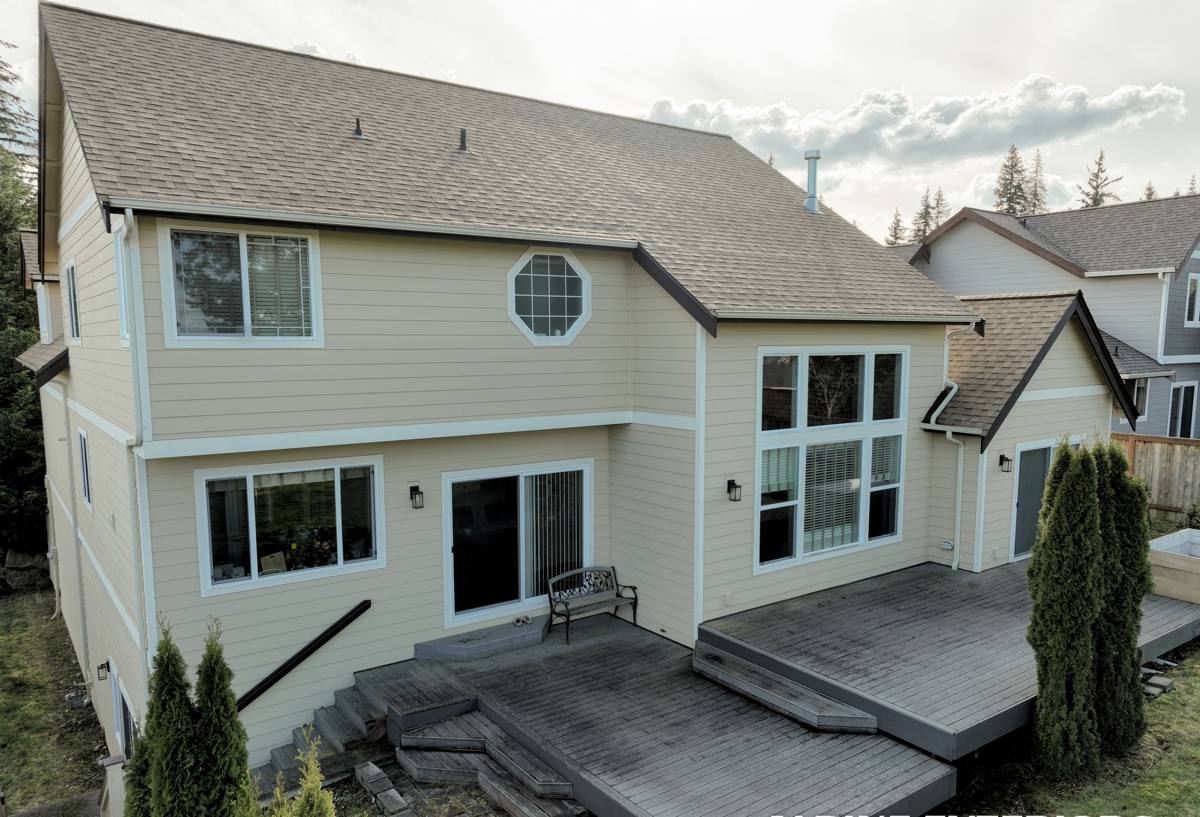
What Local Conditions Actually Do to a Deck
Moisture That Doesn't Dry Out Between Rains
In a lot of the country, decks get a good soak and then several dry, sunny days to shed that moisture. Here, the gap between rain events in the wetter months is often short, and overcast skies slow evaporation. Wood decking absorbs and releases moisture with every cycle, which is what eventually causes cupping, splitting, and fastener pull-through. Composite doesn't absorb water the way wood does, but the framing underneath it — almost always still wood — absorbs it just the same, and moisture trapped between decking and joists is one of the most common causes of premature deck failure in this region.
Moss and Algae Growth
Shaded decks, decks under trees, and decks on the north or east side of a house tend to grow moss and green algae film here for a good chunk of the year. On composite boards, this shows up as a slick surface and green tinting in the wood-grain texture, especially in low spots where water sits. It's a surface problem, not a structural one, but it needs airflow and drainage to manage, and boards installed too tight to the ground or without enough ventilation underneath will grow moss faster and hold it longer.
Salt-Influenced Air
Birch Bay's proximity to salt water means the air carries a low level of salt further inland than people expect, and it accelerates corrosion on unprotected metal — deck screws, joist hangers, post bases, and railing hardware. A composite deck with plain or poorly coated fasteners can develop rust staining and hardware failure well before the decking itself shows any wear.
What a Correct Composite Deck Installation Involves Here
The decking boards are the visible part, but most of what determines whether a deck lasts is built before a single composite board goes down.
- Ledger flashing and waterproofing where the deck attaches to the house, done correctly so water can't work its way behind siding or into the rim joist
- Pressure-treated or naturally durable framing lumber, since composite decking doesn't eliminate the need for solid wood underneath
- Joist tape or a flashing membrane on top of the joists to keep the framing dry longer, especially under composite boards that hold moisture against the joist top
- Corrosion-resistant fasteners and hardware rated for coastal or high-moisture exposure, not standard interior-grade hardware
- Adequate ventilation and clearance underneath the deck so air can move and moisture can escape rather than sit
- Correct joist spacing for the specific composite product, since composite boards often require tighter spacing than wood, particularly on angled or diagonal patterns
- Board gapping set for the season and manufacturer spec, accounting for how composite expands and contracts with temperature
Skip or shortcut any of these and the boards on top can be a premium product and still fail early — not because the composite was wrong, but because what's underneath it wasn't built for the conditions.
Composite vs. Other Decking Materials for This Climate
| Material | Moisture Resistance | Moss/Algae Handling | Maintenance | Typical Lifespan Here |
|---|---|---|---|---|
| Composite (capped) | High — doesn't absorb water into the board | Grows on surface but doesn't rot the board; needs periodic washing | Occasional cleaning, no staining or sealing | 25–30+ years |
| Composite (uncapped) | Moderate — some moisture absorption at edges/cuts | More prone to surface staining than capped boards | Low, but edges need attention | 20–25 years |
| Pressure-treated wood | Low — absorbs and releases moisture constantly | Grows moss readily, especially in shade | Annual cleaning, periodic staining/sealing | 10–15 years |
| Cedar | Moderate, but softens with age | Naturally moss-resistant early on, less so as it weathers | Regular sealing to maintain resistance | 12–18 years |
| PVC/vinyl decking | Very high — fully synthetic | Sheds moss well but can look plasticky and shows scratches | Low | 25–30+ years |
Composite sits in a practical middle ground for this area: it holds up to sustained moisture far better than wood without the fully synthetic look and feel of PVC. Within composite, capped boards — which have a protective outer shell wrapped around the core — resist moisture and staining meaningfully better than uncapped boards, which is worth the price difference for anyone building a deck exposed to shade or standing moisture.
Our Installation Process
- On-site assessment — we look at drainage, sun/shade exposure, existing structure (if replacing an old deck), and how the deck ties into the house
- Framing plan — joist layout and spacing set to the specific composite product and board pattern, not a generic spec
- Ledger and waterproofing detail — proper flashing where the deck meets the house, before anything else is installed
- Framing build-out — treated framing lumber, corrosion-resistant hardware, joist protection tape applied before decking goes down
- Decking installation — hidden fastener systems where the product supports it, correct board gapping, attention to cut-end sealing
- Railing and stair details — matched to the decking system and built to current code for height, baluster spacing, and load
- Final walkthrough — we go over basic care and what to watch for, particularly around drainage and any shaded sections prone to moss
Cost Factors for a Composite Deck Project
| Factor | Why It Matters Here |
|---|---|
| Capped vs. uncapped composite | Capped boards cost more per square foot but resist moisture and staining better in a wet climate |
| Deck height and substructure complexity | Taller decks or those over sloped, damp ground need more substantial footings and framing |
| Ledger and flashing work | Correct waterproofing at the house connection takes more labor but prevents the most common failure point |
| Fastener and hardware grade | Coastal-rated hardware costs more than standard hardware but resists corrosion from salt-influenced air |
| Ventilation/skirting design | Proper underdeck airflow may add framing detail but reduces moss and moisture problems long-term |
| Railing system | Composite or aluminum railing to match the deck adds cost versus basic wood rail |
| Removal of an old deck | Tear-off and disposal of a failing wood deck adds labor before the new build starts |
Composite decking projects in this area typically run higher up front than a comparable wood deck, largely due to material cost. The trade-off shows up over time in reduced staining, sealing, and repair work — a cost worth weighing against how many years you plan to stay in the home.
Maintaining a Composite Deck in a Wet, Mossy Climate
Composite decking is genuinely low-maintenance compared to wood, but "low-maintenance" isn't "no-maintenance," especially with the moss and algae pressure common here.
- Sweep off leaves, needles, and debris regularly, especially in fall — trapped organic matter holds moisture against the board and feeds moss growth
- Wash the deck at least once or twice a year with a soft-bristle brush and a cleaner made for composite surfaces; avoid pressure washers on high settings, which can damage the cap layer
- Pay extra attention to shaded areas and spots near the house or under railings where airflow is limited
- Keep gutters and downspouts near the deck clear so runoff isn't draining directly onto or under the decking
- Check railing hardware and fasteners periodically for rust staining, which shows up faster in salt-influenced air than most homeowners expect
- Confirm underdeck ventilation isn't blocked by stored items, plants, or added skirting that seals off airflow
Why a Crew That Works This Area Already Matters
Composite decking installation isn't complicated in the abstract — most of the manufacturers publish detailed installation guides. Where it goes wrong is in the judgment calls: how tight to gap boards for this specific microclimate, how much ventilation a particular yard's shade pattern actually needs, which hardware grade is worth the upcharge for a property this close to the water, and how to detail a ledger connection so it doesn't become the weak point five years down the road.
A crew that regularly works decks in Nooksack, Birch Bay, and the surrounding parts of Whatcom County has already seen which details matter here and which corners get punished by this climate specifically. That's different from following a manufacturer's national installation manual written for a much drier average climate.
Get a Straight Answer About Your Deck Project
If you're planning a new composite deck or replacing a wood deck that's showing its age, we're glad to take a look and give you a straightforward assessment — what your site needs, what a correct installation involves, and a realistic cost range. No pressure, no upsell script. Use the form below to request a free estimate.