 Birch Bay Exterior
 Why Point Roberts Roofs Wear Out Faster Than You'd Expect
Point Roberts sits out on its own point of land, exposed to Boundary Bay and the open water of the Strait of Georgia on three sides. That exposure means homes here take a steadier beating than roofs just a few miles inland. Salt-laden air corrodes exposed metal faster — nails, flashing, vent stacks, and drip edge all age quicker than the manufacturer's spec sheet assumes. Add driving rain that comes in sideways off the water during winter storms, and you get wind-driven moisture working its way under shingle tabs and around penetrations that would stay dry in a calmer setting.
Then there's moss. Whatcom County's wet, mild climate keeps roofs damp for long stretches of the year, and north-facing slopes shaded by conifers barely dry out between storms. Moss doesn't just look bad — its root structure lifts shingle edges, holds moisture against the roof deck, and accelerates granule loss. A roof that's fighting salt corrosion, wind-driven rain, and moss all at once needs to be installed with those three things in mind from day one, not patched later as problems show up.
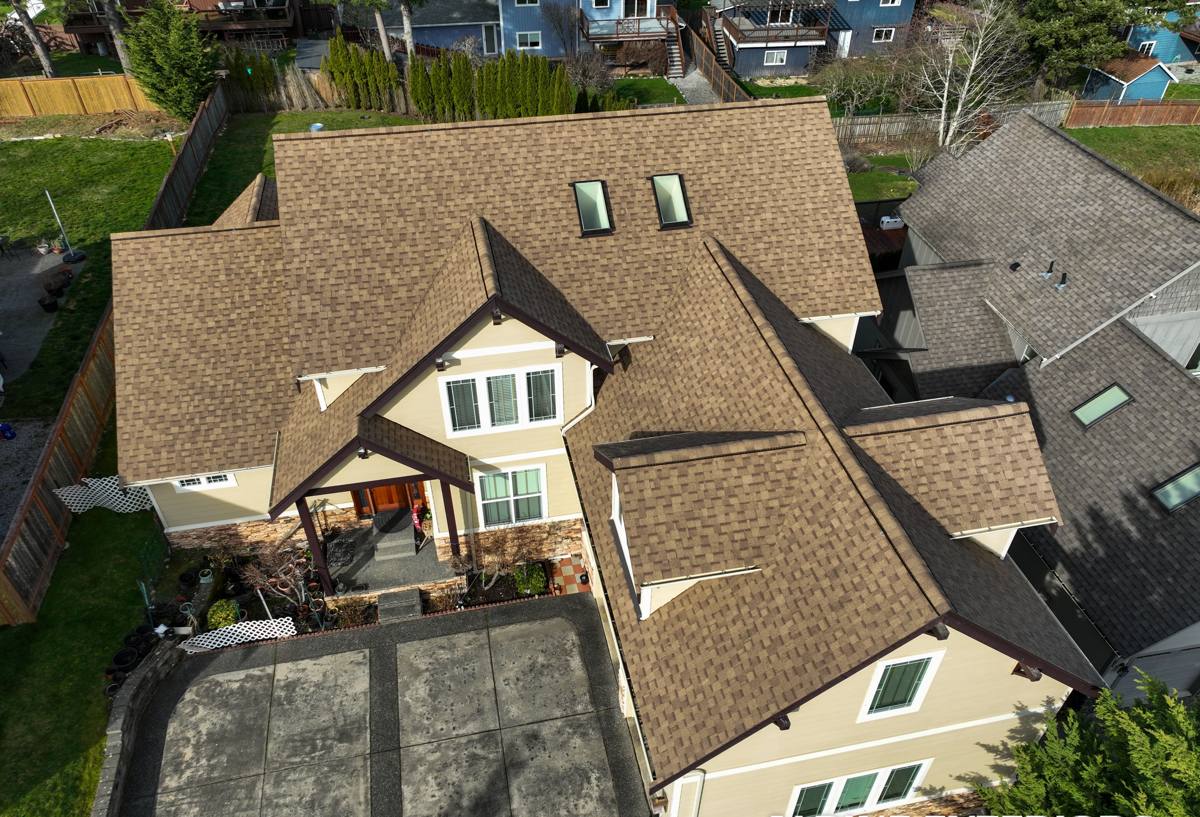
What a Correct New Roof Installation Actually Involves
A new roof is more than stripping old shingles and nailing down new ones. In a climate like this, the details underneath the surface layer are what determine whether the roof holds up for its full expected lifespan or starts leaking in year six.
Tear-Off and Deck Inspection
We remove the old roofing down to the deck rather than layering over it. That's the only way to actually see the plywood or OSB underneath — soft spots, delamination, and old water staining tell us where moisture has already been getting in, even if the ceiling below looks fine. Any damaged decking gets replaced before anything new goes down; installing new roofing over a compromised deck just hides the problem for a few more years.
Underlayment and Water Protection at Vulnerable Points
Synthetic underlayment goes down as the roof's real waterproofing layer — the shingles are the wear surface, but the underlayment is what keeps the deck dry if wind drives rain under a tab. Along eaves, valleys, and anywhere ice or standing water can back up, self-adhering membrane adds a second layer of protection in the spots that fail first.
Flashing Done Right
Most roof leaks trace back to flashing, not the field shingles. Chimneys, skylights, sidewalls, and vent penetrations all need properly formed and lapped flashing — not just a bead of sealant covering a gap. In a salt-air environment we pay close attention to flashing material choice, since not every metal ages the same way this close to the water.
Ventilation That Matches the Attic
Balanced intake and exhaust ventilation keeps the attic close to outdoor temperature and lets moisture escape instead of condensing on the underside of the deck. Get this wrong and you can void a shingle warranty and shorten the roof's life regardless of how well the rest of the job was done.
Choosing a Roofing Material for a Salt-Air, High-Moss Climate
There's no single "best" roofing material — the right choice depends on the home's roof pitch, tree cover, budget, and how much upkeep the owner wants to do. Here's how the common options compare for a Point Roberts property.
| Material | Salt-Air Durability | Moss Resistance | Typical Maintenance |
|---|---|---|---|
| Architectural asphalt shingle | Good, with corrosion-resistant fasteners and flashing | Moderate — benefits from periodic cleaning on shaded slopes | Low to moderate |
| Standing seam metal | Very good with the right coating and metal type | High — moss struggles to root on a smooth metal surface | Low |
| Synthetic/composite shingle | Good — doesn't corrode, resists salt staining | Moderate to high depending on surface texture | Low to moderate |
We don't push one product on every roof. What we won't do is install a system that looks right on paper but fights the site conditions — for example, a metal panel type prone to galvanic reaction near salt spray, or a low-grade shingle whose warranty structure doesn't hold up under sustained wind exposure. Those are trade-offs worth discussing before you commit, not after the roof is on.
The Point Roberts Access Factor
Point Roberts is separated from the rest of Whatcom County and the U.S. mainland by a stretch of Canadian territory — getting materials, crews, and equipment there and back means crossing an international border, every time. That's not a minor detail for a roofing project. A crew that hasn't planned for it can lose hours to border wait times, mistimed material deliveries, or scheduling that doesn't account for the extra logistics.
A contractor who already works this community routinely has that figured out: crossing documents in order, delivery timing coordinated so materials and dumpsters arrive when the crew does, and a realistic project timeline that isn't quietly padded because nobody accounted for the drive. This is one of the clearest reasons the "cheapest bid from an inland crew" isn't always the better deal — someone unfamiliar with the crossing can turn a three-day tear-off and install into a week of stop-and-start work.
Our New Roof Installation Process
- On-site inspection and estimate — we walk the roof, check the attic, and note pitch, penetrations, and any deck concerns before quoting anything.
- Material selection — we go over the honest trade-offs for the home's exposure and shade cover, not just a catalog of options.
- Permitting — we handle the Whatcom County permit paperwork for the project.
- Delivery and staging — materials and equipment are scheduled to arrive with the crew, accounting for the border crossing.
- Tear-off and deck repair — old roofing comes off, the deck gets inspected, and any damaged sections are replaced.
- Underlayment, flashing, and ventilation — the layers that actually keep water out go in correctly, not rushed.
- Final installation — shingles, panels, or composite material go down to manufacturer spec.
- Walkthrough and cleanup — we review the finished roof with the homeowner and clear the site of debris and fasteners.
Moss and Ventilation: Prevention Built Into the Job
A new roof is the best opportunity to get ahead of moss instead of fighting it every spring. Balanced attic ventilation reduces the moisture that feeds moss growth from underneath, while proper eave and valley protection keeps water from pooling where moss likes to start. For homes with heavy tree cover, we'll sometimes discuss zinc or copper strips near the ridge as an optional add-on — rain washing over them discourages regrowth on the slopes below. None of this replaces basic homeowner upkeep, like keeping gutters clear and trimming back branches that shade the roof, but starting clean and ventilated correctly means less moss pressure from year one.
Signs Your Point Roberts Home Needs a New Roof, Not Another Repair
Repairs make sense when the damage is isolated and the rest of the roof still has useful life left. Replacement is the honest call when the roof is failing broadly rather than in one spot. Watch for:
- Granule loss heavy enough to see bald patches or granules collecting in gutters
- Shingles that are curling, cracking, or lifting at the edges across multiple slopes
- Moss or algae covering large sections rather than a small shaded patch
- Rusted or deteriorating flashing around chimneys, vents, or skylights
- Daylight visible through the roof deck from inside the attic
- Water stains on ceilings or attic sheathing that recur after repairs
- A roof at or past the manufacturer's expected service life for its material
Permits, Codes, and Warranty Coverage
New roof installations in unincorporated Whatcom County, which includes Point Roberts, require a building permit, and the work needs to meet current Washington state building code for wind and weather exposure. We're licensed and bonded through Washington State L&I, which matters more than it sounds — it's what stands behind the work if something goes wrong. It's also worth understanding the difference between a manufacturer's material warranty and a contractor's workmanship warranty: the first covers defects in the shingle or panel itself, the second covers whether it was installed correctly. A roof can fail from bad installation even with a perfect product, so ask any contractor you're considering how each is handled.
Why Hire a Crew That Already Works Point Roberts
Beyond the border-crossing logistics, familiarity with this specific stretch of coastline means fewer surprises. We already know how salt exposure behaves on this shoreline, which slopes hold moss longest, and how wind-driven rain tends to find its way into a roof that wasn't detailed for it. That local track record shows up in fewer callbacks and a roof that's actually built for the site it's on, not a generic install dropped onto a coastal property.
If you're weighing a repair against a full replacement, or just want an honest read on where your current roof stands, we're glad to take a look. Reach out for a free, no-pressure estimate — the form below gets you started.