 Birch Bay Exterior
 Why Decks in Ferndale Wear Out Faster Than the Manual Says
Ferndale sits close enough to the water and far enough into Whatcom County's wet-season weather pattern that decks here take a beating most manufacturers never designed for. The combination of salt-laden air drifting in off the Strait, long stretches of driving rain from fall through spring, and a moss season that can run six months or more means a deck built to a generic national spec often starts failing years before it should. Fasteners corrode faster, ledger boards trap moisture against the house, and any low spot in the decking becomes a moss farm that holds water against the wood or composite surface long after the rain has stopped.
None of that means a deck can't last here — it means it has to be built for these conditions specifically, not just built to code minimums. That's the difference between a deck that needs replacing again in twelve years and one that holds up for decades with normal upkeep.
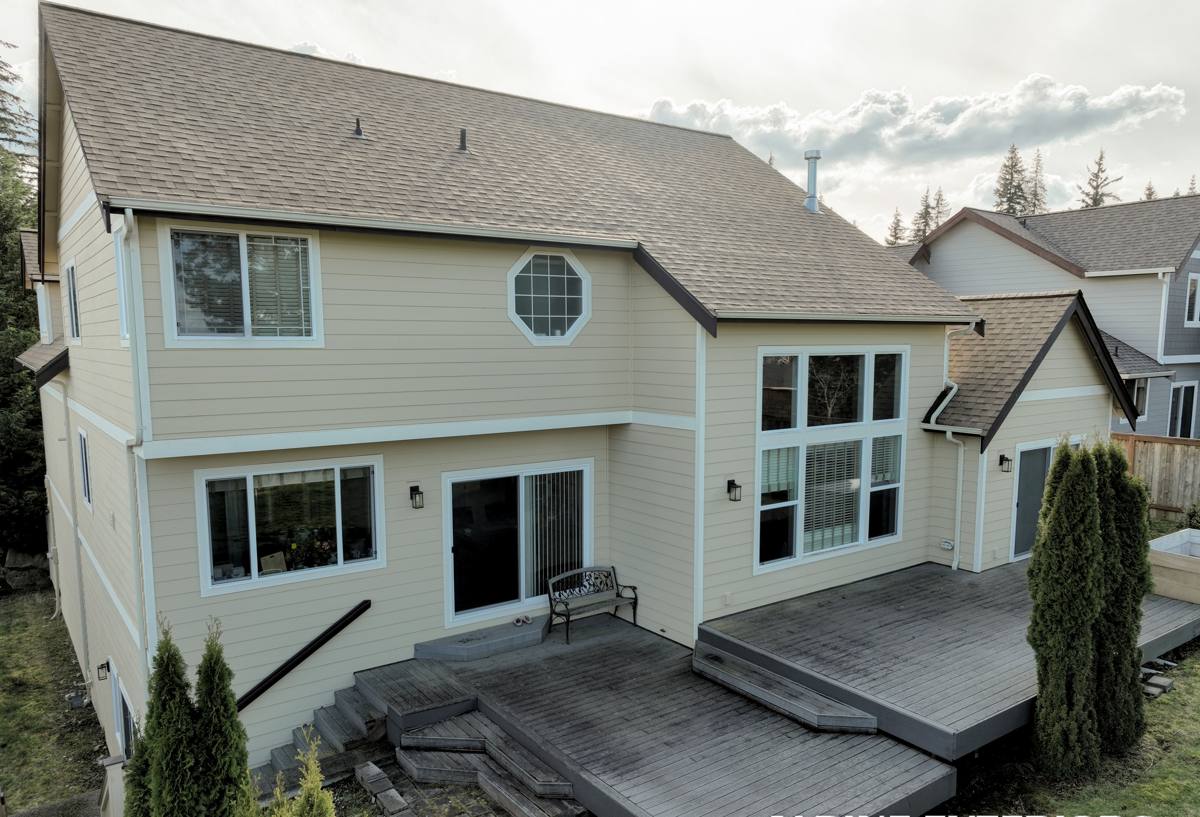
Signs a Ferndale Deck Needs Replacement, Not Just Repair
Homeowners often call us asking for a repair quote and end up needing a full replacement once we're actually underneath the deck looking at the framing. A few boards that need swapping is a repair. Structural compromise is a different job entirely. Here's how to tell which one you're dealing with:
- Soft or spongy decking in more than one area, especially near the house or at board ends — this usually means moisture has been getting into the wood fibers or the composite core for a while.
- Rust streaking or loose fasteners throughout the deck rather than in one isolated spot — a sign the hardware is failing broadly, not just in one weak point.
- A ledger board that's separating, soft, or shows staining where it meets the house — this is a structural connection point, and problems here are a safety issue, not a cosmetic one.
- Persistent moss or algae growth that comes back within weeks of cleaning, even after treatment — often a sign of poor drainage or spacing in the original build rather than something a cleaning will fix.
- Visible sagging between joists or at the rim — this points to framing that's lost structural capacity, not just a surface problem.
If what you're seeing matches more than one of these, a repair is likely to be a short-term patch. We'll always tell you honestly which category your deck falls into before we recommend a full tear-out.
What a Correct Deck Replacement Actually Involves
A deck replacement done right is not just pulling up old boards and screwing down new ones. In a climate like Ferndale's, the parts you don't see matter more than the surface material. A proper job includes:
Framing and structure
All framing gets inspected and any compromised joists, beams, or posts are replaced — not sistered over rot and hoped to hold. Post footings are checked for frost heave and drainage, since standing water at the base of a post is one of the most common causes of premature structural failure in this area.
Ledger and flashing
The ledger board connection to the house gets proper flashing that sheds water away from the wall assembly, not just caulk. This is one of the most commonly skipped steps on lower-bid decks, and it's also the single biggest cause of hidden water damage to the house itself, not just the deck.
Fasteners and hardware
Given the salt air this area gets, we use fasteners and structural hardware rated for coastal or high-corrosion exposure, not standard interior-grade hardware that starts rusting within a couple of seasons.
Drainage and airflow
Proper board spacing, joist tape where called for, and grading underneath the deck so water moves away instead of pooling. This is what actually slows down moss regrowth — more than any cleaning product will.
Choosing Materials for Whatcom County Conditions
There's no single "best" decking material — there's a best fit for your budget, your maintenance appetite, and how much sun versus shade the deck gets. Here's how the common options actually perform in this climate:
| Material | Moss/Moisture Behavior | Maintenance | Typical Lifespan Here |
|---|---|---|---|
| Pressure-treated wood | Prone to moss in shaded areas; needs sealing to resist moisture uptake | Annual cleaning, re-sealing every 2-3 years | 12-20 years with upkeep |
| Cedar | Naturally moisture-resistant but still needs treatment against moss and graying | Regular cleaning and periodic sealing or staining | 15-25 years with upkeep |
| Composite decking | Resists rot but can still grow surface moss/algae if shaded and damp | Periodic washing; no sealing or staining required | 25-30+ years, manufacturer-dependent |
| PVC decking | Most moisture-resistant option; least prone to moss adhesion | Occasional washing | 25-30+ years, manufacturer-dependent |
We install what fits your home and your budget — we're not tied to one brand. What we won't do is talk you into a low-grade composite just because it's cheaper up front; the maintenance burden and warranty gaps on bargain composite boards tend to cost more in the long run than a mid-grade product installed correctly the first time.
Our Process, Start to Finish
- On-site assessment. We look at the existing deck, the framing underneath, and the ledger connection before quoting anything — not just the visible surface.
- Honest scope and quote. You get a clear breakdown of what's structural, what's cosmetic, and what your material options actually cost — not just a single bottom-line number.
- Permitting. Deck replacements of most sizes require a permit through Whatcom County or the applicable local jurisdiction; we handle that paperwork so you don't have to chase it down.
- Tear-out and framing repair. Old decking and any compromised structural members come out; framing gets rebuilt to current code, not just patched.
- Decking, railing, and hardware installation. Installed with corrosion-resistant fasteners and proper spacing for drainage.
- Final walkthrough. We go over the finished deck with you, including what maintenance it needs and on what schedule.
What Affects the Cost of a Deck Replacement
| Factor | Why It Matters |
|---|---|
| Deck size and footprint | More square footage means more material and labor, straightforwardly |
| Framing condition | Hidden rot or undersized framing found during tear-out adds cost most homeowners don't budget for upfront |
| Material selection | Pressure-treated, cedar, composite, and PVC span a wide cost range per square foot |
| Height and stairs | Multi-level decks or decks requiring stairs and extra railing add labor and material |
| Site access | Decks with difficult access for equipment or material delivery can add labor time |
We'd rather walk you through these factors during the estimate than give you a number over the phone that doesn't hold up once we see the framing. That's part of why the estimate is free and no-pressure — it's an honest look, not a sales pitch.
Permits and Local Considerations
Most deck replacements of meaningful size in this area require a building permit, and inspections typically check the framing, the ledger attachment, and railing height and spacing before the decking goes down. Skipping this step can create real problems later — at resale, or with your homeowner's insurance if there's ever a structural claim. We manage the permit process as part of the job rather than leaving it for the homeowner to figure out.
Why It Matters to Hire a Crew That Already Works This Area
A deck built for a drier climate, or built by a crew that doesn't regularly deal with this region's moss and moisture patterns, tends to make the same avoidable mistakes: not enough board spacing, ledger flashing done as an afterthought, or fasteners that aren't rated for the salt air coming off the water. A crew that works Ferndale and the surrounding Whatcom County area regularly has already seen how decks here actually fail over time, not just how they're built on paper. That experience shows up in the details — the ones that don't matter in year one but matter a great deal by year eight or ten.
Deck Maintenance Checklist for This Climate
- Clean moss and algae off the surface at least once a year, ideally before the wet season sets in
- Check and re-tighten hardware annually, especially at stair stringers and railing posts
- Inspect the ledger board connection yearly for staining or softness
- Keep gutters and downspouts near the deck clear so runoff isn't draining directly onto it
- Re-seal or re-stain wood decking on the schedule appropriate to the product — don't wait until it's visibly graying
- Trim back vegetation that's shading the deck and keeping it damp longer than it needs to be
If your Ferndale deck is showing its age, or you're just not sure whether it needs a repair or a full replacement, we're happy to take a look and give you an honest answer along with a free, no-pressure estimate using the form below.