 Birch Bay Exterior
 Composite Decking in Ferndale: Built for the Weather We Actually Get
Ferndale sits close enough to the water that salt air is a daily fact of life, and far enough into Whatcom County's rain pattern that decks here spend a good chunk of the year wet, shaded, or both. That combination is hard on wood. It's easier on composite decking, but only if the board, the substructure, and the installation are all matched to local conditions. A composite deck installed the same way you'd install one in a dry inland climate will underperform here — trapped moisture, algae growth, and fastener issues show up faster in Whatcom County than they do further east.
We install composite decking for homeowners around Ferndale who want a deck that doesn't need yearly sanding, staining, or moss scraping. Composite isn't maintenance-free — no exterior product is — but it removes the wood-specific problems that drive most re-deck calls we get in this area: cupping boards, soft spots near the house, and moss that comes back every winter no matter how many times it's power-washed off.
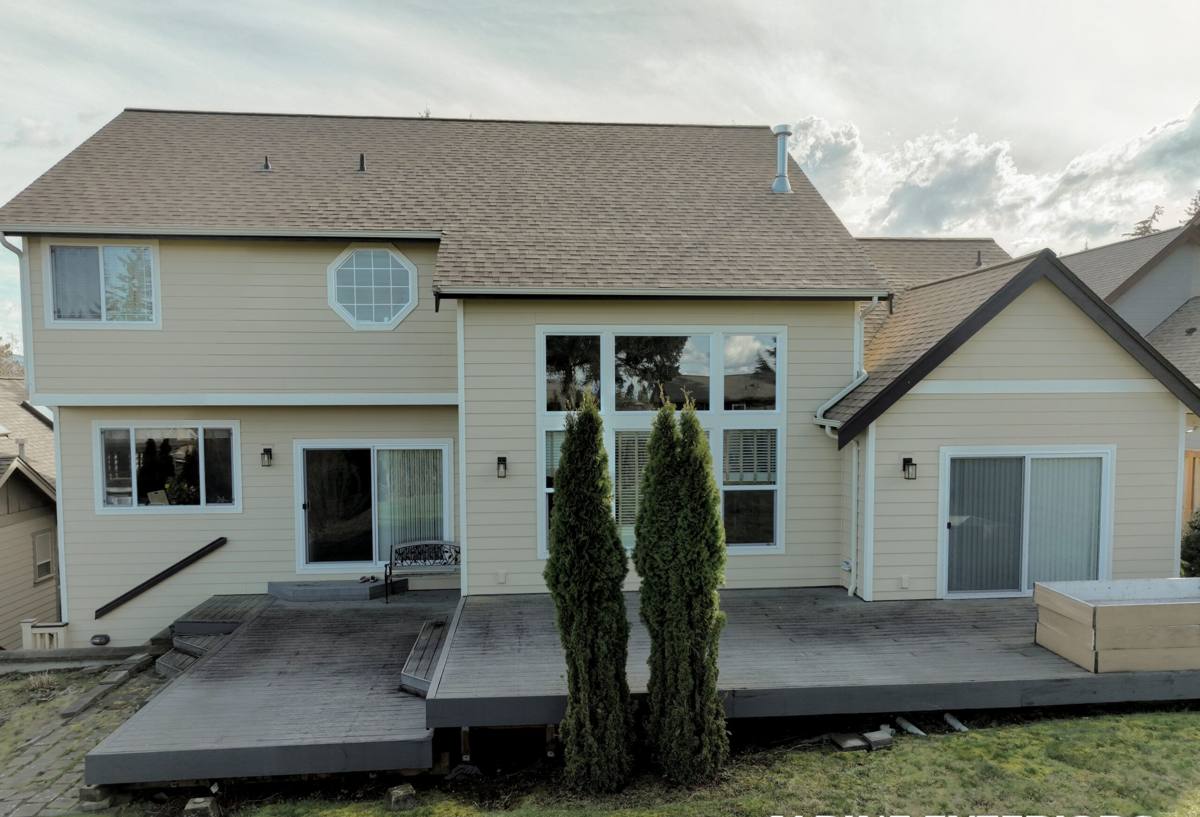
What Ferndale's Climate Does to a Deck
A few things about this specific stretch of coastline and county matter more than people expect when planning a deck:
- Salt air accelerates corrosion on any exposed metal — screws, joist hangers, post bases — long before it does visible damage to the decking surface itself.
- Driving rain off Georgia Strait and Bellingham Bay doesn't fall straight down; it gets pushed sideways under railings, against ledger boards, and into gaps that a calmer climate wouldn't expose.
- Moss season runs long here — realistically fall through spring — and any deck surface with texture, shade, and consistent moisture will grow something green if it isn't detailed to shed water and dry out between rains.
- Limited direct sun on north- and east-facing decks (common on Ferndale lots with tree cover or close-set homes) means surfaces stay damp longer after a storm than they would on an open, south-facing deck.
None of this makes composite decking a bad fit for Ferndale — it's actually one of the better options for exactly these conditions. But it does mean the installation details matter more here than in a drier climate, and it's worth understanding what "correct" looks like before you hire someone.
Why Composite Handles This Better Than Wood — And Where It Still Needs Attention
Composite decking resists the two big wood failures we see most often in this area: rot from sustained moisture, and moss/algae staining from shaded, damp surfaces. The boards don't absorb water the way wood does, so they're not cupping, splintering, or softening after a wet winter. That's the real advantage for a Ferndale property.
What composite still needs, though:
- Adequate airflow underneath the deck so moisture doesn't sit trapped against the substructure.
- Correct board spacing so water drains through rather than pooling on the surface.
- Occasional cleaning — composite can still grow surface algae if it's shaded and never gets scrubbed or rinsed, though it comes off far easier than it does on wood.
- Metal hardware rated for coastal exposure, since salt air corrodes standard fasteners faster than it degrades the decking itself.
In other words, composite trades "wood rot and moss-stained boards" for "a lower-maintenance surface that still needs a sound structure underneath it." That structure is where most of the real work — and most of the corner-cutting we see on other people's jobs — actually happens.
What a Correct Composite Deck Install Involves in This Area
The Substructure Comes First
The decking boards get the attention, but the framing underneath determines whether the deck lasts. In a climate with this much rain, we pay particular attention to:
- Ledger board flashing where the deck attaches to the house — this is the single most common point of hidden water intrusion on any deck in Whatcom County, composite or wood.
- Joist tape or a comparable moisture barrier on top of the framing, so the composite boards aren't sitting on bare, exposed wood that can still rot even though the decking itself won't.
- Post bases set above grade and away from standing water, since ground-level moisture combined with salt air is a fast track to corroded hardware.
- Proper joist spacing for the specific composite product being used — composite boards have their own span ratings, and they're not always the same as lumber.
Fasteners and Hardware
Given the salt air, we use coastal-rated or stainless fastening systems rather than standard-grade hardware. It costs a bit more up front and it's the difference between hardware that's still sound in ten years and hardware that starts staining or weakening in three or four.
Drainage and Airflow
Board gapping, ventilation at the deck's perimeter, and grading underneath the deck all affect how quickly the structure dries out after a storm. A deck that can't breathe holds moisture against the framing regardless of what the surface boards are made of.
Choosing the Right Composite Product for a Ferndale Home
Composite decking varies more than people expect — capped vs. uncapped, PVC blends, different core materials — and the right choice depends partly on budget and partly on how exposed the deck is to weather. We walk homeowners through the real trade-offs rather than pushing whichever product has the best margin.
| Factor | What It Means Locally |
|---|---|
| Capped composite | A protective outer shell resists moisture and staining better in our wet, mossy climate — generally the better choice for shaded or north-facing decks. |
| Uncapped composite | Lower upfront cost, but more prone to surface moisture absorption and staining over time in a climate this wet — worth considering mainly for covered or well-sunned decks. |
| Board color | Darker boards show less dirt/moss residue between cleanings but run hotter in direct summer sun; lighter boards show algae staining more readily in shaded spots. |
| Grooved vs. solid edge | Grooved (hidden fastener) boards give a cleaner look but can trap moisture at the groove if not installed with correct spacing; solid-edge boards drain more forgivingly. |
| Warranty structure | Varies by manufacturer — some cover fading and staining, others cover structural integrity only. Worth reading before deciding based on price alone. |
There's no single "best" composite product for every Ferndale home — it depends on how much sun and shade the deck gets, whether it's covered, and what the homeowner's maintenance expectations are. We'll give you an honest read on which option fits your specific site rather than a one-size answer.
Our Process for a Ferndale Composite Deck
- On-site assessment. We look at sun exposure, drainage, existing structure (if replacing an old deck), and how close the property is to salt air exposure — a deck two blocks from the water gets different hardware recommendations than one further inland.
- Honest product walkthrough. We explain the real differences between composite options for your situation instead of steering toward one brand regardless of fit.
- Structural build or repair. Framing, flashing, and hardware get addressed to code and to the moisture realities of this climate before a single composite board goes down.
- Composite installation. Boards are gapped, fastened, and finished per manufacturer spec — this matters for warranty coverage as much as it does for performance.
- Final walkthrough. We go over what maintenance (minimal, but not zero) looks like so there are no surprises the first wet winter.
Why a Crew That Already Works Ferndale Matters
Local experience isn't a slogan here — it changes real decisions on the job. A crew that regularly works Ferndale and the surrounding Whatcom County coastline already knows which fastener grades hold up against this specific salt air exposure, how far sideways rain travels under a railing in a Puget Sound storm, and which framing details actually prevent the moss and moisture problems that show up two or three winters after a rushed install. That's the difference between a deck that needs attention in year three and one that's still solid at year fifteen.
We also know that Ferndale properties vary a lot lot in exposure — some lots are open and get full weather, others are tucked behind trees and neighboring homes and deal more with shade and slow-drying moisture. We adjust the build accordingly rather than treating every deck the same.
Before You Hire: A Quick Checklist
- Ask what fastener/hardware grade will be used — coastal-rated hardware should be standard this close to the water, not an upcharge.
- Ask how ledger board flashing will be handled — this is the most common failure point on decks attached to a house in this climate.
- Ask whether the composite product is capped or uncapped, and why that recommendation fits your deck's sun/shade exposure.
- Ask about board spacing and drainage planning, not just "what color do you want."
- Get the warranty terms in writing — know what's covered (fading, staining, structural) and for how long.
- Ask whether they've worked in Ferndale or similar coastal Whatcom County conditions before, and what they do differently because of it.
What Ongoing Care Looks Like
Composite decking cuts maintenance dramatically compared to wood, but "low maintenance" isn't "no maintenance" in a climate with this much rain and shade. A seasonal rinse, occasional soap-and-water scrub on shaded sections prone to algae, and keeping debris out of the gaps between boards go a long way. We'll walk you through the specific care routine for whatever product you choose so it performs the way it's supposed to for the life of the warranty.
If you're planning a new deck or replacing an aging one in Ferndale, we're glad to take a look and give you a straight answer on what your site needs — no pressure, no upsell. Reach out for a free estimate using the form below.