 Birch Bay Exterior
 Board & Batten Siding in Sandy Point
Sandy Point sits close enough to the water that the weather off the Strait shapes almost every exterior decision a homeowner makes, siding included. Board and batten has become a popular choice out here for a good reason: the vertical lines read as clean, coastal, and a little more custom than standard lap siding, and the wide flat boards with narrow battens covering the seams give a house real depth and shadow line. But the look is only half the story. In a neighborhood this close to salt water, the material underneath the paint has to do the actual work — shedding wind-driven rain, resisting the swelling and cupping that comes with constant damp-dry cycling, and standing up to salt air without the joints failing first. We install board and batten using James Hardie fiber cement exclusively, and this page walks through what that means specifically for a Sandy Point home.
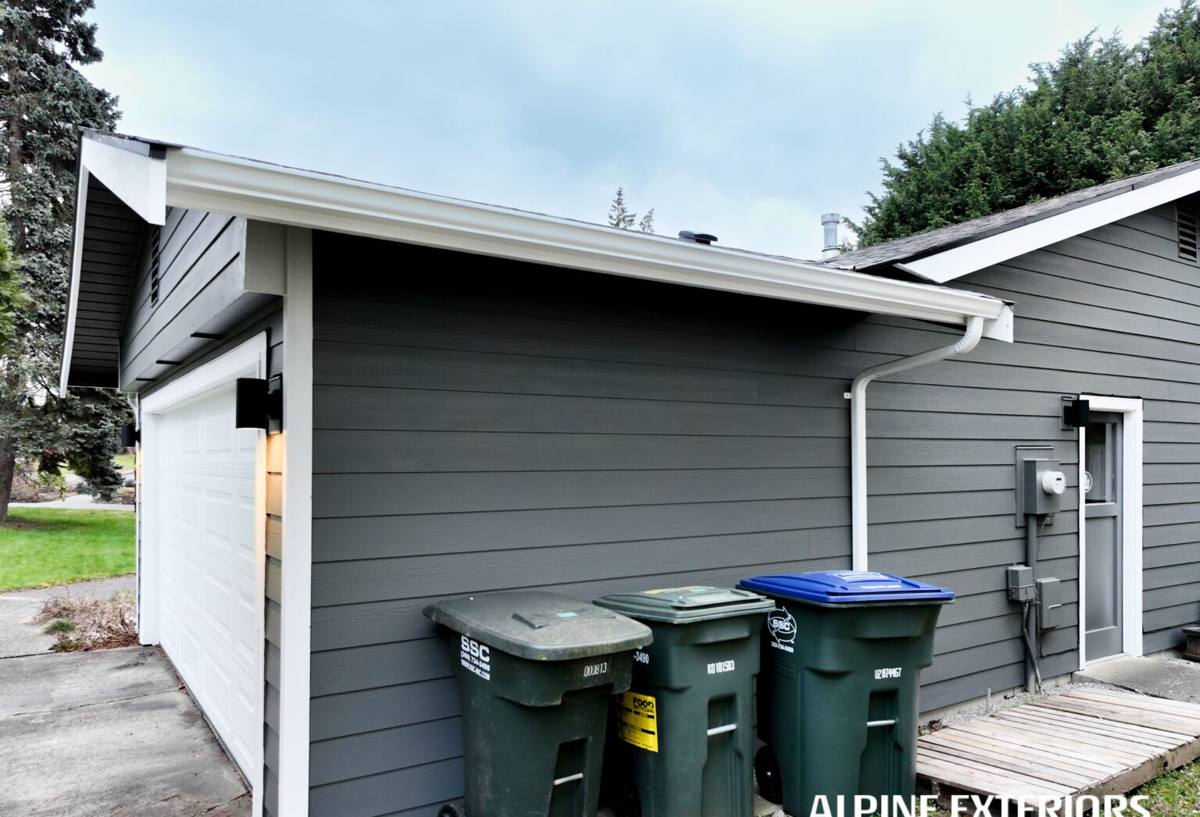
Why Sandy Point's Climate Is Tougher on Siding Than Most of Whatcom County
Every coastal property in Whatcom County deals with rain and moisture, but Sandy Point's exposure adds a few extra variables that inland Birch Bay lots don't face as directly.
Salt Air and Wind Exposure
Homes closer to the water take on airborne salt that settles on siding, trim, and fasteners. Salt is corrosive to unprotected metal fastener heads and hard on paint films over time, which is part of why fastener choice and finish quality matter more here than they would twenty miles inland. Wind off the water also drives rain sideways into wall assemblies far more aggressively than a calm rainstorm would, which puts real pressure on every seam, joint, and batten reveal in a board and batten system.
A Long, Wet Moss Season
Whatcom County's moss season runs long — shaded north and west-facing walls, tree-lined lots, and anything close to grade stay damp for weeks at a stretch through fall, winter, and much of spring. Moss and algae don't just look bad; sustained dampness against a wall is exactly the condition that punishes any siding material with poor moisture tolerance, and it's a major reason board and batten in particular needs to be installed with real drainage behind it, not just caulked and painted over.
Driving Rain and Cupping
Board and batten's wide, flat boards are more exposed to sun and wind than narrower lap boards, which means more surface area moving through daily and seasonal moisture cycles. On a wood-based product, that movement is what causes boards to cup, bow, or pull the battens loose over a few seasons. On correctly installed fiber cement, that movement is engineered out of the equation.
What Correct Board & Batten Installation Actually Requires
Board and batten looks simple from the street — vertical boards, thin strips over the seams — but it's one of the less forgiving siding profiles to install correctly, especially in a wet, salt-exposed setting like Sandy Point.
- Rainscreen or drainage gap behind the panels — a small air gap lets bulk water that gets past the surface drain and dry out instead of sitting against the wall sheathing.
- Correct fastener pattern and depth — battens need to land on structural framing with the right embedment, not just tacked through the field board into sheathing.
- Proper flashing at every horizontal transition — window heads, roof-to-wall intersections, and belly bands are where wind-driven rain finds its way in if flashing is skipped or undersized.
- Factory-primed or factory-finished boards, caulked and painted per manufacturer spec — field-cut edges need to be sealed, not left raw, especially on a material that will sit in salt air.
- Batten spacing and reveal consistent with the manufacturer's engineering, not just eyeballed for looks.
Skip any one of these steps and the failure shows up exactly where you'd expect on a house near the water — moss and staining at the base of the wall, paint failing early around window heads, or battens starting to separate from the field boards within a few years instead of holding for decades.
Why We Only Install James Hardie for This Application
Board and batten is available in wood, engineered wood, vinyl, and fiber cement, and we get asked fairly often why we've standardized on one manufacturer. The short answer is that board and batten's wide, exposed boards make material choice matter more than it does on most other siding profiles, and in a coastal, high-moisture environment like Sandy Point, the trade-offs of the alternatives are the ones we're not willing to put our name behind.
What James Hardie Gets Right Here
- Fiber cement doesn't absorb and swell like wood-based products, which directly addresses the cupping and joint separation problem that shows up on exposed board and batten walls.
- Non-combustible material — not the deciding factor for every homeowner, but a real advantage with no downside.
- ColorPlus factory finish is baked on and warranted separately from the substrate, which matters on wide flat boards where a field-applied paint job would otherwise show every flaw.
- HZ5 and climate-engineered product lines are built for the wetter, more marine-influenced conditions the Pacific Northwest coast produces, which is a closer match to Sandy Point's exposure than a general-purpose product.
- A strong, transferable limited warranty that follows the house if it sells — worth asking about directly if you're planning to stay in Sandy Point long-term or not.
We don't install LP SmartSide, vinyl, Cemplank, Allura, primed spruce, or cedar board and batten. Each of those has legitimate uses elsewhere, but none of them, in our professional judgment, hold up to this specific combination of salt air, driving rain, and a long moss season as reliably as correctly installed Hardie fiber cement — and we'd rather turn down work than install something we don't trust to perform on a house exposed the way Sandy Point homes are.
Comparing Board & Batten Material Options for a Coastal Lot
| Material | Moisture Behavior | Maintenance Burden | Typical Longevity Here |
|---|---|---|---|
| Cedar / primed spruce | Absorbs moisture, prone to cupping and swelling on wide boards | Regular repainting, caulk maintenance, moss treatment | Shorter — repainting and board replacement cycles common |
| Vinyl board and batten | Doesn't rot, but battens can warp/gap in wind and temperature swings | Low, but limited repair options once damaged | Moderate, appearance often degrades first |
| Engineered wood (LP-type) | Better than raw wood, still wood-based and moisture-sensitive at cut edges | Edge sealing and caulk maintenance required | Moderate, dependent on installation quality |
| James Hardie fiber cement | Dimensionally stable, engineered for wet climates (HZ5) | Low — factory finish holds up, occasional wash-down | Long, backed by transferable warranty |
This table reflects general material characteristics, not a guarantee for any individual home — actual performance always depends on installation quality, wall orientation, and how exposed a given elevation is to wind and rain.
What Cost Factors Look Like for a Sandy Point Board & Batten Project
We don't quote pricing sight-unseen, but a few things consistently move the number for board and batten specifically in this area:
- Wall exposure and elevation count — water-facing walls often need more attention to flashing and drainage detail, which affects labor time.
- Existing siding removal and sheathing condition — if there's hidden moisture damage from a prior siding failure, that gets addressed before new siding goes on, not covered over.
- Trim and batten complexity — homes with more window and door openings need more flashing and cut work per square foot than a simple rectangular wall.
- Color and finish selection — factory ColorPlus finishes versus field-painted options carry different costs and different long-term maintenance.
- Access — waterfront and bluff-adjacent lots sometimes need different scaffolding or staging than a standard in-town lot.
The only way to get real numbers is a walk-around of the specific house, which is what our estimate covers.
Our Process for a Sandy Point Project
- On-site assessment — we look at wall exposure, existing siding condition, and any moisture or ventilation issues before quoting anything.
- Detailed proposal — product line, color, drainage plan, and flashing details spelled out, not left vague.
- Removal and inspection — old siding comes off and we check sheathing before covering it back up.
- Drainage and flashing installed first — the part of the job that never shows once siding goes on, and the part that determines whether the house stays dry.
- Board and batten installation to manufacturer spec — correct fastening, reveal, and sealing throughout.
- Final walkthrough — we go over the finished work with the homeowner before calling the job done.
Why Local Experience in Sandy Point Matters
A crew that's worked this specific stretch of coastline knows which elevations take the worst of the wind-driven rain, where moss builds up fastest, and how salt exposure changes fastener and flashing choices compared to a job ten miles inland. That's not something you can fully substitute with general siding experience — a contractor unfamiliar with Whatcom County's coastal conditions is more likely to under-detail the drainage plane or skip flashing steps that don't matter in a drier climate but matter a great deal here. We'd rather a Sandy Point homeowner ask a contractor directly about their coastal experience and drainage approach than assume every siding crew handles this exposure the same way.
If you're weighing board and batten for a Sandy Point home, we're glad to walk the property, look at what your walls are dealing with, and put together a straightforward, no-pressure estimate. There's a short form below to get that started.