 Birch Bay Exterior
 Fiber Cement Siding Built for Blaine's Coastal Exposure
Blaine sits at the far northwest corner of Whatcom County, right where the Strait of Georgia and Semiahmoo Bay meet a long, wet Pacific Northwest winter. Homes here take a different kind of beating than houses even ten miles inland in Birch Bay or Ferndale. Salt-laden air off the water accelerates corrosion on fasteners and trim, wind-driven rain finds every gap in a wall assembly, and the shaded, damp conditions common on tree-lined lots keep siding wet longer than it should ever stay wet. Add a moss season that can run from October through May, and you have a climate that is genuinely hard on exterior materials.
We are a Birch Bay-based crew that works Blaine regularly, and fiber cement siding is the one product we install. Not because it is trendy, but because it is the one exterior cladding that holds up to this specific combination of salt, rain, and moss without the maintenance spiral that other materials fall into out here.
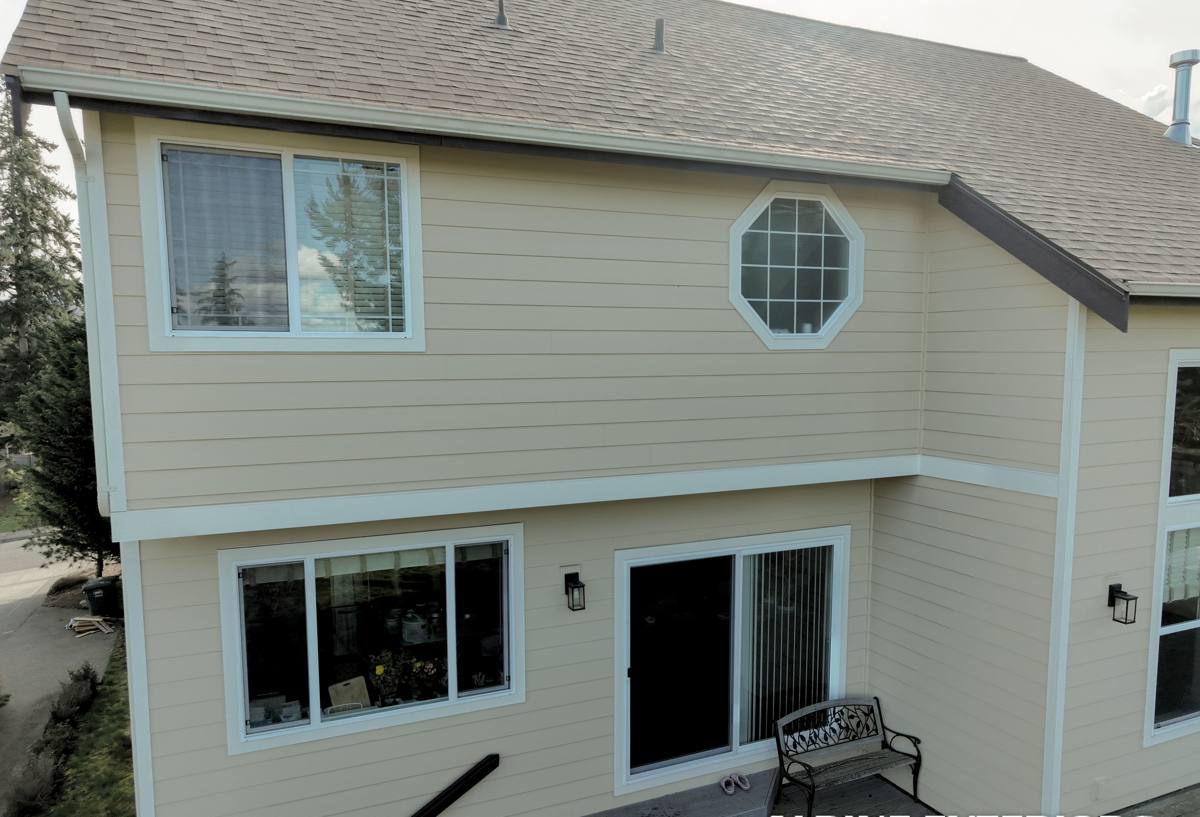
What Blaine's Climate Actually Does to Siding
It helps to be specific about the failure modes we see, rather than talking about "harsh weather" in the abstract.
Salt Air and Corrosion
Homes within a mile or two of the water pick up airborne salt that settles on every exterior surface. Over years, that salt attacks unprotected metal fasteners, flashing, and trim, and it accelerates the breakdown of lower-grade paints and coatings. Any siding product installed here needs corrosion-resistant fastening and a factory finish that isn't relying on a homeowner to repaint every few years to keep ahead of it.
Wind-Driven Rain
Blaine's exposure to open water means rain doesn't just fall straight down — it drives sideways into wall assemblies, especially on gable ends and anywhere siding meets a window, door, or roofline. A siding system with weak water management at the seams and penetrations will let moisture behind the cladding, and once that happens the sheathing and framing pay the price, not just the siding itself.
Moss and Prolonged Dampness
Long, cool, wet stretches with limited direct sun — common on shaded and north-facing walls throughout Blaine — let moss and algae take hold on any surface that stays damp. Moss doesn't just look bad; it holds moisture against the siding surface and, on products that absorb water or swell, it accelerates degradation underneath the growth.
Why We Install James Hardie Fiber Cement — Not Alternatives
We get asked why we don't offer vinyl, LP SmartSide, or cedar. It's a fair question, and the honest answer is that we've standardized on one product because it performs consistently under Blaine's specific conditions, and we'd rather be excellent at installing one correct system than mediocre across several.
| Material | How it handles salt air & moisture | Trade-off in this climate |
|---|---|---|
| Vinyl siding | Doesn't corrode, but panels can warp and gap over time, opening paths for wind-driven rain | Seams and J-channels are weak points; limited color depth, can look flat |
| Engineered wood (LP SmartSide) | Wood-based core is vulnerable if moisture gets past the coating at cut edges or fastener points | Requires diligent edge-sealing and caulking maintenance to avoid swelling |
| Cedar / primed spruce | Natural material absorbs moisture readily; moss and mildew take hold quickly in shaded, damp spots | Needs regular refinishing and moss treatment or it degrades fast |
| James Hardie fiber cement | Non-combustible, dimensionally stable cement-based material that doesn't swell, rot, or feed moss the way organic materials do | Heavier product, requires correct fastening and joint detailing to perform as designed |
Fiber cement is not immune to Blaine's weather — nothing is. But its cement composition means it doesn't swell with moisture the way wood-based products do, it won't rust, and James Hardie's ColorPlus factory finish is baked on and warranted against fading and peeling, which matters a lot for a home a short walk from salt water.
What Correct Installation Involves in a Coastal Setting Like Blaine
Fiber cement siding is only as good as its installation. A rushed or generic install undermines everything the product is designed to do, especially with wind-driven rain in the mix. Correct installation on a Blaine home includes:
- A water-resistive barrier installed and lapped correctly behind the siding, so any moisture that does get past the cladding has a path to drain out, not soak in
- Rainscreen or proper drainage gap where wall conditions call for it, keeping the back of the siding ventilated instead of sitting wet against sheathing
- Stainless or coated corrosion-resistant fasteners throughout, not standard fasteners that will rust in salt air over time
- Correct flashing at every window, door, and roof-to-wall intersection, since these are the spots wind-driven rain exploits first
- Manufacturer-specified fastener spacing and clearances, including the gap kept between siding and roofline, deck, or grade to prevent wicking moisture
- Factory-cut and factory-sealed edges used wherever possible, minimizing field cuts that expose raw material to moisture
Every one of these details is called out in James Hardie's installation instructions, and every one of them is also a place where a crew unfamiliar with coastal exposure can cut a corner that won't show up as a problem for a year or two — by which point it's a repair, not a maintenance item.
Why a Crew That Already Works Blaine Matters
Siding crews that mostly work drier, inland areas don't always think about rainscreen detailing, fastener corrosion, or moss-prone shaded walls as a default — because they don't have to, most of the time. Working Birch Bay and Blaine regularly means we plan for wind-driven rain at every gable end and every window as a matter of course, not an afterthought.
It also means we've seen how homes in this specific area age — where moss tends to establish first, which wall orientations take the worst weather, and which older siding jobs in the area failed because water management was skipped rather than because the material itself was wrong. That local pattern recognition is hard to replicate if you're not out here regularly.
James Hardie Product Lines for This Climate
James Hardie makes climate-engineered product lines, and for a location like Blaine, the HZ5 product line — engineered for wetter, harsher climates — is generally the right fit. Beyond the core panel or plank product, a few choices matter for a coastal home:
- Lap siding — the standard horizontal siding profile, available in several widths and exposure options
- Shingle-style siding — for homes wanting a more textured, traditional Pacific Northwest look
- Trim boards — matched fiber cement trim resists the same moisture and salt exposure as the field siding, avoiding a mismatch where wood trim fails faster than the siding around it
- ColorPlus factory finish — a baked-on finish with a manufacturer warranty against fading and peeling, which reduces the repainting burden that salt air and UV exposure would otherwise create
Choosing factory-finished ColorPlus over field painting is particularly worth it in Blaine — field-applied paint has to work harder against salt air and moisture cycling, and a factory finish starts ahead on both.
What a Blaine Siding Job Actually Costs to Plan For
Pricing depends on the home's size, existing wall condition, and how much water management upgrading is needed, but a few honest cost drivers are worth knowing going in:
| Cost factor | Why it matters here |
|---|---|
| Existing sheathing condition | If wind-driven rain has already gotten behind old siding, sheathing repair may be needed before new siding goes on |
| Rainscreen / drainage gap addition | Adds labor and material but is often the right call for exposed or shaded walls in this climate |
| Trim and detail complexity | Homes with more windows, dormers, and rooflines have more flashing and joint work |
| ColorPlus finish vs. field painting | Factory finish costs more upfront but removes a recurring maintenance cost |
Our Process for a Blaine Fiber Cement Project
We start with an on-site look at the home's exposure — which walls face the water and prevailing wind, where moss is already established, and what condition the existing siding and sheathing are in. From there we walk through product line, profile, and color, plan out water management detailing specific to that home's exposure, and give a clear written scope before any work begins. During installation, we follow James Hardie's fastening and clearance specs exactly, because those specs exist for climates like this one.
If you're in Blaine and dealing with aging, moss-covered, or failing siding — or planning ahead for a home that's about to face its first Whatcom County winter with new cladding — we're happy to take a look and give you a straight, no-pressure estimate on what correct James Hardie fiber cement siding would involve for your specific home.