 Birch Bay Exterior
 Why Birch Bay Village Roofs Take a Different Kind of Beating
Birch Bay Village sits close enough to the water that roofs here deal with a combination of stresses most inland Whatcom County homes never see. Winter storms roll in off the Strait of Georgia with sustained wind and driving, near-horizontal rain that finds every weak seam, lifted shingle tab, and undersized flashing detail. Add in the salt air that drifts across the bay and settles on every exposed surface, and you've got a slow, steady corrosion problem working alongside the sudden damage a windstorm causes in a single afternoon.
Then there's moss. Whatcom County's long wet season, combined with the tree cover around many Birch Bay Village lots, gives moss months at a time to establish itself on north-facing slopes and shaded valleys. Moss holds moisture against the roofing material, works its way under shingle edges, and by the time it's visible from the ground it's often already lifted material and let water underneath. Storm damage rarely shows up on a roof that's otherwise in good shape — it shows up on a roof that's already been softened up by salt corrosion and moss intrusion, and that's exactly the combination we see over and over in this neighborhood.
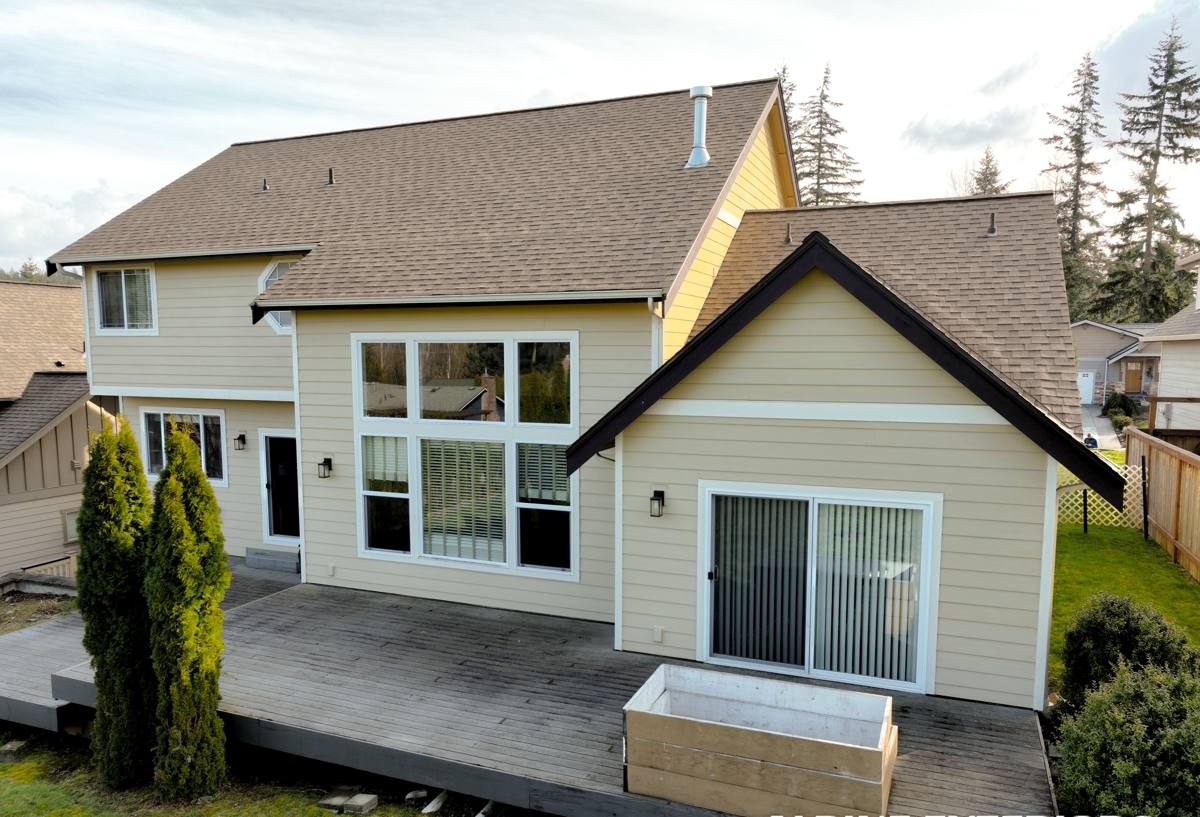
What "Storm Damage" Actually Looks Like Here
Homeowners often picture storm damage as a dramatic event — a tree limb through the roof, shingles scattered across the yard. Sometimes that's exactly what happens. But a lot of the storm damage we find in Birch Bay Village is quieter and easier to miss:
- Wind-lifted shingle tabs that reseal crooked or not at all, leaving a gap for the next rain to exploit
- Flashing around chimneys, vents, and skylights knocked loose or bent by wind-driven debris
- Fasteners backed out or sheared by repeated wind flex, especially near roof edges and ridges
- Granule loss from hail or wind-blown grit, which thins the shingle's UV and weather protection without an obvious visible hole
- Gutter and downspout damage that redirects water back under the roof edge instead of away from the house
- Soffit and fascia damage that lets wind-driven rain into the attic space from the side, not just through the roof deck
None of these need to look dramatic to cause real problems. A quarter-inch gap under a shingle tab, sitting on a roof that already gets driving rain off the water, can move a surprising amount of water into a wall cavity or attic over a single storm season.
Why Salt Air Changes the Math
Salt-laden air accelerates corrosion on exposed metal — flashing, fasteners, gutter hardware, and any metal roofing accents. A fastener or flashing seam that would hold up for decades a few miles inland can start showing rust and pitting years sooner this close to the bay. When we're repairing storm damage on a Birch Bay Village roof, we're not just patching what the wind broke — we're checking whether salt exposure has already weakened the metal components nearby, because a repair fastened into corroded material won't hold through the next storm.
What a Correct Storm Damage Repair Actually Involves
A rushed storm repair — a few new shingles nailed over the damaged spot, a bead of roofing cement over a flashing gap — might stop a leak for a season. It won't address why the damage happened or whether the same wind event exposed weaknesses nearby that haven't failed yet. Our approach starts with a full assessment, not just a patch of the obvious damage point.
Step 1: Full-Roof Inspection, Not Just the Damaged Spot
Wind and rain rarely damage just one location. If a storm was strong enough to lift shingles or knock loose a flashing detail in one area, we walk the whole roof plane by plane, checking ridges, valleys, penetrations, and edges for related damage that hasn't announced itself with a leak yet.
Step 2: Moisture Check Before Cosmetic Repair
Where we find evidence of water intrusion — staining, soft decking, or damp insulation from the attic side — we address the moisture source and any wet substrate before closing the roof back up. Covering a wet deck with new shingles just traps the problem and sets up rot underneath a roof that looks fine from the ground.
Step 3: Match Materials and Fastening to the Original System
Repairs get tied into the existing roofing system correctly — proper shingle weaving and nail patterns, correctly lapped flashing, and fasteners suited to a salt-air environment. A repair that doesn't integrate with the surrounding material becomes its own future leak point.
Step 4: Address Contributing Conditions
If moss growth or debris buildup contributed to the failure, we deal with that as part of the repair, not as a separate afterthought — clearing growth, addressing drainage, and flagging any trim or tree conditions worth the homeowner's attention going forward.
Storm Damage vs. Wear-and-Tear: Why the Distinction Matters
This distinction matters for two practical reasons: how the repair should be scoped, and whether it's the kind of damage insurance is likely to cover.
| Sign | More Likely Storm Damage | More Likely Gradual Wear |
|---|---|---|
| Timing | Appears right after a specific wind or hail event | Develops slowly over multiple seasons |
| Pattern | Concentrated on the windward slope or around one impact point | Spread evenly, often worst on shaded, moss-prone areas |
| Shingle condition | Torn, creased, or missing tabs; fresh granule loss | Curling, brittle edges, widespread granule thinning |
| Flashing | Bent, dislodged, or separated at seams | Rusted, corroded, or degraded sealant |
| Supporting evidence | Neighboring properties report similar damage after the same storm | No specific event; roof is simply near end of service life |
We document what we find with this distinction in mind, which matters if a homeowner intends to file an insurance claim — an honest, clearly documented assessment holds up a lot better than a vague description of "damage."
Our Process for Birch Bay Village Storm Calls
When we get a storm damage call in this neighborhood, the process is straightforward:
- Initial contact and triage — we ask what you're seeing (active leak, visible exterior damage, missing material) so we can prioritize active water intrusion first.
- On-site inspection — a full roof assessment, including areas beyond the obviously damaged spot, plus a check of attic-side conditions where accessible.
- Written scope and honest options — we explain what needs repair now, what's worth monitoring, and what the range of approaches looks like, including cost factors, before any work starts.
- Temporary protection if needed — if there's an active leak and full repair can't happen immediately, we can put temporary weatherproofing in place to stop water intrusion.
- Repair and cleanup — the actual work, tied into the existing system correctly, followed by a cleanup of debris and old material.
Cost Factors Homeowners Should Understand
Storm damage repair costs vary widely based on scope, and we're not going to quote a number without seeing the roof. What we can tell you is what drives the range:
| Factor | Why It Matters |
|---|---|
| Extent of damage | A handful of lifted shingles is a very different job than damage spread across multiple roof planes |
| Roof accessibility | Steep pitches, multiple stories, or difficult access add labor time |
| Underlying deck condition | If moisture has reached the roof deck, repair may require replacing sheathing, not just surface material |
| Material matching | Older roofs may need shingles matched by color and profile, which can affect sourcing |
| Flashing and metal work | Salt-air corrosion sometimes means replacing more metal than the storm alone damaged |
Why a Crew That Already Works Birch Bay Village Makes a Difference
Roofing crews from outside the area aren't wrong about roofing in general, but they're guessing about the local conditions instead of knowing them. A crew that's already worked in Birch Bay Village has a working sense of how the wind typically hits these roofs, which slopes tend to hold moss longest, and how salt exposure tends to age flashing and fasteners on homes this close to the water. That local pattern recognition shortens the inspection, sharpens the diagnosis, and helps avoid repairs that solve today's leak but ignore a condition that's about to cause next year's.
There's also a practical response-time factor. After a significant storm moves through Whatcom County, demand for roof repair spikes across the whole region. A contractor already established in the Birch Bay area is better positioned to get to local homes quickly, rather than working through a queue of jobs spread across an entire county or beyond.
What to Do If You Suspect Storm Damage
- Check the attic (if safely accessible) for fresh staining, damp insulation, or daylight coming through the roof deck
- Look at ceilings and upper walls for new discoloration or soft spots after a storm
- From the ground, scan for visibly missing or displaced shingles, bent flashing, or debris on the roof
- Check gutters for excessive granule buildup, which can signal accelerated shingle wear from wind or hail
- Avoid climbing onto the roof yourself, especially on wet or steep surfaces — a ground-level and attic check is enough to know whether it's time to call for an inspection
- Don't wait out a small leak — a minor intrusion after one storm tends to get worse with the next one, especially given how much rain this area sees over a winter
If you're seeing any of these signs on a Birch Bay Village home, it's worth having someone take a real look before the next system rolls in off the water. We'd be glad to come out, walk the roof, and give you a straight, no-pressure assessment of what's actually going on and what it would take to fix it — just fill out the form below to get started.