 Birch Bay Exterior
 A Neighborhood Where the Weather Doesn't Let Up
California Creek sits close enough to Birch Bay's shoreline and wetlands that homes here take on a particular combination of exposure most inland Whatcom County properties don't deal with year-round. Salt-tinged air drifts in off the water, rain arrives with wind behind it more often than it falls straight down, and the moss season isn't really a season at all — it's closer to a permanent condition that eases up for a few dry weeks in summer and comes right back. None of that is unusual for this part of the county. What it means, though, is that siding installation here has less margin for shortcuts than it does in a drier, more sheltered town.
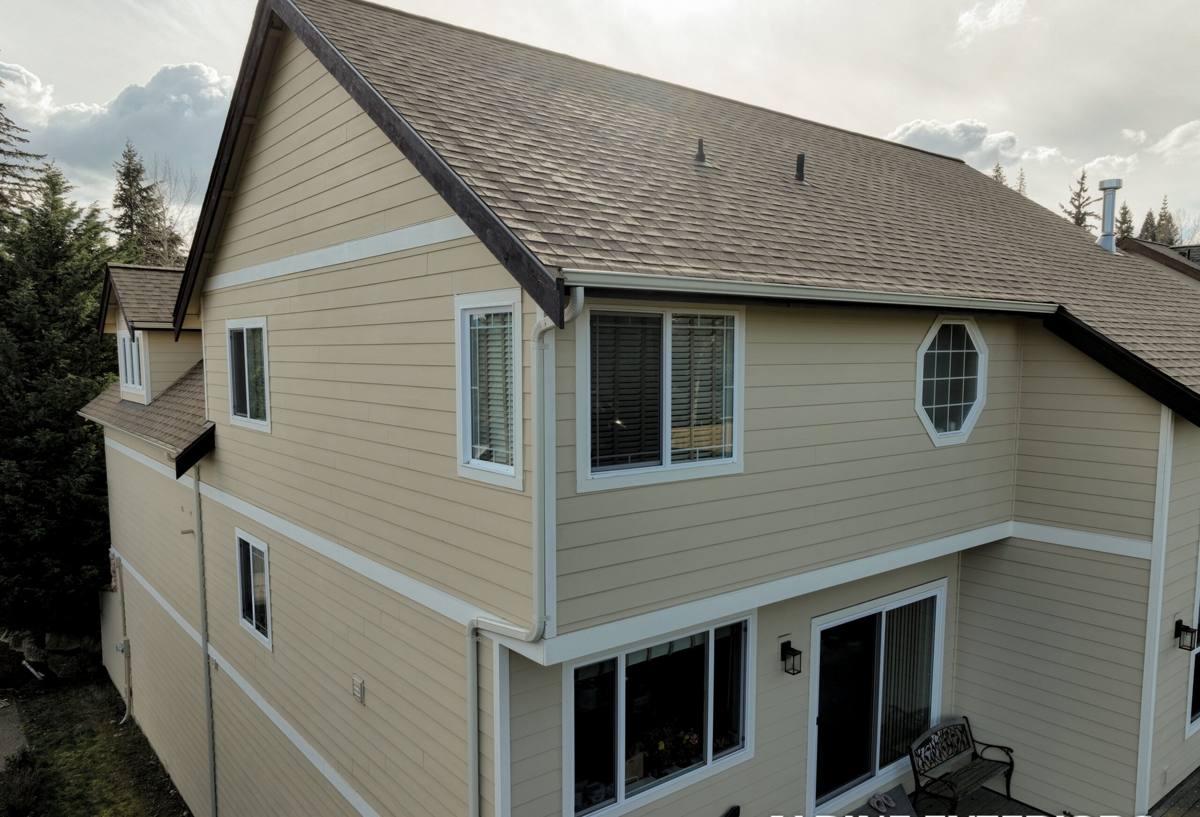
This page covers siding installation specifically for California Creek homes — new builds and full re-siding jobs, not spot repairs — and what separates a job that's actually built for this environment from one that just looks finished on the day the crew packs up. We install James Hardie fiber cement exclusively. Everything below assumes that system, because it's the only one we'll install to spec on homes in this area.
What California Creek's Climate Actually Demands
Salt Air Working on Hardware Year-Round
Proximity to Birch Bay's tidal water and the creek corridor itself means homes here are exposed to salt-laden air on an ongoing basis, not just during storms. That accelerates corrosion on fasteners, flashing, and trim hardware faster than it would twenty or thirty miles inland. Using standard-grade hardware because it's cheaper or easier to source on a given day is a decision that shows up later as rust streaking down the siding face and trim that's loosened at the fastener points well before it should be.
Driving Rain and the Barrier Behind the Siding
Wind off the water pushes rain sideways into panel joints, window and door flashing, and wherever trim meets field siding. The water-resistive barrier underneath the cladding — and how carefully it's lapped, taped, and terminated at every penetration — matters as much as the siding itself in this kind of weather. Get that barrier right and it sheds wind-driven water before it reaches the sheathing. Rush it, and you've built a path for water to get in that won't show itself until well after the crew is gone.
Moss, Algae, and a Wall's Ability to Dry Out
Sustained damp conditions turn any wall surface that stays wet into a growth surface eventually — moss and algae staining are common on homes throughout Birch Bay, and California Creek's low-lying, creek-adjacent terrain doesn't help. Installation detail plays a bigger role in this than most homeowners expect. Correct clearance at the base of the wall, proper drainage-plane or rainscreen detailing, and siding that isn't crammed tight against trim or flashing all give a wall the chance to actually dry out between wet stretches instead of staying damp continuously.
Low-Lying Ground and Moisture at Grade
Homes near creek corridors and wetland edges often sit on ground that holds moisture longer after a rain event than a home on higher, better-drained land. That raises the stakes on anything related to grade clearance, splash-back, and how the bottom courses of siding are detailed — this is one of the more site-specific factors that separates a California Creek installation from a generic one.
What a Correct James Hardie Installation Actually Involves
Fastening and Spacing to Spec
James Hardie publishes exact fastener type, spacing, and placement requirements, and those specs differ by product line and by exposure category. Following the actual spec — not an abbreviated version of it — is what keeps panels secured through wind loads off the water, and it's also what keeps the manufacturer's warranty valid if a problem ever surfaces down the line.
Clearances Above Grade, Roofline, and Decks
Hardie specifies minimum clearance between siding and grade, roofing, decks, and other horizontal surfaces. Those clearances exist to keep the bottom edge of the siding out of standing water or splash-back — a common failure point on homes where the yard has been regraded over the years, mulch beds have built up against the foundation, or a deck was added after the original siding went in.
Flashing and Sealant at Every Penetration
Windows, doors, hose bibs, vents, and exterior light fixtures all interrupt the siding plane, and each one is a place water can get behind the cladding if it's flashed or sealed incorrectly. This is the slowest and least visible part of the job, and it's usually the part that determines whether a wall stays dry behind the siding for decades or starts trapping moisture within a few winters.
Sealing Field-Cut Edges
Any panel cut on site — around a window, at a corner, at the end of a run — needs its cut edge sealed or primed to Hardie's spec before it goes up. An unsealed cut edge is one of the more common places fiber cement siding actually takes on water, and it's almost always an installation gap rather than a material flaw.
Rainscreen and Drainage Plane Detailing
On a site with this much sustained moisture exposure, how the wall assembly is built behind the siding matters as much as what's visible from the street. A properly furred-out rainscreen gap lets bulk water drain and lets the wall cavity dry through airflow, rather than trapping whatever moisture gets past the outer cladding against the sheathing.
James Hardie Product Lines Suited to This Exposure
| Product Line | Best Fit For | Why It Matters Here |
|---|---|---|
| HZ5 (or regional HZ10 equivalent) | Homes with direct wind and moisture exposure near water or wetlands | Engineered for the specific climate zone, with performance matched to the moisture and freeze-thaw pattern the area actually sees |
| ColorPlus factory finish | Any home where repainting siding is something the owner would rather avoid | Baked-on finish resists fading and holds up against salt air better than field-applied paint, and it's backed by its own finish warranty |
| Lap siding profiles | Most standard residential re-siding jobs | Traditional look, straightforward water-shedding geometry, well suited to the wind-driven rain pattern here |
| Panel and batten systems | Homes wanting a more modern or Craftsman-style exterior | Requires more precise joint and seam detailing to perform well in this climate — installation quality matters even more on this profile |
How Our Process Works on a California Creek Job
Site Assessment First
Before any material gets ordered, we walk the property and look specifically at drainage patterns, existing moisture damage, grade relative to the foundation, and how exposed the home is to wind off the water and the creek corridor. That assessment shapes product selection and installation detailing — it's not a generic walk-through.
Tear-Off and Substrate Inspection
On a full re-siding job, removing the old cladding is also when we find out what's actually going on behind it — rot, compromised sheathing, or a water-resistive barrier that's failed. Any of that gets addressed before new siding goes on, because siding installed over a bad substrate fails regardless of how well the visible work is done.
Barrier and Flashing Installation
The water-resistive barrier goes on with careful lapping and taping at every seam and penetration, and flashing gets integrated at windows, doors, and any other opening before siding installation starts. This is the step that's invisible once the job is done and the one that matters most for long-term performance.
Siding Installation to Manufacturer Spec
Fastening, spacing, clearances, and cut-edge sealing all follow Hardie's published specifications for the product line and exposure category involved — not a shortcut version. This is also where we register the installation for warranty purposes where applicable.
Final Walkthrough
Before we consider a job finished, we walk the exterior with the homeowner, cover maintenance basics specific to a coastal, creek-adjacent property, and make sure any questions about the warranty coverage are answered clearly.
Installation Shortcuts That Fail Fastest Near the Water
| Shortcut | What it looks like on install day | How it shows up later on a California Creek home |
|---|---|---|
| Standard-grade fasteners | No visible difference — the panels look secure | Rust streaking and loosened trim within a few years, faster than an inland home would see |
| Rushed barrier lapping | Barrier is up and covered, looks complete | Water intrusion behind the siding that isn't visible until staining or softness appears |
| Tight clearance at grade | Clean, finished appearance right at the ground line | Wicking and rot at the bottom courses, especially where the yard holds moisture longer |
| Unsealed field cuts | Cut edges are covered by trim or hard to see | Localized water absorption and swelling at corners and window returns |
| Skipped rainscreen gap | Wall looks flush and tight | Cavity moisture with no path to dry, worsening the moss and staining problem over time |
What This Costs and What Drives the Number
Every re-siding job is different, but the factors that move the price on a California Creek home are fairly consistent. Broad ranges only — an accurate number requires seeing the actual property.
- Home size and wall complexity — more corners, dormers, and trim details mean more cutting, flashing, and labor time.
- Substrate condition — if tear-off reveals rot or a failed barrier, that repair work is additional and is usually the biggest source of surprise cost on older homes.
- Product line and profile — lap siding is generally more straightforward to install than panel-and-batten or board-and-batten profiles, which affects labor.
- Site access — properties near wetland edges or with limited equipment access can add time to material staging and scaffolding.
- Trim and accessory scope — full trim replacement alongside siding costs more up front but avoids mismatched materials aging at different rates.
Maintenance That Actually Matters Here
A correctly installed Hardie exterior is low-maintenance, not no-maintenance, and the maintenance that matters most on a California Creek property is different from what a homeowner further inland deals with.
- Rinse siding periodically to clear salt residue and organic buildup before it sets into staining.
- Keep gutters and downspouts clear so water is directed away from the wall rather than sheeting down the face of the siding.
- Watch for vegetation or mulch creeping up against the bottom courses — trim it back to keep the manufacturer's clearance intact.
- Have caulking and sealant at penetrations checked every few years, since sealant is the first thing to age out in a marine-influenced climate.
- Address any moss or algae growth early with an appropriate cleaning method rather than letting it establish and hold moisture against the surface.
Why Hiring a Crew That Already Works This Area Matters
Installation technique that's correct in a dry inland climate isn't automatically correct here. A crew that hasn't worked near Birch Bay's water and wetland exposure regularly can miss the details that matter most in this specific setting — the clearance decisions, the hardware grade, the barrier detailing around penetrations, the extra attention a rainscreen gap deserves when a wall rarely gets a long enough dry stretch to fully recover. Those aren't things you can retrofit easily once the siding is up. They have to be right the first time.
We install James Hardie fiber cement because it's engineered for exactly this kind of climate exposure when it's installed correctly — non-combustible, factory-finished, and backed by a strong transferable warranty. But the product is only half the equation. The other half is a crew that treats every clearance, fastener, and sealed edge as non-negotiable, because on a California Creek home, those are the details that decide whether the siding is still performing well in twenty years or showing problems in five.
If you're planning a re-siding project or building new in the California Creek area, we're happy to walk the property, look at what your home's specific exposure actually demands, and put together a straightforward estimate — no pressure, no hard sell, just a clear look at what the job actually involves.