 Birch Bay Exterior
 Point Roberts sits on its own peninsula at the very northwest corner of Whatcom County, surrounded on three sides by the waters of Boundary Bay and the Strait of Georgia. That geography is part of what makes the community special, and it's also exactly why siding here takes more of a beating than siding on a home twenty miles inland. Salt-laden wind comes off the water nearly year-round, rain arrives sideways more often than straight down, and the shoulder seasons stay damp long enough for moss and algae to get a real foothold on anything that holds moisture. A siding installation done right for Point Roberts is not the same job as a siding installation done right in a drier, more sheltered part of the county.
What Point Roberts' Climate Actually Does to Siding
Three conditions define siding performance on this peninsula, and any contractor working here needs to plan for all three, not just the one that's easiest to talk about.
Salt Air and Wind-Driven Moisture
Homes exposed to open water take on airborne salt that settles into seams, fasteners, and any exposed edge of siding material. Over years, that salt exposure accelerates corrosion in metal fasteners and trim, and it works into porous or improperly sealed siding surfaces faster than most homeowners expect. Combine that with wind off the water pushing rain nearly horizontal during winter storms, and water gets driven into gaps, laps, and penetrations that would stay dry in a more sheltered location.
A Long, Wet Moss Season
Whatcom County's marine climate keeps humidity high for much of the year, and Point Roberts' exposure to water on multiple sides only adds to that. North-facing walls, areas shaded by trees or the home itself, and any siding with a rough or absorbent surface become prime real estate for moss, algae, and mildew. Once moss establishes itself at a seam or behind a poorly flashed trim board, it holds moisture against the material long after the rain has stopped, and that's when real damage starts.
Freeze-Thaw Cycling
Point Roberts doesn't see the deep freezes of the Cascades or eastern Washington, but it does see repeated cycles of damp cold followed by thaw, especially in winter. Any siding material that absorbs water is vulnerable to that cycle — trapped moisture expands and contracts, and over enough seasons it opens cracks, pops fasteners, and breaks down finishes.
Why We Install James Hardie Fiber Cement — Not Vinyl, Not LP SmartSide
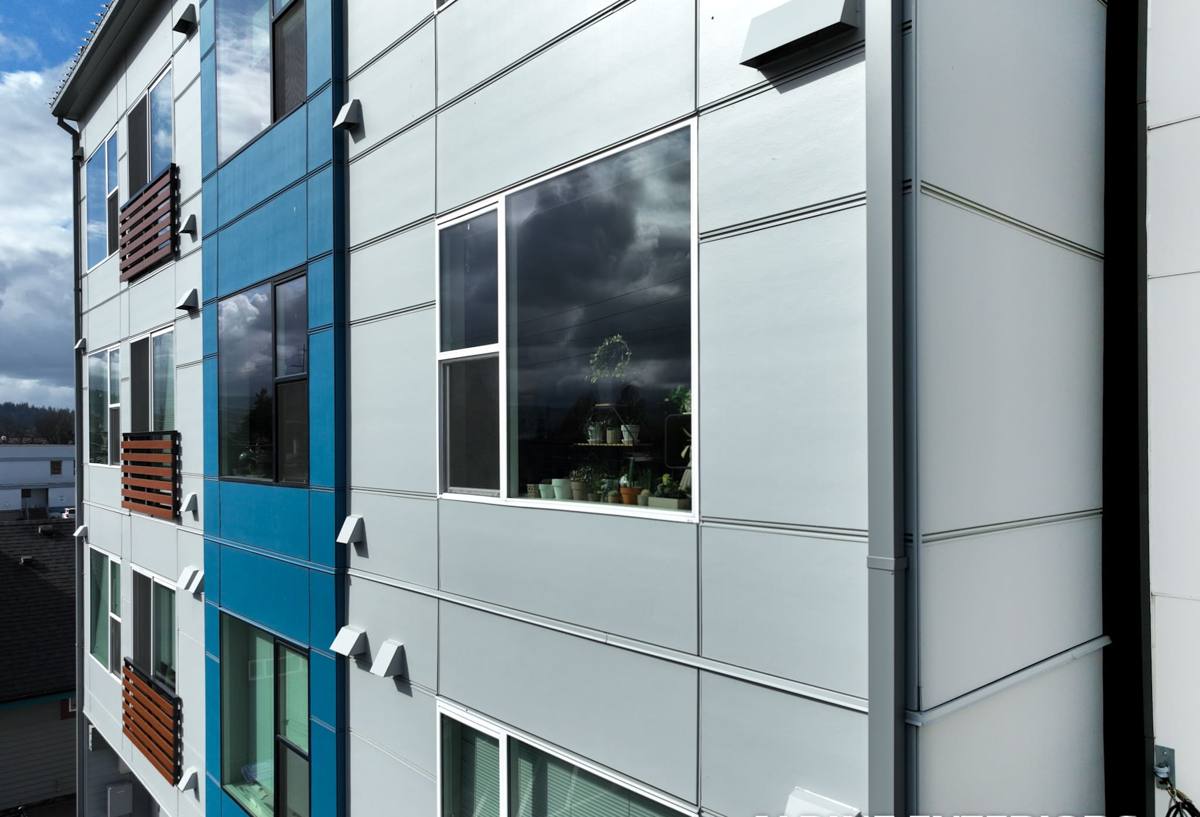
We standardized on James Hardie fiber cement siding for every home we side, and Point Roberts is a good example of why. Fiber cement doesn't absorb water the way engineered wood products do, and it doesn't flex, fade, or become brittle in salt air and UV exposure the way vinyl does over a couple of decades. It's also non-combustible, which matters in a region where wildfire smoke and ember exposure have become a bigger part of summer conversation across the Pacific Northwest.
James Hardie also engineers its siding by climate zone through its HardieZone system. The HZ5 formulation, which fits the wetter, cooler weather pattern common across western Washington, is built with moisture performance as the priority — a different engineering focus than the HZ10 formulation made for hot, humid southern climates. That distinction matters more in a place like Point Roberts, where the material spends most of the year damp, than it does somewhere drier.
ColorPlus factory-applied finish is the other piece of the equation. Field-painted siding — and this includes primed wood and touch-up-dependent products — starts losing finish integrity at the first exposed edge or hairline crack, and salt air speeds that up. A factory-baked finish, applied and cured under controlled conditions before the boards ever reach the job site, holds up to UV and moisture exposure far longer than anything painted on-site, and it's backed by a substantial finish warranty in addition to the product warranty.
What a Correct Installation Involves
Fiber cement siding only performs the way it's engineered to perform if it's installed correctly. In a high-exposure location like Point Roberts, the margin for error is smaller, because any mistake gets tested by weather sooner and harder than it would elsewhere.
The Water-Resistive Barrier and Drainage Plane
Everything starts underneath the siding, not at the siding itself. A properly lapped water-resistive barrier, correctly integrated with window and door flashing, is what actually keeps bulk water out of the wall assembly. A drainage plane behind the siding — whether furring strips or a manufactured rainscreen product — gives any moisture that does get past the cladding a path to drain and dry, instead of sitting against the sheathing.
Flashing and Penetrations
Every window, door, hose bib, vent, and light fixture that penetrates the siding is a potential entry point for wind-driven rain. Correct head flashing, kick-out flashing at roof-wall intersections, and proper sealant at penetrations are not optional extras — they're the details that separate a siding job that lasts thirty-plus years from one that starts showing rot behind the trim in five.
Fastening and Clearances
James Hardie specifies fastener type, spacing, and placement for a reason, and those specs change depending on exposure category. We also hold the manufacturer-required clearances between siding and grade, roofing, and decks, because closing that gap is one of the most common ways moisture gets trapped against the bottom of a wall.
Caulking — Used Correctly, Not Everywhere
Caulk has a place at specific joints and penetrations, but it's not a substitute for correct flashing and lap sequencing. Over-reliance on caulk to "seal" a wall is a shortcut that fails once the caulk itself ages and cracks — which happens faster in a salt-air environment than people expect.
Our Process
- On-site assessment. We look at wall exposure, existing siding and sheathing condition, moisture damage, trim and flashing details, and how the home's orientation interacts with prevailing wind and sun.
- Scope and product selection. We walk through profile, color, and trim options and explain what's involved in removal versus overlay, based on the condition of what's currently on the walls.
- Prep and moisture check. Before new siding goes up, we address any sheathing rot, inadequate flashing, or drainage issues found underneath the old cladding — covering up a moisture problem is not a repair.
- Installation to manufacturer spec. Water-resistive barrier, drainage plane, flashing, and Hardie's fastening requirements are followed as engineered, not shortcut for speed.
- Final walkthrough. We go over the finished work with the homeowner, including care and warranty information, before calling the job done.
Why Hiring a Crew That Already Works Point Roberts Matters
Point Roberts is a U.S. exclave — the only land route in and out runs through Canada, via the border crossing at Tsawwassen, British Columbia. That's simply a fact of the geography, and it affects how contracting work here gets scheduled. A crew unfamiliar with that logistics reality can end up adding delays, uncertainty, or extra cost to a project that a crew already accustomed to working the peninsula plans around from the start — material deliveries, crew scheduling, and job sequencing all need to account for it.
Beyond logistics, a contractor who has actually sided homes on this peninsula understands which walls take the worst of the wind and salt exposure, where moss tends to establish first, and how the local moisture pattern differs from a job five or ten miles inland. That local knowledge shows up in the details — where extra flashing attention goes, which trim details need upgrading, and what maintenance schedule actually fits the site.
Cost Factors for a Point Roberts Siding Project
Every home is different, so we don't publish blanket pricing, but the factors below are what actually move the number up or down on a siding installation in this area.
| Factor | Why It Matters Here |
|---|---|
| Home size and wall complexity | More square footage and more corners, gables, and dormers mean more material and more labor-intensive flashing and trim work. |
| Existing siding removal | Full tear-off costs more than installing over a sound substrate, but it's often necessary when moisture damage is found underneath. |
| Sheathing and framing repair | Salt air and long-term moisture exposure can lead to hidden rot; repair scope isn't known until the old siding comes off. |
| Exposure level of the site | Homes with direct water exposure or unbroken wind fetch often warrant upgraded flashing and trim detailing beyond the baseline. |
| Trim and accessory details | Corner boards, window and door trim, and fascia work add labor and material beyond flat wall siding. |
| Access and logistics | Delivery scheduling and crew logistics for the peninsula are a real, if modest, factor in project timing and coordination. |
Maintenance and What to Expect Long-Term
James Hardie fiber cement with ColorPlus finish is low-maintenance compared to painted wood, but "low-maintenance" doesn't mean "no maintenance" — especially in a salt-air, high-moisture environment. A periodic rinse to clear salt residue and organic buildup, prompt attention to any caulking that starts to fail at trim joints, and keeping gutters and downspouts clear so water isn't dumping down a wall all go a long way toward getting the full service life out of the material. James Hardie's product warranty is transferable, which also matters to homeowners thinking about resale in a market where buyers increasingly ask about siding age and type.
A Checklist Before You Hire
- Ask whether the contractor is a James Hardie-focused installer and can explain why, not just that they "also do" siding.
- Confirm they'll address water-resistive barrier, drainage plane, and flashing details — not just fasten new boards over the old wall.
- Ask how they handle sheathing repair if rot is found once old siding comes off.
- Get clarity on which HardieZone product line and profile they're specifying, and why it fits this climate.
- Ask about their experience scheduling and delivering material to Point Roberts specifically.
- Get the warranty terms in writing — both the manufacturer's product warranty and any workmanship warranty from the installer.
If you're weighing a siding project for a home in Point Roberts, we're glad to walk the property with you, take a look at what's on the walls now, and give you a straightforward, no-pressure estimate. Use the form below to get started.