 Birch Bay Exterior
 Roofing in a Place That's Its Own Small World
Point Roberts sits in a strange spot on the map — a piece of the United States that hangs below the 49th parallel, cut off from the rest of Washington by water and by Canada. If you live there, you already know what that means for getting contractors, materials, and service calls to your door. It also means the exposure your roof takes is a bit more concentrated than what we see on other jobs around Birch Bay and the rest of Whatcom County: more open water on more sides, more wind with nothing to break it up, and a long, damp season that gives moss every reason to move in and stay.
A roof replacement out here isn't fundamentally different in the tools or techniques — good roofing is good roofing. But the decisions around material choice, ventilation, and maintenance schedule should reflect where the house actually sits, not a generic template. That's the point of this page: what a Point Roberts roof replacement should look like when it's done right, and why the planning around it matters as much as the shingles themselves.
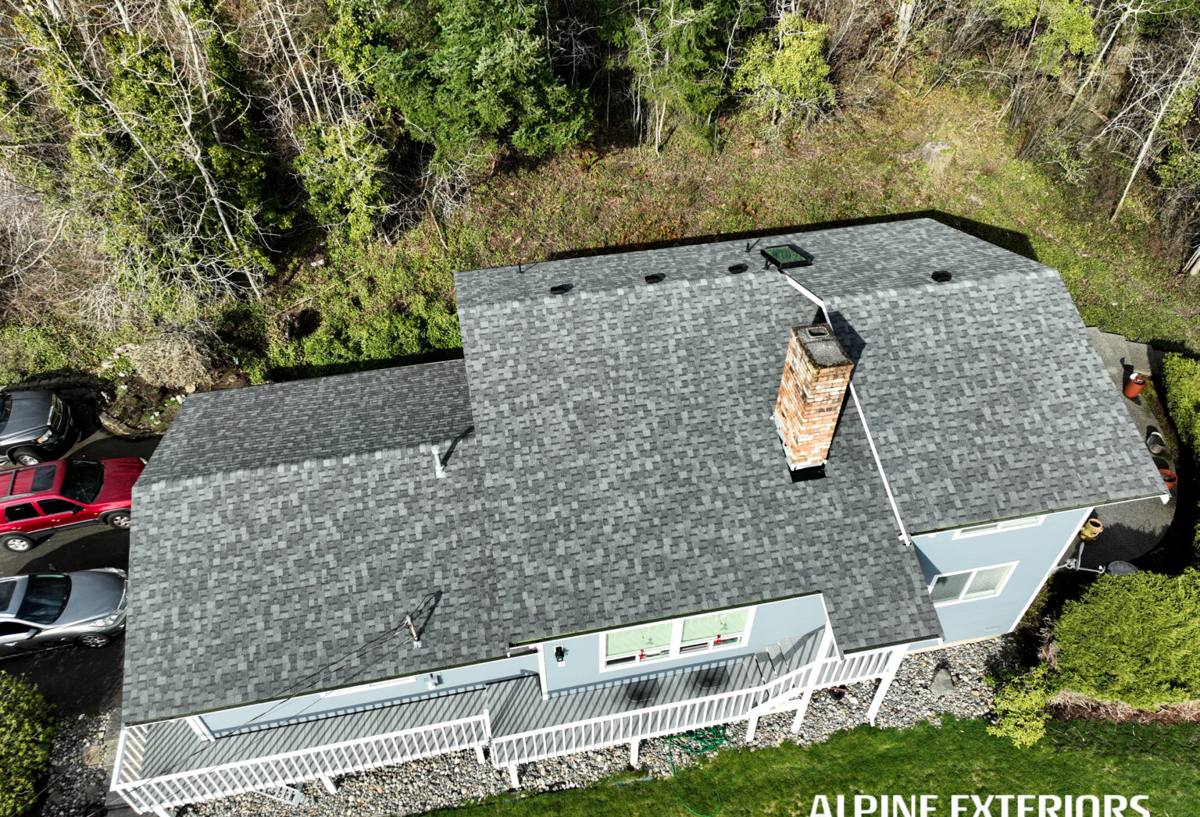
What Salt Air, Rain, and Moss Actually Do to a Roof
Salt Air
Homes close to the water pick up airborne salt that settles on roofing metal — flashing, vents, gutters, fasteners — and accelerates corrosion over time. It's slow and easy to ignore until a flashing joint has thinned out or fastener heads start rusting through their coating. Salt exposure doesn't ruin a roof on its own, but it shortens the useful life of the metal components that keep water out at the seams, which is exactly where leaks start.
Driving Rain
Wind-driven rain off the water doesn't just fall on a roof, it gets pushed sideways into laps, seams, and anywhere a shingle edge or flashing detail isn't sealed tight. On a well-built roof this is a non-issue. On a roof with worn underlayment or flashing that's been patched one too many times, driving rain finds the gaps that a normal straight-down rain never would.
Moss
Whatcom County's wet season runs long, and north-facing or shaded roof sections that stay damp for weeks at a time are moss's favorite real estate. Moss isn't just cosmetic — it holds moisture against the roofing material, lifts shingle edges as it grows, and works its way under laps over years. A roof that's been carrying a moss load for a long time is often in worse shape underneath than it looks from the ground.
Signs You're Looking at Replacement, Not Repair
- Granule loss heavy enough that you're finding grit in gutters every season, not just after a storm
- Shingles that are cupping, curling, or cracking across multiple sections of the roof, not one isolated spot
- Soft or spongy decking felt underfoot in the attic, or daylight visible through the roof boards
- Repeated leaks in different locations rather than one recurring spot
- Moss that's returned within a year or two of a cleaning, especially on north-facing slopes
- A roof that's at or past the manufacturer's expected service life for its material and exposure
One or two of these on their own might point to a targeted repair. Several at once, especially combined with age, usually means the roof system as a whole has reached the point where patching costs more over time than replacing it does.
Material Options for a Water-Exposed Roof
There's no single "right" material for every Point Roberts home — it depends on the roof pitch, the home's exposure to wind and salt, and your budget. Here's how the common options stack up for this specific environment:
| Material | How it handles salt air | How it handles driving rain | Moss resistance |
|---|---|---|---|
| Architectural asphalt shingle | Good — minimal exposed metal beyond flashing | Good with proper underlayment and flashing detail | Moderate; benefits from algae/moss-resistant granules |
| Standing seam metal | Very good with the right coating and fastener spec | Excellent — few horizontal laps for wind-driven rain to exploit | Very good; smooth surface sheds moss easily |
| Cedar shake | Fair; needs regular maintenance near salt exposure | Fair — more seams and joints than shingle or metal | Poor without consistent upkeep; naturally moss-prone |
| Composite/synthetic shake or slate | Good — engineered for weather resistance | Good | Good, varies by product line |
We'll talk through these with you honestly, including the maintenance commitment each one carries. A material that looks great on day one but needs yearly upkeep to hold up near the water isn't necessarily the wrong choice — it just needs to be a choice you're making with full information, not a surprise two years in.
What a Correct Roof Replacement Actually Involves
A roof replacement is only as good as what's underneath the visible surface. On a home exposed to wind-driven rain and salt air, the details matter more than usual:
- Full tear-off and deck inspection. Layering new shingles over old is never something we do — it traps moisture and hides problems. Every job starts with the old roofing removed down to the deck, so we can see and address any rot or soft spots before covering them up again.
- Ice and water shield at vulnerable points. Valleys, eaves, and any low-slope transitions get a self-adhering waterproof membrane, not just standard felt, because these are the spots wind-driven rain targets first.
- Synthetic underlayment across the field. A quality synthetic underlayment holds up better to the time between tear-off and dry-in, and gives the whole roof a stronger second line of defense.
- New flashing, not reused flashing. Given what salt air does to metal over the years, existing flashing on an older roof is usually near the end of its useful life even if it looks intact. New step, counter, and valley flashing goes in as part of the job.
- Proper attic ventilation. Balanced intake and exhaust ventilation keeps the underside of the deck dry and reduces the moisture buildup that feeds both rot and moss. A roof that traps humid air underneath ages faster no matter how good the shingles are.
- Corrosion-resistant fasteners and hardware. In a salt-air environment, using standard hardware is a false economy. We spec fasteners and flashing hardware rated for coastal exposure.
How Our Process Works, Start to Finish
Because Point Roberts is only reachable by crossing into Canada and back, scheduling and logistics take a bit more planning than a job across town in Birch Bay — and we build that into how we run the project so it doesn't become your problem:
- On-site assessment. We walk the roof, check the attic where accessible, and give you a straight read on repair versus replacement — no upselling a full tear-off if a targeted repair genuinely solves the problem.
- Written estimate with material options. You'll see the cost difference between material choices and what each one means for maintenance down the road, not just a single bottom-line number.
- Materials staged and border logistics handled ahead of time. We plan delivery and crew crossings so your project isn't held up mid-job waiting on supplies.
- Whatcom County permitting handled before work starts. Permit requirements apply the same way in Point Roberts as anywhere else in the county, and we take care of that paperwork rather than leaving it to you.
- Full tear-off, dry-in, and flashing work. Weather windows matter here — we watch the forecast and don't leave a roof open to the elements longer than necessary.
- Final walkthrough. We go over the finished roof with you, including what maintenance (if any) the chosen material calls for.
Living With Your New Roof: Maintenance That Actually Matters
A properly installed roof in this climate still benefits from a little seasonal attention. This isn't about babying it — it's the difference between a roof that reaches its full expected life and one that doesn't:
- Keep gutters and downspouts clear so water isn't backing up under the eaves during heavy rain
- Trim back overhanging branches to reduce shade and debris on north-facing slopes where moss takes hold fastest
- Have moss growth treated early rather than waiting for a visible mat to form
- Check flashing and exposed metal periodically for early corrosion, especially after storm seasons
- Confirm attic ventilation isn't blocked by insulation or storage, since blocked vents undo a lot of the moisture protection built into the roof
Cost Factors Worth Understanding Upfront
Every roof is priced based on its own specifics, but the main variables that move the number are consistent:
| Factor | Why it affects cost |
|---|---|
| Roof size and number of planes | More square footage and more valleys/hips mean more material and labor time |
| Roof pitch and access | Steeper or harder-to-access roofs require more safety setup and time |
| Deck condition | Rot or soft decking found during tear-off adds material and labor to replace it properly |
| Material choice | Asphalt, metal, and composite/shake products carry different material and installation costs |
| Flashing and ventilation upgrades | Bringing older flashing and ventilation up to current standards adds scope but reduces future risk |
We'd rather walk you through these factors on your specific roof than throw out a broad number that doesn't hold up once we're actually up there. A written estimate after an on-site look is the only number worth trusting.
Why Local Experience on This Job Matters
Point Roberts isn't a place a crew wants to be figuring out on the fly. Between the border crossing logistics, Whatcom County permitting, and a roofing environment shaped by salt air, driving rain, and a long moss season, a contractor who's already done the work here brings real value beyond just installing shingles. It means fewer surprises in scheduling, material choices that reflect what actually holds up locally, and a finished roof built for the conditions it will actually face — not a generic install dropped into a coastal exclave and hoped for the best.
If your roof is showing its age or you just want an honest opinion on where it stands, we're glad to come take a look. Fill out the form below for a free, no-pressure estimate — we'll tell you what we see, plainly, and let you decide from there.