 Birch Bay Exterior
 Building New in California Creek Means Planning for the Climate Before Framing Is Even Done
If you're building new in the California Creek area of Birch Bay, the windows you choose and how they're installed will do more to determine your long-term maintenance costs than almost any other decision on the job. This is Whatcom County's marine climate zone: salt-laden air moving in off the water, wind-driven rain that doesn't just fall but gets pushed sideways into wall assemblies, and a moss season that can stretch from October well into spring. None of that is a problem you solve after the house is built. It's a problem you solve at the framing and rough-opening stage, with the right products and the right flashing sequence, before siding ever goes up.
A lot of new-construction window problems we get called out to fix aren't product failures — they're installation shortcuts. Water finds the one gap in a sill pan, or a nailing fin that wasn't sealed correctly, and it sits inside the wall for months before anyone notices a soft spot in the trim. In this climate, that timeline is faster than most builders from drier regions expect.
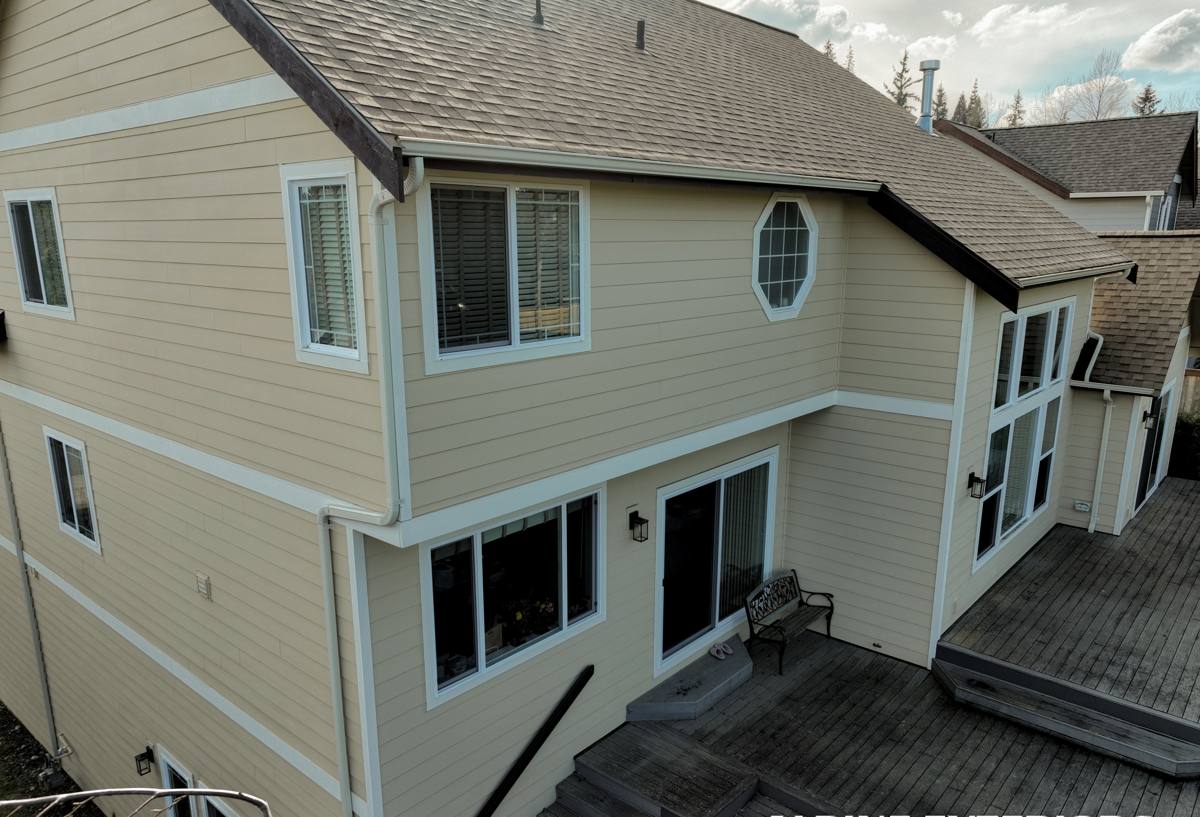
New-Construction Windows Are a Different Job Than Replacement Windows
It's worth being clear about this distinction, because the terminology gets used loosely. New-construction windows have a nailing fin (sometimes called a flange) around the perimeter of the frame that gets fastened directly to the sheathing before the weather-resistive barrier (WRB) and siding go on. Replacement or "pocket" windows are designed to fit into an existing, already-flashed opening without disturbing the exterior wall.
On a new build, you have the advantage of doing this right the first time — there's no old flashing to work around, no guessing what's hidden behind existing trim. But that advantage only pays off if the installation sequence is followed correctly. Skipping steps because "it's new construction, it should be easy" is exactly how water problems get built into a house from day one.
Why the Installation Sequence Matters More Here Than Inland
In a drier climate, a slightly imperfect flashing detail might never get tested by enough rain to matter. Near the water in Whatcom County, it gets tested constantly. Wind-driven rain during a fall or winter storm can push moisture uphill and sideways against a wall, which means gravity-only flashing details — the kind that work fine in a calm rain — aren't good enough here.
What a Correct New-Construction Window Installation Involves
There's a specific order of operations that protects the rough opening long before the window itself is even set. Skipping or reordering these steps is the single biggest cause of moisture intrusion in new builds.
- Sill pan flashing — a sloped, sealed pan at the bottom of the rough opening that directs any water that gets past the window back outside, rather than letting it pool against the framing.
- WRB integration — the housewrap or building paper is lapped and sealed so water is shed over each layer, shingle-style, from the top down.
- Window setting and fastening — the unit is set level, plumb, and square, then fastened through the nailing fin per the manufacturer's schedule (this affects both structural performance and warranty validity).
- Fin taping and flashing — the nailing fin is taped or flashed on the sides and top, with the head flashing lapped over the WRB above it — never tucked underneath, which would direct water into the wall instead of over it.
- Sealant at the interior and exterior — backer rod and sealant where appropriate, without over-sealing the exterior in a way that traps moisture that gets in from another path.
Every one of those steps needs to hold up under repeated saturation, not just a single storm. That's the standard we build to on every window we set.
Choosing Window Materials That Hold Up to Salt Air and Moss Season
Frame material matters more here than in a lot of the country, because salt air accelerates corrosion of hardware and fasteners, and prolonged dampness gives mold and algae a long runway to take hold on anything that stays wet. Here's how the common options compare for a build in this specific environment:
| Frame Material | Salt Air / Corrosion Behavior | Moisture & Moss Season Behavior | Maintenance Burden |
|---|---|---|---|
| Vinyl | Does not corrode; hardware quality varies by manufacturer | Won't rot; can develop algae/mildew film that needs occasional cleaning | Low |
| Fiberglass | Excellent corrosion resistance, stable in temperature swings | Very stable dimensionally in wet-dry cycling | Low |
| Aluminum-clad wood | Cladding resists weather; exposed hardware needs marine-grade fasteners | Wood core must stay sealed at joints; failure point is usually the interior wood if moisture gets past the cladding | Moderate |
| Bare aluminum | Prone to pitting and corrosion in salt air over time without upgraded finishes | Conducts cold, increases condensation risk during damp winters | Moderate to high |
We don't push a single brand or material on every job — the right choice depends on your budget, your home's design, and how much upkeep you want to take on. But we will tell you honestly where a given product's trade-offs are, especially around hardware corrosion resistance and how a frame handles months of sustained dampness rather than an occasional rainstorm.
Meeting Washington State Energy Code in a Marine Climate
Whatcom County falls under Washington's marine climate zone for energy code purposes, which sets minimum performance requirements for U-factor (how much heat escapes through the window) on new construction. New-construction windows give you the chance to hit these targets efficiently, since you're not retrofitting around an existing opening size or wall depth.
A few practical points worth knowing as you spec windows for a new build here:
- Lower U-factor glass reduces both heating costs and interior condensation on cold, damp days — a real issue during a long moss-season stretch of low sun and high humidity.
- Low-E coatings and gas-filled (typically argon) sealed units are standard on most new-construction packages now and are worth the modest upcost.
- Your builder or designer should confirm the specific U-factor and other prescriptive or performance-path targets required for your permit — code compliance is verified at permitting and inspection, not left to guesswork after the fact.
- Bigger glass areas (popular in a lot of new coastal home designs) mean the U-factor and installation quality matter even more, since there's more window area for heat loss or moisture problems to show up.
Our Process: Working With Your Builder From Framing to Final Trim
Before Framing Is Closed In
We prefer to be in the loop while rough openings are being framed, not after. Confirming opening sizes, header heights, and flashing plans before sheathing goes on avoids costly rework and keeps the schedule moving.
At Window Set
We follow the sill pan, WRB, fin-flashing sequence outlined above on every unit, documenting as we go so there's a clear record of how each opening was flashed — useful for your builder, your inspector, and for you if any warranty question ever comes up.
After Siding and Trim
Once exterior finishes are on, we do a final check of caulking, weep paths, and operation on every window before we consider the job done. A window that looks finished but doesn't drain correctly is not a finished job.
Common Mistakes We See on New Builds in This Area
Most of these aren't hard to avoid — they happen when a crew is moving fast on a schedule and treats window installation as a quick task rather than a weatherproofing detail.
- Head flashing tucked under the WRB instead of over it, which channels water into the wall instead of away from it.
- Sill pans skipped entirely on the assumption that sealant alone will keep water out — sealant fails eventually; a sill pan gives water somewhere to go when it does.
- Standard fasteners used where marine-grade or corrosion-resistant hardware should have been specified, leading to rust staining and hardware failure well before the window itself wears out.
- Over-sealing the exterior in a way that traps any moisture that does get in, instead of leaving the assembly a path to dry out.
Cost Factors on a New-Construction Window Job
Every build is different, but the main variables that move the price on a California Creek job are consistent enough to lay out honestly:
| Factor | Why It Affects Cost |
|---|---|
| Frame material | Vinyl is typically the most budget-friendly; fiberglass and aluminum-clad wood cost more up front but can lower long-term maintenance |
| Glass package | Upgraded Low-E coatings, gas fills, or triple-pane glass add cost but improve comfort and code compliance |
| Opening size and count | Larger glass areas and more openings mean more flashing detail work, not just more material |
| Site access and timing | Coordinating with framing and other trades efficiently keeps labor costs predictable; delays and rework don't |
| Hardware grade | Corrosion-resistant fasteners and hardware cost a bit more but matter directly in a salt-air environment |
Why Hire a Crew That Already Works in California Creek
A window installer who mostly works inland, or in a drier part of the state, isn't wrong about window installation in general — they're just calibrated to a different set of risks. Around Birch Bay and California Creek, the calibration has to account for sustained wind-driven rain, salt air's effect on hardware and finishes, and a moss season long enough that any drainage mistake gets found out. We work in this specific stretch of Whatcom County regularly, which means we're not learning the local climate on your project. We already know which details can't be shortcuted here, and we build every new-construction window installation around that.
A Practical Checklist Before You Finalize Your Window Order
- Confirm the U-factor and glass package meet Washington's marine climate zone energy code for your permit.
- Ask what fastener and hardware grade is specified, especially for units facing prevailing wind and rain.
- Confirm sill pan flashing is included in the installation plan, not just sealant at the sill.
- Ask how head flashing will be lapped relative to the weather-resistive barrier.
- Get the flashing and installation sequence in writing so it's part of your build documentation, not just a verbal assurance.
If you're building new in California Creek and want windows installed to hold up to this stretch of Whatcom County's climate, we're happy to walk your plans and give you a straightforward, no-pressure estimate — just fill out the form below.