 Birch Bay Exterior
 Why Sandy Point Roofs Wear Differently
Sandy Point sits right up against the water, and that changes what a roof has to deal with year after year. Salt-laden air moves off Birch Bay and settles on every exposed surface, including roofing metal, fasteners, and flashing. Add in wind-driven rain that comes at the house sideways during winter storms, and a long, damp moss season that runs from fall through spring, and you've got a combination that finds every weak point in a roofing system faster than it would inland. A roof that would hold up fine twenty miles east in Whatcom County can show corrosion, streaking, or moss colonization within a few years out here if it wasn't built with this exposure in mind.
None of that means metal roofing is a bad fit for Sandy Point. It's actually one of the better options for this kind of exposure, when it's specified and installed correctly. The issue is that "correctly" looks different on the waterfront than it does in a subdivision a few miles inland, and a lot of roofing problems we get called out to fix started with a spec sheet that didn't account for that.
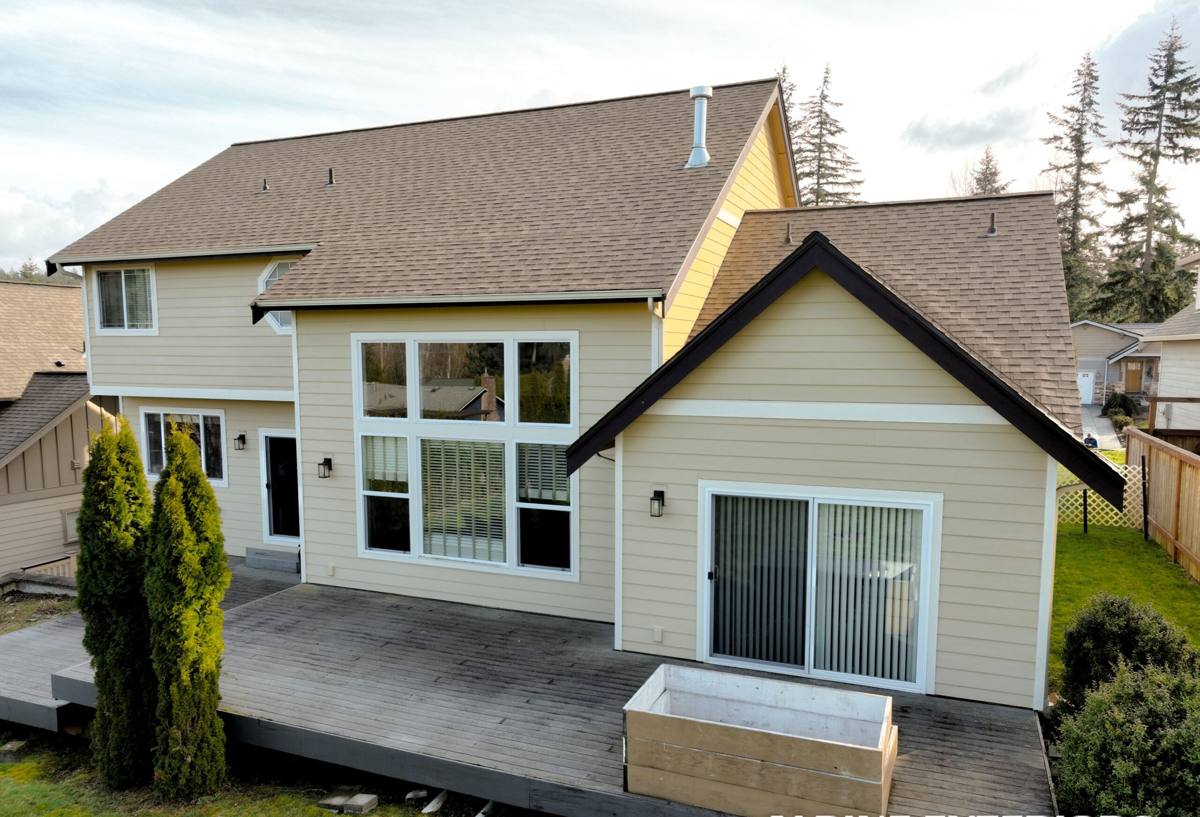
What Salt Air Actually Does to a Roof
Salt air is corrosive to bare or poorly coated metal, and it accelerates rust at cut edges, exposed fastener heads, and any spot where a protective coating has been scratched or worn through. Over time this shows up as rust streaking down panel seams, pitting around fastener penetrations, and premature failure of cheaper coated steel. It's not that metal roofing can't handle a marine environment — coastal metal roofs are common all along the Pacific Northwest coastline — it's that the coating system and fastener hardware matter a lot more here than they would on a roof set back from the water.
Where Salt Exposure Causes the Most Damage
- Cut panel edges where the factory coating has been exposed by field trimming
- Exposed fastener heads, especially with mismatched or standard-grade screws
- Flashing transitions around chimneys, vents, and valleys where water and salt spray collect
- Ridge caps and eave edges, which take the brunt of wind-driven spray
Driving Rain and Wind Uplift
Storms coming off the water don't just drop rain straight down — wind pushes it sideways and up under laps, ridge caps, and poorly sealed penetrations. A roof detailed for calmer, drier conditions can leak at Sandy Point even when every panel is technically installed. That's why underlayment choice, lap direction, and fastening pattern matter more here than the panel style itself. We also pay close attention to wind uplift resistance, since waterfront lots are more exposed to sustained gusts than homes tucked behind tree lines or hills further inland.
The Moss Problem on the Washington Coast
Whatcom County's mild, wet winters are ideal for moss growth on any roof surface that stays damp and shaded, and Sandy Point's tree cover and marine humidity make it worse than average. Moss doesn't attack metal the way it does asphalt shingles, but it still causes real problems: it holds moisture against seams and fasteners, traps debris in valleys, and can work its way under improperly lapped panels or loose trim. On a well-installed metal roof with the right panel profile, moss has almost nothing to grip and washes off easily. On a roof with too many flat spots, low-slope sections, or organic debris buildup in the valleys, moss can establish and slowly cause the same moisture problems it does on other roofing types.
What a Correct Metal Roof Installation Involves
A metal roof is only as good as what's underneath it and how it's fastened down. For Sandy Point homes, we treat the following as non-negotiable, not upgrades:
- A high-quality synthetic or self-adhered underlayment rated for wind-driven rain, not just a basic felt layer
- Corrosion-resistant fasteners matched to the panel material, with sealing washers rated for the coating type used
- Proper lap direction and overlap length on every seam, following the prevailing wind and water flow across the roof
- Fully detailed flashing at every penetration, valley, and wall transition — this is where most roof leaks actually start, on any roofing material
- Adequate attic and roof deck ventilation, which reduces condensation buildup that can accelerate corrosion from the underside
Cutting corners on any one of these doesn't usually show up right away. It shows up in year three or four, as a leak at a valley, rust bleeding from a fastener, or a soft spot in the decking underneath. That delayed failure is exactly why the installation details matter more than the brand name on the panel.
Panel Style and Finish Comparison
| Option | Best For | Coastal Considerations |
|---|---|---|
| Standing seam (concealed fastener) | Long-term, low-maintenance roofs | No exposed fasteners to corrode; best wind and water resistance for waterfront exposure |
| Exposed fastener panel | Budget-conscious projects, outbuildings | Lower upfront cost, but fastener maintenance and re-sealing becomes an ongoing task near salt air |
| Galvalume/steel with premium coating | Most residential coastal applications | Coating quality matters more than the base metal; ask specifically about coastal warranty coverage |
| Aluminum | Homes closest to the water or with prior corrosion issues | Naturally corrosion-resistant, doesn't rust, often worth the added cost right on the waterfront |
Our Process for Sandy Point Homes
1. On-Site Inspection and Honest Assessment
We start by getting on the roof, not just looking at it from the ground. We check the deck condition, existing ventilation, flashing detail, and how exposed the roof is to wind and salt spray based on its orientation and surrounding tree cover. We'll tell you plainly if a full metal roof makes sense, if repairs will hold for now, or if there's a better option for your specific situation.
2. Tear-Off vs. Overlay Decision
In most cases we recommend a full tear-off to bare decking, especially on older Sandy Point homes where moisture may already be trapped under the existing roofing. An overlay can sometimes work over a sound existing metal roof, but we won't recommend it if there's any sign of deck rot or trapped moisture underneath — installing over a problem just hides it.
3. Deck Repair and Underlayment
Any soft or water-damaged decking gets replaced before anything else goes down. Then we install underlayment rated for this climate, paying extra attention to valleys, eaves, and any low-slope transitions where wind-driven rain tends to collect.
4. Panel Installation and Detailing
Panels go down with fastening patterns and lap directions suited to the roof's wind exposure, not a one-size-fits-all approach. Every flashing detail — chimneys, vents, valleys, wall transitions — gets built up in layers rather than caulked over, since caulk is a maintenance item, not a permanent fix.
5. Final Walkthrough and Cleanup
We walk the finished roof with you, confirm ventilation is working as intended, and make sure the job site is cleaned up, including magnetic sweeps for stray fasteners and debris.
What Drives the Cost
| Factor | Why It Matters |
|---|---|
| Roof size and pitch | More surface area and steeper pitches take more labor and material |
| Panel material (steel vs. aluminum) | Aluminum costs more upfront but resists corrosion better this close to salt water |
| Fastener style (standing seam vs. exposed) | Concealed fastener systems cost more but reduce long-term maintenance |
| Deck condition | Rotted or damaged decking found during tear-off adds repair cost |
| Roof complexity | Valleys, dormers, chimneys, and multiple roof planes add flashing and labor time |
We don't publish fixed prices online because every roof and every home is different, but we'll always give you a clear, itemized estimate before any work starts — no vague allowances or surprise change orders.
Maintenance That Actually Extends the Life of a Coastal Metal Roof
A metal roof installed correctly for this climate needs relatively little upkeep, but "little" isn't "none." A short annual routine goes a long way:
- Clear debris from valleys and gutters before the wet season sets in
- Rinse accumulated salt spray and grime off the roof surface periodically, especially on homes with direct water exposure
- Check and re-seal any exposed fastener heads if your roof uses an exposed fastener system
- Have flashing around chimneys, vents, and skylights inspected every few years, since these are the most common points of failure
- Trim back overhanging branches that keep sections of the roof shaded and damp, which encourages moss growth
Why It Matters That We Already Work This Area
Sandy Point isn't a generic roofing job, and a crew that mostly works inland Whatcom County subdivisions may not think to spec coastal-grade fasteners or plan flashing for wind-driven rain, because they haven't needed to. We work throughout Birch Bay and the surrounding coastline, so accounting for salt exposure, wind direction, and moss pressure isn't an afterthought — it's built into how we spec and install every roof out here. That local familiarity also means we know what permitting and inspection expectations look like for this part of Whatcom County, so there are no surprises mid-project.
A Straightforward Standard, Not a Sales Pitch
We're not going to tell you every metal roofing product on the market is a bad choice for the coast — most of the name-brand systems are engineered well. What we will tell you honestly is that cheaper coating packages, mismatched fastener hardware, and rushed flashing work cause more early failures on the water than any inherent flaw in metal as a roofing material. Our standard is to spec and install roofs the way this specific stretch of coastline demands, even when that means recommending a slightly higher-cost material or fastener system upfront to avoid a maintenance headache in year four.
If you're weighing a metal roof for a Sandy Point home, we're glad to come take a look, walk the roof with you, and give you a straight answer about what it needs — no pressure, no obligation. Use the form below to request a free estimate.