 Birch Bay Exterior
 Ferndale's Weather Is Harder on Siding Than It Looks
Ferndale sits in the same stretch of Whatcom County marine climate that runs along Birch Bay and the rest of the Salish Sea shoreline, and that climate is tougher on exterior building materials than most homeowners realize until they're dealing with a failure. The combination that matters most for siding is salt-laden air drifting in off nearby coastal waters, long stretches of driving, wind-pushed rain rather than gentle vertical rainfall, and a moss and algae season that can run eight or nine months out of the year on shaded and north-facing walls.
None of that is dramatic on any given day. It's cumulative. Siding that looks fine in year one can be trapping moisture behind it by year six, and by the time paint is visibly failing or boards are soft at the bottom edge, the damage is usually already into the sheathing. Understanding what this climate actually does to a wall assembly is the starting point for choosing the right siding product and the right installation approach for a Ferndale home.
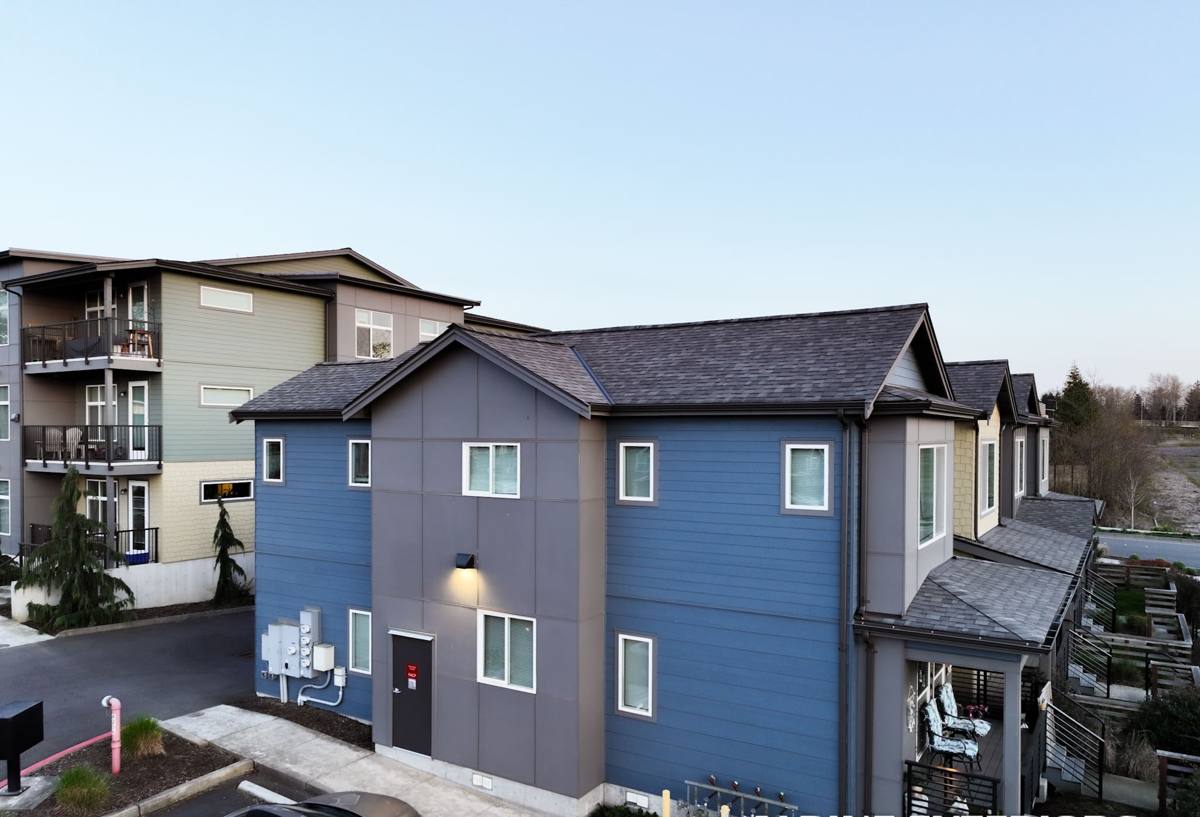
Why We Only Put James Hardie on Ferndale Homes
Birch Bay Exterior Co installs James Hardie fiber cement exclusively — not vinyl, not LP SmartSide, not cedar or primed spruce. That's a deliberate standard, not a sales preference, and it's grounded in how each of those materials actually performs under the specific conditions Ferndale homes face.
Salt Air and Coastal Drift
Salt-bearing air corrodes metal fasteners and trim faster than inland air does, and it accelerates the breakdown of lower-grade coatings. Vinyl siding can chalk and become brittle faster in this kind of exposure, and wood products need more frequent refinishing to keep salt-laden moisture from working into end grain and fastener holes. James Hardie's fiber cement doesn't corrode, and its factory-applied ColorPlus finish is formulated to hold up to UV and airborne salts far longer than a field-applied coat.
Wind-Driven Rain
Rain that comes in sideways finds every gap a straight-down rain never would — lap joints, butt seams, trim returns, and window flashing details. Fiber cement's dimensional stability means those joints stay tighter over time than wood or vinyl, which expand, contract, and warp with humidity swings. But the product is only half the equation; a wall detailed with proper flashing and water-resistive barrier work is what actually keeps wind-driven rain out, regardless of siding material.
Moss, Algae, and Shaded Exposures
Ferndale properties with mature trees, fenced yards, or north-facing walls that rarely see direct sun hold moisture longer, which is exactly what moss and algae need to take hold. Untreated wood and lower-grade composite products give organic growth something to root into over time. Hardie's cement-based composition doesn't feed mold or algae the way wood fiber does, which matters enormously on the shaded sides of a house where a wash-and-repaint cycle would otherwise become an annual chore.
What a Correct James Hardie Installation Actually Requires
The product is only as good as the installation behind it. Most siding failures we get called out to inspect in this region aren't material failures at all — they're installation shortcuts that let water in behind a perfectly good board.
Flashing and Water-Resistive Barrier
Every penetration — windows, doors, hose bibs, light fixtures, vents — needs proper flashing integrated with a continuous water-resistive barrier behind the siding. In a wind-driven rain climate, this layer is what actually keeps a wall dry; the siding itself is the first line of defense, not the only one. Skipping or rushing this step is the single most common cause of hidden rot behind newer siding.
Fastening Pattern and Clearances
James Hardie publishes specific fastener spacing, minimum ground clearance, and gap requirements for good reason — get them wrong and you invite moisture wicking, buckling, or premature fastener corrosion. Ground clearance matters even more on Ferndale lots with low-lying or poorly drained sections, where splash-back and standing moisture near the foundation are common.
Caulking and Trim Details
Hardie's installation guidance is specific about where caulk is required and where it isn't — over-caulking a joint that's supposed to allow drainage can trap water just as easily as under-caulking a joint that needs a seal. Getting these details right is a matter of following the manufacturer's specification exactly, every time, not improvising based on what's fastest.
Choosing the Right Hardie Product for a Ferndale Property
James Hardie's HZ product line is engineered by climate zone, and Whatcom County falls into the wetter, cooler HZ5 zone rather than the hotter, drier HZ10 zone used in the Southwest and parts of the Southeast. That distinction affects the formulation used to resist moisture and cold-weather stress, and it's part of why we spec HZ5 products for Ferndale jobs rather than treating all Hardie siding as interchangeable.
| Consideration | HZ5 (Whatcom County / Pacific Northwest) | HZ10 (hot/dry climates) |
|---|---|---|
| Primary stress | Sustained moisture, wind-driven rain, freeze-thaw cycles | Extreme heat, UV exposure, wildfire zones |
| Formulation focus | Moisture resistance, cold-climate durability | Heat and UV stability |
| Fit for Ferndale | Correct match | Not engineered for this climate |
Beyond the HZ designation, there's the question of profile. Lap siding (traditional horizontal boards) is the most common choice and performs well across nearly every Ferndale home style. Shingle-style panels give a textured, cottage look that many homeowners like on gables or accent walls. Board-and-batten suits more modern or farmhouse-style exteriors. All three are available in the HZ5 formulation, so the choice usually comes down to the look you want rather than a performance trade-off.
ColorPlus Factory Finish vs. Field-Painted Siding
One of the most overlooked advantages of James Hardie in this climate is the ColorPlus finish option — a coating baked on in a controlled factory environment rather than applied on-site with a brush or sprayer. In a region with Ferndale's rain and humidity patterns, field paint has a much harder job: it has to cure properly between rain events, adhere evenly across every board, and hold up to salt-air exposure from day one. Factory finishing removes most of that variability and typically carries a longer, separately backed color warranty than a job-site paint job would.
Homeowners who've repainted wood or fiber cement siding every five to seven years in this climate are often surprised by how much longer a ColorPlus finish holds its color and seal. It's not a cosmetic upgrade — it's a durability decision.
Our Process for a Ferndale Siding Project
- Exterior and moisture assessment — we look at existing siding, trim, and any soft spots or staining that hint at moisture already behind the wall, paying particular attention to shaded and low-lying sections common on Ferndale lots.
- Tear-off and sheathing check — old siding comes off so we can actually see the wall, not guess at its condition. Any rotted sheathing or framing gets addressed before anything new goes up.
- Water-resistive barrier and flashing — a continuous barrier and correctly integrated flashing at every window, door, and penetration, sized for wind-driven rain rather than a minimum-code approach.
- Hardie installation to spec — correct fastener pattern, ground clearance, and joint treatment, following James Hardie's published installation requirements rather than shortcuts.
- Trim, caulking, and final inspection — trim details finished, caulking applied only where it belongs, and a final walkthrough before we call the job done.
What Drives Cost on a Ferndale Hardie Job
Every home is different, but the same handful of factors move the price on most Ferndale siding projects:
- Total square footage and number of stories
- Condition of the existing sheathing once old siding comes off
- Number and complexity of window, door, and roofline transitions
- Profile choice — lap, shingle-style, or board-and-batten
- Site access, including landscaping, fencing, or setbacks that affect staging
- Whether trim, soffit, or fascia need replacement alongside the siding
We walk through all of this on-site before giving a number — general online estimates rarely account for the sheathing condition question, which is often the biggest variable on an older Ferndale home.
Signs Your Current Siding Is Already Losing the Fight
A lot of siding problems in this climate stay hidden until they're significant. Worth checking for:
- Paint that's peeling, bubbling, or chalking heavily on one or more walls
- Soft or spongy spots when you press on lower siding boards
- Persistent moss or algae staining that returns within a season of cleaning
- Visible gaps or warping at lap joints and trim seams
- Rust streaking from fastener heads
- Musty smell or discoloration on interior walls that back up to exterior siding
Any one of these on its own isn't necessarily an emergency, but they're worth a professional look before the next wet season adds to the damage.
Why Hiring a Crew That Already Works Ferndale Matters
Siding installation guidance reads the same everywhere on paper. What's different is knowing which walls in this specific area tend to hold moisture longest, which lot conditions call for extra attention to ground clearance and drainage, and which details actually matter once wind-driven rain and a long moss season are part of the equation rather than a hypothetical. A crew that installs Hardie siding across Whatcom County regularly brings that judgment to a Ferndale job site rather than treating it like generic exterior work.
If you're weighing a siding replacement or want a second opinion on what's already on your home, we're happy to take a look. The estimate is free, there's no pressure, and you'll get a straight answer about what your home actually needs.