 Birch Bay Exterior
 Custer's Climate Is Harder on Siding Than It Looks
Custer sits close enough to the water that homes here deal with a combination most siding products were never designed for: salt-laden air off the Strait of Georgia and Birch Bay, wind-driven rain that hits walls sideways instead of falling straight down, and long stretches of gray, damp months where surfaces barely get a chance to fully dry out. Add in the shade from mature evergreens on a lot of Whatcom County properties, and you get ideal conditions for moss, algae, and mildew to take hold on anything that holds moisture.
None of that is exotic weather. It's just Pacific Northwest coastal weather, day in and day out, for decades. But it means the siding on a Custer home is doing more work than siding on a house fifty miles inland, and the material and installation choices that would be fine somewhere drier start to show their weaknesses here faster than homeowners expect.
What Siding Actually Needs to Survive Here
Strip away the marketing and a handful of physical properties determine whether siding holds up in this climate:
- Dimensional stability — the material shouldn't swell, cup, or warp as it cycles through wet and dry
- Resistance to moisture absorption — siding that soaks up water stays wet longer, which feeds rot and moss growth
- A finish that doesn't rely on the homeowner — paint and stain both fail faster in salt air and constant damp, so a factory-cured finish matters more here than in drier regions
- Non-combustible material — wildfire smoke and ember exposure have become a real-season concern even west of the Cascades
- Installation that respects water management — correct flashing, gaps, and fastening matter more when wind is driving rain into every seam
This is the checklist we install against on every Custer job, and it's the reason we standardized on one product line instead of offering a menu of options with different trade-offs.
Why We Only Install James Hardie Fiber Cement
We install James Hardie fiber cement siding exclusively. We don't install vinyl, LP SmartSide, cedar, primed spruce, or other fiber cement brands like Cemplank or Allura. That's a deliberate standard, not a lack of options.
Fiber cement as a category — cement, sand, and cellulose fiber pressed and cured — is inherently dimensionally stable and non-combustible, which already solves two of the biggest problems homes near the water face. Within that category, Hardie's ColorPlus factory-applied finish is baked and cured under controlled conditions rather than painted on-site, which matters directly in a climate where field-applied paint and stain degrade faster from salt exposure and moisture cycling. Hardie also engineers specific product lines (HZ5, for example) for cold and wet regional climates, and backs installations with a long transferable warranty that assumes the product is installed to their written specifications.
Other siding products aren't necessarily bad products — vinyl is inexpensive and low-maintenance in mild climates, cedar has real aesthetic appeal, LP SmartSide is a legitimate engineered wood option in the right setting. But each carries trade-offs — heat and impact sensitivity, ongoing staining and sealing, or higher moisture sensitivity at cut edges — that we don't think are worth carrying on a home exposed to Whatcom County's coastal weather. We'd rather install one product correctly and stand behind it than offer several and let a homeowner absorb a trade-off they didn't fully understand going in.
How This Plays Out on a Custer Home
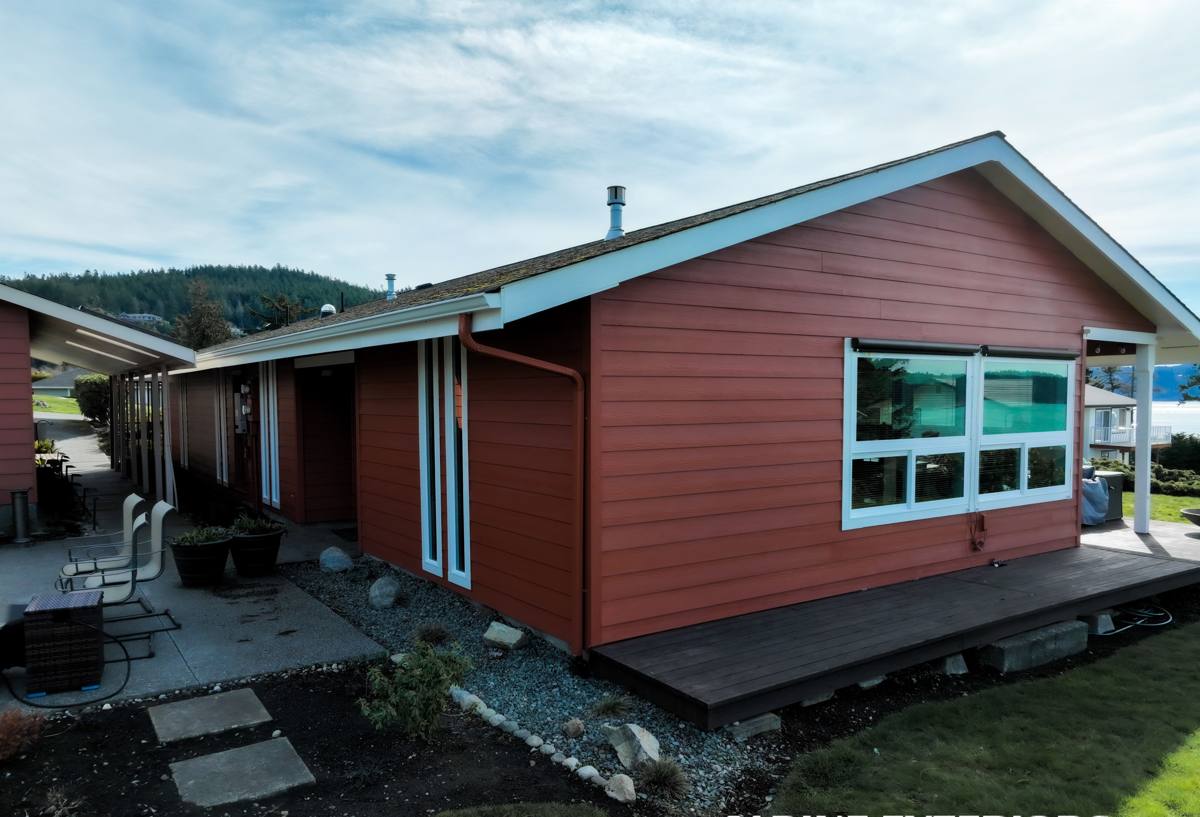
On a home near Birch Bay or Custer, that generally means lap siding or panel siding in an HZ5 formulation, factory-finished in a ColorPlus color, with trim and soffit material matched to the same system. The goal is a wall assembly where every component — siding, trim, flashing, house wrap — is doing its job together, not a patchwork of materials with different expansion rates and different failure points.
What Correct Installation Actually Involves
Fiber cement siding fails early almost exclusively because of installation mistakes, not because the material itself gave out. In a climate like this one, the installation details matter even more, because there's less margin for water to find its way behind the cladding and stay there.
- Inspect and repair the substrate. Old siding comes off, sheathing gets checked for rot or soft spots, and anything compromised gets repaired before anything new goes up.
- Install a proper water-resistive barrier. House wrap or building paper goes on correctly lapped, sealed at penetrations, and paired with rain screen or furring strips where the assembly calls for it, so moisture that does get past the siding has a path to drain and dry.
- Flash every opening. Windows, doors, and any wall penetration get flashed so water is directed out and down, never sideways or behind the barrier — this is where driving coastal rain finds weak installations fastest.
- Fasten and gap to Hardie's written specifications. Correct fastener type, spacing, and clearance from grade, from roof lines, and between board ends and corners — get this wrong and you get cracking, moisture intrusion, or a voided warranty.
- Caulk and seal only where Hardie specifies it — not everywhere, and not as a substitute for correct flashing.
- Final inspection against the manufacturer's checklist, not just a visual walk-around.
Every one of those steps is inspectable, and we don't skip any of them to move faster. A siding job that looks finished from the curb but skipped flashing details or fastener spacing is a callback waiting to happen, and in this climate that callback tends to arrive sooner rather than later.
Moss, Algae, and Salt: What to Expect Year-Round
Even correctly installed siding in Custer will get algae and moss growth on shaded, north-facing walls, and on any surface that stays damp under tree cover. That's a fact of the region's climate, not a defect. The difference correct fiber cement installation makes is that the siding itself isn't absorbing water and rotting underneath the growth — it's a surface issue that washes off, not a structural one.
Salt air primarily affects fasteners and metal components — flashing, trim nails, and any exposed hardware. Part of installing to spec here means using fasteners and flashing rated for coastal exposure, not just whatever is standard inland. It's a small material cost difference that has an outsized effect on how the assembly ages.
Comparing Siding Options in a Coastal Climate
| Material | Moisture Behavior | Salt Air / Coastal Fit | Maintenance | Finish Longevity |
|---|---|---|---|---|
| James Hardie Fiber Cement | Dimensionally stable, engineered HZ lines for wet climates | Strong — non-combustible, corrosion-resistant fastening when installed to spec | Occasional wash-down | Factory-cured ColorPlus finish, long warranty |
| Vinyl | Won't rot, but can warp or crack with temperature swings and impact | Fair — color can fade faster under UV and salt exposure over time | Low, but panels aren't repaired individually if damaged | Color is through the material, not a separate finish |
| Cedar / Wood | Absorbs moisture readily; prone to rot without diligent upkeep | Weaker — needs consistent sealing to resist coastal moisture | High — periodic staining/painting required | Field-applied finish degrades faster in damp, salty air |
| LP SmartSide (engineered wood) | Treated to resist moisture, but cut edges are a vulnerability point | Fair — sensitive to sustained moisture exposure at seams and edges | Moderate — edge sealing and touch-up over time | Field or factory finish depending on product; edge maintenance matters |
This table reflects general material characteristics, not a claim that any of these products fail outright — it's why we made a standard, not a prohibition.
Our Process for Custer Homeowners
We walk every home in person before quoting anything. On a Custer property, that inspection specifically looks at wall exposure to prevailing wind and rain, shaded areas prone to moss, existing moisture damage around windows and at the foundation line, and the condition of trim and soffits. From there we put together a written scope covering the siding line, color, trim package, and any sheathing repair we expect to need, so there are no surprises once the crew starts pulling old material off.
Because we work this area regularly, we already know which details tend to matter on Custer and Birch Bay homes specifically — corner and window flashing on west- and north-facing walls, clearance at grade where landscaping holds moisture against the wall, and fastener choice near the water. That familiarity shows up in fewer surprises mid-project and a tighter, more consistent finished result.
Signs Your Current Siding Is Already Losing the Fight
- Soft or spongy spots when you press on the siding, especially near the bottom courses or window sills
- Paint or finish that's peeling, chalking, or needs recoating more often than every few years
- Visible warping, cupping, or gaps opening up between boards or panels
- Moss or algae that keeps returning heavily in the same spots within weeks of cleaning
- Rust streaks around fasteners or trim, a sign hardware isn't holding up to the salt air
- Rising energy bills with no other explanation, which can point to a compromised weather barrier behind the siding
Any one of these is worth a look before it turns into a sheathing or framing repair, which costs considerably more than a siding replacement addressed early.
What a Custer Project Generally Involves
Every home is different, but a typical fiber cement re-side here includes removing the old siding, addressing any sheathing repairs found underneath, installing a correct water-resistive barrier and flashing package, and installing James Hardie lap or panel siding with matching trim, all fastened and gapped to manufacturer specification. Timeline and cost depend on the home's size, existing condition, and how much sheathing repair turns up once the old siding is off — which is exactly what an in-person walkthrough is for, rather than guessing from a phone call.
If you're weighing a siding replacement on a Custer or Birch Bay home, we're glad to come take a look and give you a straight, no-pressure estimate along with what we find on the walkthrough itself.