 Birch Bay Exterior
 Why Roofs Age Differently in Cottonwood Beach
Cottonwood Beach sits close enough to the water that salt-laden air reaches roofs year-round, not just during storms. Combined with the driving rain that rolls in off the Strait and a moss season that can stretch from fall through spring, homes in this part of Birch Bay put more wear on a roof system than most manufacturers' warranty language assumes. Fasteners corrode faster, algae and moss get a longer runway to take hold on north-facing slopes, and wind-driven rain finds any weak point in flashing or underlayment that a drier inland roof might never expose.
None of that means a roof here needs to fail early. It means the materials, ventilation, and installation details have to be chosen with this specific exposure in mind, not treated as an afterthought. A roof replacement done for Whatcom County's coastal conditions looks a little different from a standard tear-off-and-reshingle job, and that difference is usually what separates a roof that lasts its full rated life from one that needs attention again in eight or ten years.
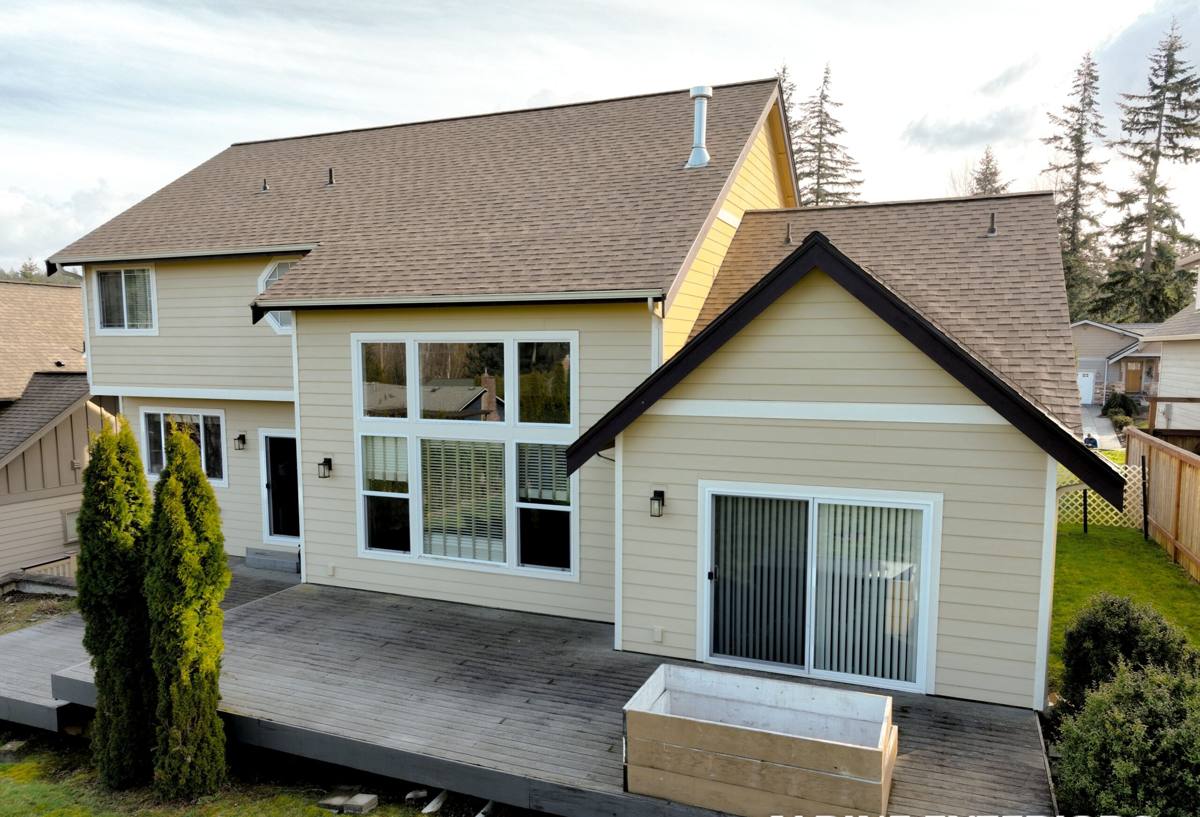
Signs Your Roof Has Reached the End of Its Service Life
Repairs make sense when the damage is isolated. Replacement becomes the honest recommendation when the roofing system as a whole is compromised. Homeowners in Cottonwood Beach usually see a combination of these signs before we get the call:
- Granule loss heavy enough that you're finding grit in gutters or downspout runoff every time it rains
- Shingles that are cupping, curling, or have gone brittle enough to crack when walked on
- Persistent moss or algae growth that comes back within weeks of cleaning, especially on shaded or north-facing slopes
- Soft spots in the decking, visible sagging along the ridge or eaves, or daylight visible through the attic sheathing
- Repeated leaks around the same penetration or valley despite prior patch repairs
- A roof that's past 20-25 years old for asphalt composition, or showing widespread wear rather than one bad section
One or two of these on their own might still be repairable. Several at once usually means the underlayment and decking beneath the shingles have absorbed enough moisture cycling that patching one area just shifts the problem to the next.
What a Correct Roof Replacement Actually Involves
Tear-Off and Deck Inspection
We don't install new roofing over old shingles, and we don't recommend it on a coastal property. A full tear-off is the only way to see the actual condition of the decking underneath — soft, delaminated, or water-stained plywood needs to be replaced before anything new goes down, and skipping that step just buries a problem under a fresh layer of shingles.
Underlayment and Water Protection
Given how much driving rain Birch Bay sees, we pay particular attention to underlayment quality and how it's lapped, along with ice-and-water shield membrane at eaves, valleys, and roof penetrations — the spots where wind-driven rain is most likely to work its way backward under a shingle edge. This is one of the details that's invisible once the job is done, which is exactly why it matters who's installing it.
Flashing and Fasteners
Flashing around chimneys, skylights, and wall intersections is one of the most common leak sources on older roofs, and it's often the first thing to fail in salt air if lower-grade metal was used originally. We use corrosion-resistant fasteners and flashing suited to a marine-influenced climate, since standard hardware can start showing rust well before the shingles themselves are due for replacement.
Ventilation
Proper intake and exhaust ventilation keeps moisture from condensing in the attic space, which matters as much for shingle lifespan as anything happening on the outside of the roof. Poor ventilation traps humidity that feeds moss and algae growth from underneath and can shorten the life of new shingles regardless of how well they're installed.
Matching Roofing Materials to Salt Air and Moss
There isn't one "best" roofing material for every home — it depends on budget, roof pitch, and how much long-term maintenance you want to take on. Here's how the common options hold up under Cottonwood Beach conditions specifically:
| Material | Salt Air / Moisture Behavior | Moss Resistance | Typical Lifespan Here |
|---|---|---|---|
| Architectural asphalt shingle | Good with proper flashing and fasteners; algae-resistant granules help | Moderate — needs periodic cleaning on shaded slopes | 20-30 years |
| Standard 3-tab shingle | Adequate but less margin for error on exposed slopes | Lower — shows growth sooner without maintenance | 15-20 years |
| Metal roofing (standing seam) | Excellent when properly coated; sheds moisture fast | High — little surface for moss to anchor | 40-50+ years |
| Cedar shake | Requires more upkeep in a wet, salt-air climate | Lower without regular treatment | 20-25 years with maintenance |
We don't push cedar shake on homes this close to the water as a first recommendation — not because it's a bad-looking product, but because the maintenance burden of keeping it treated and moss-free in this climate is higher than most homeowners want to sign up for. Architectural asphalt with algae-resistant granules or a metal roof are the two options we most often install in Cottonwood Beach, depending on the homeowner's budget and how long they want to go between maintenance visits.
What Drives the Cost of a Roof Replacement
Every roof is priced individually after an on-site inspection, but the factors that move the number are consistent. Understanding them ahead of time makes it easier to compare quotes honestly.
| Factor | Why It Matters |
|---|---|
| Roof size and number of planes | More material, more cut edges, more seams to flash correctly |
| Pitch and access | Steeper or harder-to-access roofs take longer and require more safety setup |
| Decking condition | Hidden rot or delamination found at tear-off adds material and labor |
| Material choice | Asphalt, metal, and cedar carry different material and labor costs |
| Number of penetrations | Chimneys, skylights, and vents each need individual flashing work |
| Existing layers | Removing multiple old layers of roofing adds disposal and labor time |
Be cautious of any quote that's dramatically lower than the others for the same scope of work — it often means a step like tear-off, deck replacement, or upgraded flashing has been left out, not that the contractor found a way to do it cheaper.
Our Process, Start to Finish
We keep the process straightforward because a roof replacement is disruptive enough without added surprises:
- On-site inspection — we get on the roof and in the attic, not just a look from the driveway, to assess the deck, ventilation, and flashing conditions specific to your home
- Written estimate — a clear scope of work and material selection, with options explained rather than a single take-it-or-leave-it number
- Scheduling around weather — we plan installation windows with Birch Bay's rain patterns in mind so materials aren't exposed longer than necessary
- Tear-off and deck repair — old roofing removed, decking inspected and replaced where needed before anything new goes down
- Installation — underlayment, flashing, ventilation, and roofing material installed to manufacturer specification
- Final walkthrough and cleanup — magnetic sweep for stray fasteners, debris hauled off, and a walkthrough so you know exactly what was done
Timing It Right: Moss Season and Weather Windows
Roofing work can happen most of the year in this part of Washington, but scheduling around the wettest stretches matters more here than in drier climates. We watch for realistic dry windows rather than forcing a tear-off ahead of an incoming system, because an exposed deck in driving rain is exactly the scenario that causes the water damage a replacement is supposed to prevent. If moss has already taken hold on your current roof, that's often a sign it's been retaining moisture for a while — worth having looked at before another wet season adds to the problem.
Why Local Experience in Cottonwood Beach Matters
A roofing crew that works this stretch of Whatcom County regularly already knows which slopes tend to hold moss longest, which flashing details fail first under this kind of wind-driven rain, and how far salt exposure reaches inland from the water. That's not something you get from a general contractor passing through the area once. It shows up in smaller decisions — the fastener grade specified, the underlayment lapped an extra few inches at a valley, the ventilation calculated for the actual attic rather than a rule of thumb — that add years to a roof's service life without adding much to the cost.
A Homeowner's Pre-Replacement Checklist
- Get a full inspection, not just a quote based on square footage or a satellite photo
- Ask what happens if decking damage is found once tear-off starts, and how that's priced
- Confirm what underlayment and flashing materials are included, not just the visible shingle
- Check that attic ventilation is being assessed, not assumed to be adequate
- Get the scope of work, material brand and type, and warranty terms in writing
- Ask how debris and disposal are handled, and whether a magnetic sweep for nails is included
If your roof is showing its age or you're just planning ahead, we're happy to take a look and give you a straightforward assessment — no pressure, no inflated urgency. Fill out the form below for a free estimate on your Cottonwood Beach roof replacement.