 Birch Bay Exterior
 Composite Decking Built for Lummi Island's Coastal Climate
Lummi Island and the surrounding Birch Bay area sit right at the edge of the Salish Sea, and that location shapes everything about how an outdoor deck ages. Salt-laden air moves in off the water almost daily, rain arrives sideways more often than straight down, and the shoulder seasons bring long stretches of damp, shaded conditions where moss and algae get a foothold on any horizontal wood surface. A deck built here doesn't fail the way one does in a dry inland climate — it fails at the fasteners, the framing, and the board surface, usually from moisture that never fully leaves the wood between storms.
Composite decking was designed to solve exactly this kind of exposure. It doesn't mean every composite board or every installation method holds up the same way, though. This page covers what we've learned installing and maintaining composite decks for homes on Lummi Island and along the Birch Bay shoreline, and what a correctly built deck actually needs in this specific environment.
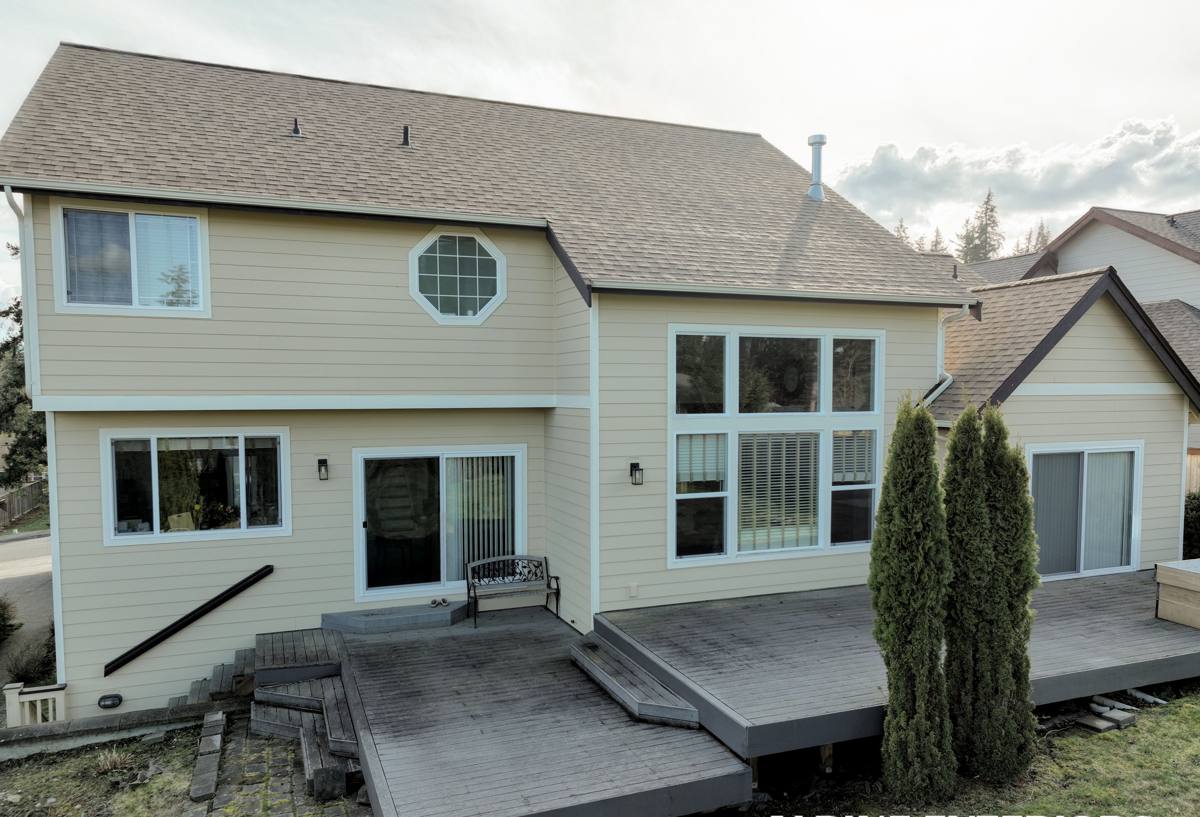
What Salt Air, Driving Rain, and Moss Season Do to a Deck
Salt Air and Metal Fasteners
Airborne salt accelerates corrosion on any exposed metal — screw heads, joist hangers, structural brackets. On a wood deck, corroding fasteners streak and stain the boards around them and eventually lose their grip. On a poorly built composite deck, the same corrosion happens out of sight in the framing, which is why fastener and hardware choice matters as much as the decking material itself.
Driving Rain and Water Intrusion
Wind-driven rain off the water doesn't just fall on a deck surface — it gets pushed into gaps, end cuts, and anywhere boards meet a house wall or railing post. Water that gets trapped and can't drain or dry out is the single biggest cause of premature deck failure in this region, regardless of decking material.
Moss and Algae Season
Whatcom County's long, cool, wet stretches from fall through spring create ideal conditions for moss and algae on any deck surface that stays shaded or doesn't dry quickly. On real wood, moss holds moisture against the fibers and speeds up rot. On composite, moss is mostly a surface and traction issue rather than a structural one — but it still needs to be planned for in board selection and layout.
Why Composite Makes Sense for This Location
We install both wood and composite decking, and we're upfront with homeowners about the trade-offs of each. For a deck on Lummi Island or anywhere along the Birch Bay waterfront, composite generally holds up better against the specific combination of salt, moisture, and shade this area produces — provided the framing underneath is built correctly, which we'll get to below.
| Factor | Wood Decking | Composite Decking |
|---|---|---|
| Moisture absorption | Absorbs and releases water; swells, cups, and checks over time | Minimal absorption; dimensionally stable in wet conditions |
| Moss and algae growth | Growth penetrates and holds moisture against wood fibers | Growth stays on the surface; cleans off without damaging the board |
| Salt air exposure | Accelerates fastener corrosion and surface graying | Board itself is unaffected; fastener choice still matters |
| Annual maintenance | Sealing or staining every 1-2 years in this climate | Periodic washing; no sealing or staining required |
| Upfront cost | Lower material cost | Higher material cost, offset by lower maintenance cost over time |
| Appearance over time | Changes character with age and weathering | Consistent color and texture for the life of the board |
Neither material is automatically the "right" answer for every homeowner — budget, the look you want, and how much upkeep you're willing to do all factor in. We'll talk through it honestly rather than push one option.
What a Correct Composite Deck Installation Actually Involves
Composite boards are only as good as what's underneath them. A rushed or undersized substructure will let a composite deck develop soft spots, uneven boards, or drainage problems even though the decking itself never rots. Here's what we treat as non-negotiable on every install in this area:
Framing and Substructure
Joist spacing has to match the specific composite product's span rating — composite boards generally need tighter joist spacing than solid wood decking of the same dimension, and skipping this is one of the most common corner-cutting mistakes we see on other people's work.
Fastener and Hardware Selection
Given the salt exposure here, we use stainless steel or coated fasteners and corrosion-resistant hardware throughout, not just at the visible surface. Hidden fastener systems also reduce the number of surface penetrations where water and salt residue can collect.
Drainage and Airflow Underneath
Standing water under a deck is a slow-motion problem — it keeps the framing damp long after the surface has dried, which is exactly the condition that shortens the life of joists and ledger boards regardless of what decking sits on top. We grade and vent the substructure so air and water both keep moving.
Ledger Board Attachment
Where a deck attaches to the house, flashing and waterproofing at the ledger board matter more here than almost anywhere else on the structure — it's the single most common point of hidden water intrusion into a home's framing, and driving rain off the water makes it worse.
Board Layout for Drying
Where a deck sits in shade for much of the day, we consider board direction and gapping so water sheds efficiently and surfaces dry out between rain events instead of staying damp, which cuts down on moss and algae buildup.
Working on Lummi Island: What's Different About the Logistics
Lummi Island is reached by a short ferry crossing, which is a real factor in how a deck project gets scheduled and staged — material deliveries, crew arrival, and equipment all have to work around the crossing rather than around highway traffic. We plan material orders and crew scheduling with that in mind so a project doesn't stall out waiting on a delivery that missed a window. It's a small detail, but it's the kind of thing that causes delays for a crew that hasn't worked on the island before.
Our Process for a Lummi Island Composite Deck Project
- On-site assessment — we look at the existing structure (if there is one), sun and shade exposure, drainage patterns, and how close the deck sits to salt air exposure or standing water.
- Framing evaluation — on replacement projects, we check whether the existing substructure can be reused or needs to be rebuilt to current span and fastener standards.
- Material and layout planning — board selection, direction, and fastener system chosen for the specific site conditions, not a one-size-fits-all spec.
- Logistics planning — material delivery and crew scheduling coordinated around ferry access.
- Installation — framing, flashing, drainage, and decking installed in sequence with inspection points along the way rather than all at once.
- Final walkthrough — we walk the finished deck with the homeowner and cover basic care specific to the board product installed.
Maintaining a Composite Deck Through Moss Season
Composite decking is genuinely low-maintenance compared to wood, but "low-maintenance" doesn't mean "no maintenance" in this climate. A little seasonal care goes a long way toward keeping a deck looking and performing the way it should.
- Sweep debris off the deck regularly, especially in fall when leaves and needles trap moisture against the surface
- Wash the deck surface a couple of times a year with a soft-bristle brush and mild soap and water to remove salt residue and early moss growth
- Avoid pressure washing at close range or high PSI, which can damage the board surface over time
- Keep gutters and downspouts near the deck clear so water isn't dumping directly onto or under it
- Check railing posts and stair connections annually for any looseness, which can signal a fastener or framing issue underneath
- Clear standing debris from under the deck periodically to keep airflow and drainage working as designed
What Affects the Cost of a Composite Deck Project Here
| Cost Factor | Why It Matters |
|---|---|
| Deck size and shape | Square footage and complexity of angles or curves drive material and labor directly |
| Substructure condition | Rebuilding framing versus reusing existing joists changes scope significantly |
| Board and fastener tier | Composite products range widely in price based on capstock quality and warranty length |
| Railing system | Composite, aluminum, and cable railing all carry different material and install costs |
| Site access and logistics | Ferry scheduling and site access on Lummi Island can affect delivery and crew time |
| Height and stairs | Elevated decks and multi-run stairs add framing and code requirements |
We give straightforward, itemized estimates so you can see exactly where the cost is coming from, rather than a single lump number.
Why Hiring a Crew That Already Works Lummi Island Matters
A composite deck built with the wrong assumptions — framing spaced for a different climate, fasteners that weren't rated for salt exposure, a schedule that didn't account for ferry logistics — can look fine on the day it's finished and still cause problems within a few years. Working regularly in Birch Bay and on Lummi Island means we've already accounted for the specific combination of salt air, driving rain, and moss-prone shoulder seasons that this part of Whatcom County deals with every year, instead of applying a generic decking spec and hoping it holds up.
If you're planning a composite deck on Lummi Island or anywhere in the Birch Bay area, we're happy to come take a look and put together a free, no-pressure estimate. There's a form below whenever you're ready.