 Birch Bay Exterior
 Siding Built for California Creek's Weather, Not Just Its Zip Code
California Creek sits close enough to Semiahmoo Bay and the Birch Bay shoreline that homes here take on a specific mix of punishment: salt-laden air blowing off the water, wind-driven rain that hits siding sideways instead of straight down, and a mossy, shaded understory in places where tree cover and low winter sun keep siding damp for days at a time. None of that is unusual for Whatcom County, but it adds up faster in low-lying, creek-adjacent areas than it does a few miles inland. Siding that would coast through its warranty period in a drier climate can start showing real wear here in half that time if it wasn't built — or installed — for these conditions.
This page is specifically about replacing siding on a California Creek home, not siding in general. The distinction matters because the right approach to material selection, installation detail, and long-term maintenance changes when your house sits in a salt-air, high-moisture microclimate rather than a generic Pacific Northwest one.
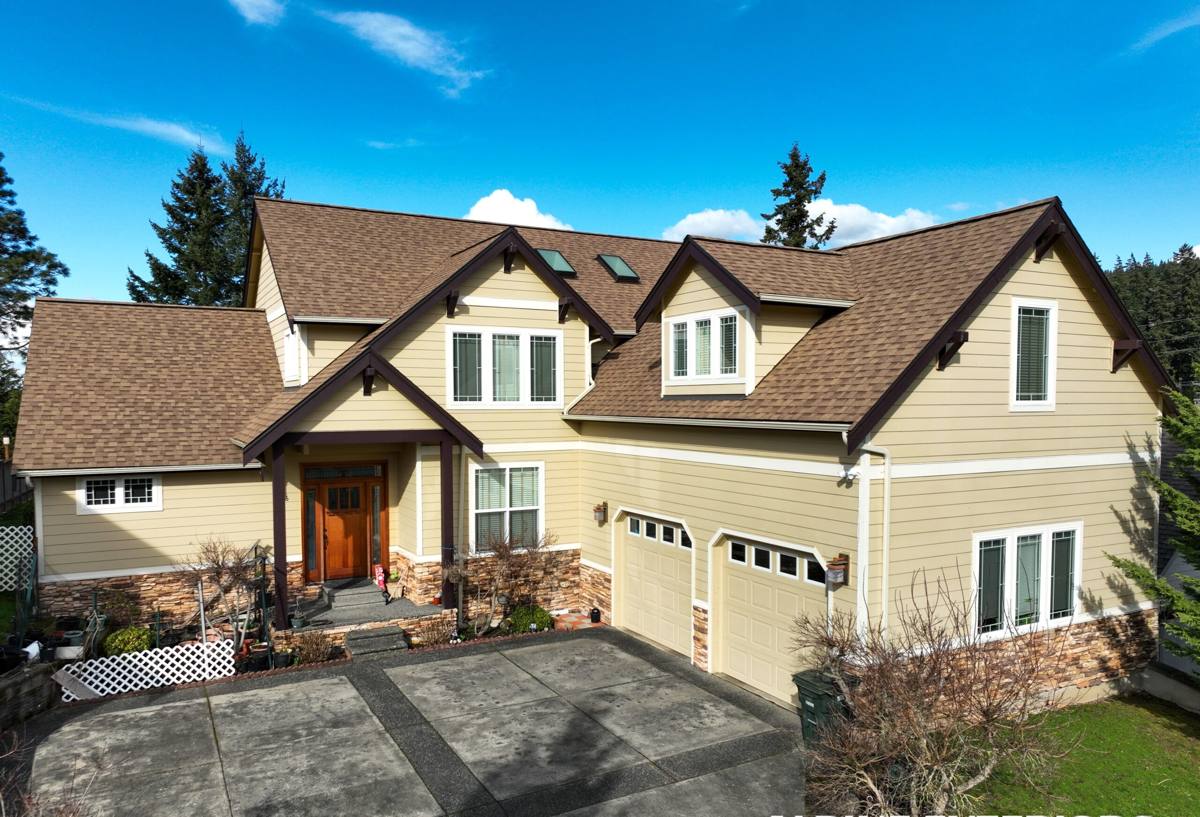
What Salt Air, Driving Rain, and Moss Actually Do to Siding
Salt Air
Airborne salt is corrosive to fasteners, flashing, and any exposed metal trim, and it accelerates the breakdown of lower-quality paint finishes. Over years, homes near the water tend to show chalking, fading, and edge deterioration on their siding well before homes set back from the shoreline — especially on the west- and south-facing walls that catch the prevailing weather.
Driving Rain
Wind-driven rain doesn't just wet the surface of your siding — it pushes water sideways and upward into laps, seams, and butt joints that were designed for water running straight down. If those joints, the house wrap behind them, and the flashing details around windows and doors aren't installed correctly, water finds its way behind the siding. Once moisture gets behind the cladding, it's out of sight and doing damage — to sheathing, framing, and insulation — long before anything looks wrong from the curb.
Moss Season
Wherever California Creek homes sit in shade or near mature trees, siding stays damp longer after every rain event, and moss and algae get a foothold. Organic growth on siding isn't just cosmetic — it holds moisture against the surface, which is exactly the condition that rots wood-based products and stresses paint finishes on lesser fiber cement.
Why We Only Install James Hardie Fiber Cement
We stopped installing vinyl, LP SmartSide, primed wood, and other fiber cement brands on Birch Bay homes because we kept seeing the same climate-driven failures repeat themselves — and because we didn't want to keep telling homeowners the same story five or ten years after installation. James Hardie fiber cement is what we put on homes now, for reasons specific to conditions like the ones in California Creek:
- Non-combustible composition — fiber cement doesn't burn, rot, or feed insects, which matters in a region where houses sit close to trees and vegetation.
- Engineered for moisture — Hardie's HZ5 product line is formulated specifically for wetter, harsher climates, which fits the driving-rain, salt-air profile of a creek-adjacent Birch Bay lot.
- ColorPlus factory finish — a baked-on finish that resists the fading and chalking that salt air accelerates on field-applied paint, and it holds up better against moss and algae staining than raw wood surfaces.
- Dimensional stability — fiber cement doesn't swell, warp, or cup the way wood-based siding can when it cycles through repeated wet-dry conditions all winter.
- Strong transferable warranty — backed by a manufacturer warranty structure that holds up if you sell the home, which matters more in a market where buyers ask pointed questions about siding age and condition.
To be fair to the alternatives: vinyl is inexpensive and low-maintenance in mild conditions, and LP SmartSide performs reasonably well when it's kept dry and well-maintained. But vinyl can warp and become brittle under UV and temperature swings, and any wood-based product depends heavily on caulking, painting, and moisture management staying perfect for decades — a maintenance burden that's harder to keep up with in a climate that's wet more months than it's dry. We'd rather install one product correctly than ask a homeowner to maintain a product that's fighting its environment from day one.
What a Correct Siding Replacement Involves Here
Replacing siding on a California Creek home isn't just pulling off old material and nailing up new panels. The details that actually determine how the job holds up over the next 20-30 years happen underneath the siding, not on the surface.
Tear-Off and Inspection
Once the old siding comes off, we inspect the sheathing and framing underneath for water damage, soft spots, or rot — which is common to find around window and door openings on homes that have taken years of driving rain without adequate flashing. Any compromised sheathing gets repaired or replaced before anything new goes up; installing new siding over damaged substrate just hides a problem instead of fixing it.
Weather-Resistive Barrier and Flashing
A correctly installed water-resistive barrier, properly lapped and taped, combined with correctly flashed windows, doors, and any wall penetrations, is what actually keeps driving rain out — not the siding itself. This is the step that gets rushed or skipped on lower-quality installs, and it's the step that matters most in a wind-driven-rain climate.
Fastening and Clearances
James Hardie siding has specific fastener spacing, nailing patterns, and clearance requirements — including gaps between siding and roof lines, decks, and grade — that are engineered into the manufacturer's install specs for a reason. Improper clearances trap moisture at the bottom edge of siding, which is one of the most common places we find early deterioration on homes that had cladding replaced without following spec.
Caulking and Sealant Details
Butt joints, trim intersections, and penetrations get sealed with sealants rated for the exposure, not just whatever's on hand. In a salt-air environment, sealant quality and application matter more than they would inland.
Comparing Siding Options for a California Creek Home
| Factor | James Hardie Fiber Cement (HZ5) | Vinyl | LP SmartSide / Wood-Based |
|---|---|---|---|
| Salt air resistance | Strong — factory finish resists fading/chalking | Moderate — can fade and become brittle | Moderate — depends entirely on paint upkeep |
| Driving rain / moisture behavior | Engineered for wet climates, doesn't swell or rot | Water-resistant surface, but seams can leak | Vulnerable if moisture gets behind or into panel edges |
| Moss/algae resistance | Good — dense, factory-finished surface | Fair — smooth surface sheds growth easier | Weaker — organic material is more susceptible |
| Fire resistance | Non-combustible | Combustible | Combustible |
| Maintenance burden | Low — occasional wash, no repainting for years | Low, but limited repair options once damaged | Higher — repainting/recaulking on a schedule |
| Typical lifespan when installed to spec | Decades, with strong transferable warranty | Long, but prone to UV/temp degradation | Shorter if maintenance lapses |
Why Hiring a Crew That Already Works California Creek Matters
Siding installation quality varies enormously between crews, and the gap shows up years later, not on install day. A crew that regularly works Birch Bay and the surrounding Whatcom County shoreline already knows what this specific stretch of coastline does to a house — which walls take the worst of the driving rain, where moss builds up fastest, and which flashing details actually hold up against salt air over time. That's different from general siding experience anywhere in the Pacific Northwest.
It also means we're not learning your microclimate on your project. We've seen how California Creek homes age, what fails first, and what doesn't — and we build the install around that, rather than a generic spec sheet.
What to Check Before Hiring Anyone for Siding Replacement
- Are they installing to the manufacturer's written specifications for fastening, clearances, and flashing — not just "however they usually do it"?
- Do they inspect and repair sheathing/framing before covering it, or just install over whatever's there?
- Do they use a proper weather-resistive barrier system, correctly lapped and taped?
- Can they explain why they chose the product line they're proposing for your specific site conditions?
- Is the manufacturer warranty transferable if you sell the home?
- Do they have experience specifically in coastal or high-moisture areas, not just siding in general?
Signs Your California Creek Home May Need Siding Replacement Soon
A few things worth watching for, especially heading into another wet Whatcom County winter: soft or spongy spots when you press on siding near the bottom edge or around windows, persistent moss or dark staining that keeps returning after cleaning, visible cracking or buckling, paint that's chalking or peeling faster than it should, and any musty smell or interior staining near exterior walls, which can point to moisture already working behind the siding.
Get a Straight Answer About Your California Creek Home
Every home in California Creek sits a little differently relative to the water, tree cover, and prevailing wind, and that affects what your siding actually needs. If you're not sure whether you're looking at a repair, a partial replacement, or a full re-side, we're happy to take a look and give you a straightforward assessment — no pressure, no upsell. Reach out using the form below for a free estimate.