 Birch Bay Exterior
 Why Birch Bay Village Siding Takes a Different Kind of Beating
Birch Bay Village sits close enough to the water that siding here deals with a combination most inland Whatcom County homes never see: salt-laden air rolling off the bay, driving rain that comes in sideways during winter storms, and a moss season that can stretch for most of the year on shaded or north-facing walls. Any one of those on its own is manageable. Together, they wear down the wrong siding material fast — and they're exactly the conditions James Hardie's coastal-rated products were engineered to handle.
Salt air is corrosive to fasteners and hard on paint film. Driving rain finds every gap in flashing and trim, and pushes moisture into places that face away from the prevailing weather. Moss and algae thrive in the shade and moisture that a lot of Birch Bay Village lots have from mature trees and marine cloud cover. We don't guess at how these factors interact — it's the daily reality of every siding job we run in this neighborhood.
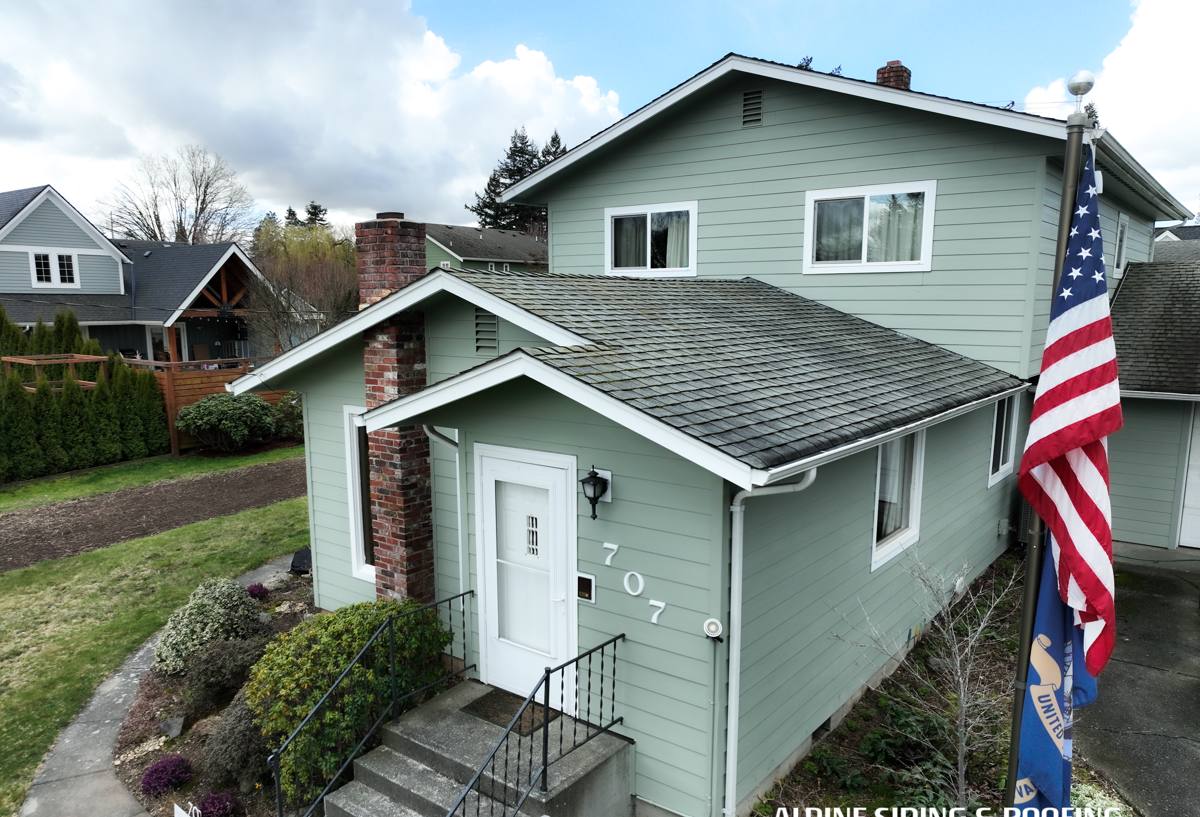
What James Hardie Siding Is, and Why It's the Only Product We Install
James Hardie siding is fiber cement — a mix of cement, sand, and cellulose fiber pressed and cured into planks and panels. It's non-combustible, it doesn't swell or rot the way wood-based products can, and it holds its factory-applied ColorPlus finish far longer than field-painted materials. We standardized our company on Hardie exclusively. We don't install vinyl, LP SmartSide, Cemplank, Allura, primed spruce, or cedar, and we're upfront with homeowners about why: in a climate like Birch Bay's, the long-term performance gap between fiber cement and those alternatives is real, and we'd rather put our name on one product we trust completely than juggle several.
Built for This Specific Climate
James Hardie engineers its siding in climate-specific formulations under the HZ5 designation for regions like ours — the Pacific Northwest's wet, moderate-temperature coastal belt. HZ5 siding is formulated to resist moisture-related damage in exactly the freeze-thaw-adjacent, high-humidity conditions Whatcom County delivers. That's a meaningfully different product than what gets shipped to arid or hard-freeze climates, and it's the version we order for every Birch Bay Village project.
What a Correct Installation Actually Involves
Fiber cement siding performs the way it's supposed to only when it's installed to Hardie's published specifications. Most siding failures we get called out to inspect aren't a product problem — they're an installation shortcut. On a property exposed to bay winds and driving rain, the margin for error is smaller than on a sheltered inland lot.
- Correct fastener placement and spacing, sized and spaced per Hardie's fastening schedule — not "close enough"
- Proper minimum clearances from grade, roof lines, decks, and patios so water has somewhere to go
- Weather-resistant barrier installed and lapped correctly behind the siding, not just stapled up
- Flashing at every window, door, and horizontal joint, integrated with the water-resistive barrier rather than caulked over as an afterthought
- Butt joints and panel seams treated per spec, since these are where driving rain finds its way in first
- Factory-cut edges sealed where required, since raw-cut fiber cement is more vulnerable to moisture uptake
- Proper caulking at penetrations — using sealants rated for the exposure, not whatever's on the truck
Skip any one of these and you can still end up with siding that looks right for a year or two before problems show up behind it — usually as trapped moisture, which is the one thing fiber cement's other advantages can't compensate for.
Our Process for a Birch Bay Village Siding Project
Assessment and Product Selection
We start by walking the exterior and noting which elevations take the worst weather — usually the sides facing the bay and prevailing storm direction — and which stay shaded and damp longer, which matters for moss planning. That informs product selection: lap siding, panel systems, or a mix, along with trim and accessory choices that hold up to marine exposure.
Tear-Off and Substrate Check
Old siding comes off and we inspect the sheathing underneath. This step matters more on coastal properties than almost any other, because it's where hidden moisture damage from a previous installation's flashing mistakes tends to surface. Any compromised sheathing gets addressed before anything new goes up — covering it over is how small problems become expensive ones.
Weather Barrier and Flashing
We install the water-resistive barrier and flashing system correctly lapped, working from the bottom up so every layer sheds water to the one below it. This is the layer that does the real work of keeping driving rain out, long before the siding itself is a factor.
Installation
Siding goes up to Hardie's fastening and clearance specifications, with joints, corners, and penetrations detailed as we go rather than caulked at the end. We don't treat trim and accessory work as an afterthought — the transitions around windows, doors, and rooflines are where most coastal siding failures actually start.
Final Walkthrough
We walk the finished job with the homeowner, checking sightlines, joint work, and caulking, and go over basic care so the siding performs the way it's rated to for years to come.
Comparing How Siding Materials Hold Up in Birch Bay Village Conditions
| Factor | James Hardie Fiber Cement (HZ5) | Vinyl | Wood / Primed Spruce / Cedar |
|---|---|---|---|
| Salt air / corrosion resistance | Strong — non-metallic substrate, factory finish resists salt exposure | Can become brittle and discolor faster near marine air | Finish and fasteners degrade faster; needs more frequent recoating |
| Moisture and moss-prone shade | Resists moisture absorption; surface can be treated/cleaned without damaging substrate | Doesn't rot, but traps moisture behind panels if installed poorly | Most vulnerable — absorbs moisture, feeds rot and moss growth |
| Driving rain / wind-driven water | Performs well when flashed and installed to spec | Can flex and open seams under wind pressure | Depends heavily on paint/seal maintenance schedule |
| Fire resistance | Non-combustible | Combustible, can melt/deform near heat | Combustible |
| Finish longevity | ColorPlus factory finish, long warranty coverage | Color baked in but fades and chalks over time | Field-applied paint/stain, shortest repaint cycle |
This isn't a knock on the other materials — vinyl and cedar both have legitimate uses elsewhere. It's why, specifically for the conditions Birch Bay Village properties face, we standardized on Hardie and don't install the alternatives.
Living With Moss Season: What Homeowners Can Do Between Services
Moss doesn't damage fiber cement the way it damages wood, but left unchecked it holds moisture against any surface and looks bad doing it. A few habits keep Hardie siding looking factory-fresh through a long Whatcom County moss season:
- Trim back tree limbs and shrubs that keep a wall shaded and damp longer than the rest of the house
- Rinse siding with a garden hose a couple times a year, focusing on north-facing and shaded elevations
- Avoid pressure washing directly into joints and seams — it can drive water where it shouldn't go
- Have gutters checked and cleared so overflow isn't running down the siding face
- Address any caulking gaps at trim or penetrations as soon as they're noticed, rather than waiting for the next paint cycle
None of this is heavy maintenance — that's part of the point of fiber cement. But a five-minute walk around the house each season catches small issues before winter storms turn them into bigger ones.
Why a Crew That Already Works Birch Bay Village Matters
Siding installation guidance is generic; siding installation in a specific microclimate isn't. A crew that's worked other properties in this neighborhood already knows which elevations tend to take the worst of the bay wind, how the local moss pattern behaves on shaded lots, and where drainage and grading tend to cause trouble on this stretch of coastline. That's knowledge you can't get from a spec sheet, and it shows up in the details — flashing choices, joint placement, clearance decisions — that separate siding that looks good on install day from siding that's still performing correctly a decade later.
We also stand behind the work with James Hardie's manufacturer warranty on the product and our own installation workmanship, backed by a company that's going to be reachable if a question comes up down the road — not just for the one job, but because we're already established in this area.
Get a Straight Answer for Your Home
If your Birch Bay Village home has siding that's showing its age — chalking paint, soft spots, moss buildup that won't quit, or visible gaps at the trim — it's worth a look before another winter storm season. We'll walk the exterior with you, tell you honestly what we see, and put together a no-pressure estimate for James Hardie siding built for this exact stretch of coastline. Use the form below to get started.