 Birch Bay Exterior
 Why Point Whitehorn Roofs Wear Differently Than Roofs Inland
Point Whitehorn sits close enough to the water that roofs here deal with a combination most inland Whatcom County homes don't: salt-laden air off the Strait of Georgia, wind-driven rain that hits shingles at an angle instead of straight down, and a shaded, damp tree canopy in a lot of the surrounding lots that keeps roof surfaces wet longer after every storm. None of these things alone is unusual for Western Washington. Together, on the same roof, year after year, they shorten the useful life of a shingle roof that wasn't installed with this specific combination in mind.
Salt air accelerates corrosion on exposed metal fasteners, flashing edges, and vent housings faster than it does a few miles inland. Driving rain finds its way under shingles that are laid with standard exposure and no upgraded underlayment at the eaves, valleys, and penetrations. And the extended damp season that Birch Bay and the surrounding area get every fall through spring is exactly the environment moss and algae need to take hold on north-facing slopes and anywhere tree cover blocks the sun. A roof built to a generic spec will survive here. A roof built for this spot will survive here longer, with fewer callbacks and less maintenance drama.
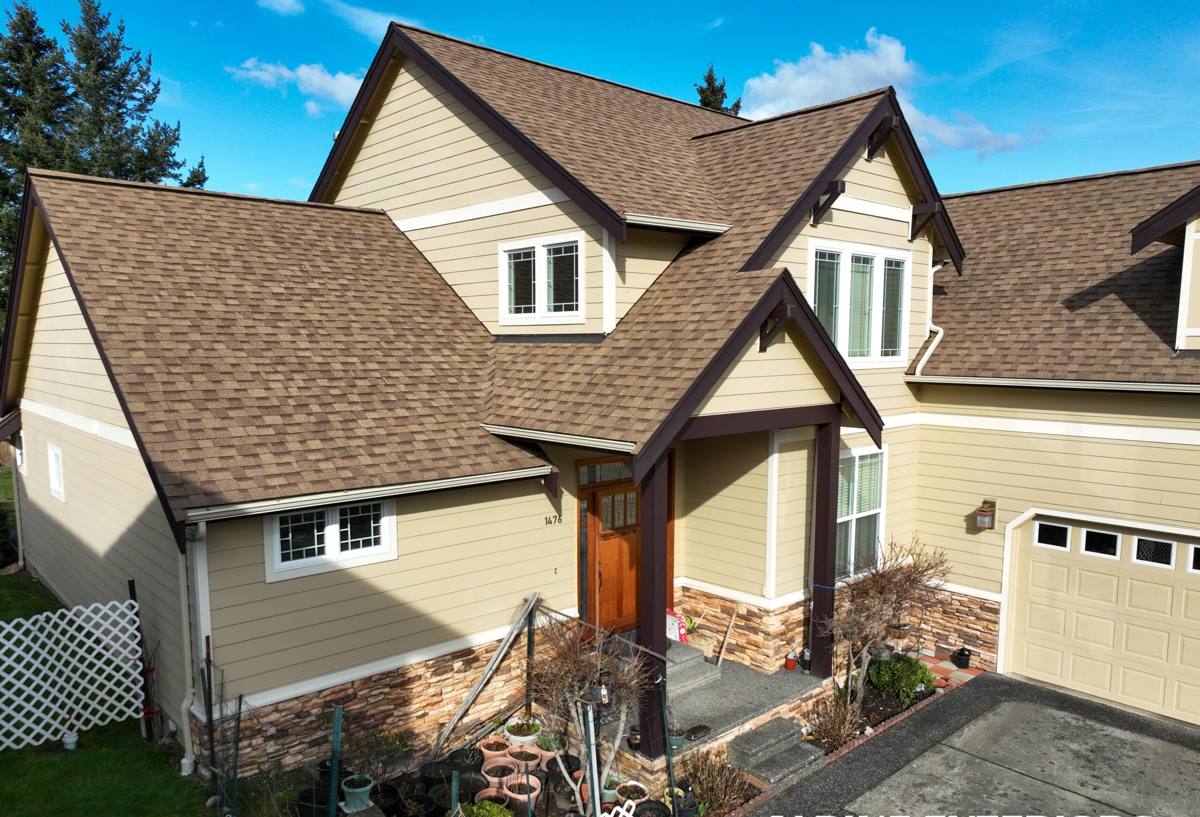
What a Correctly Built Shingle Roof Looks Like in This Environment
The Deck and Ventilation Come First
Before a single shingle goes down, the roof deck needs to be sound and the attic or roof assembly needs to be able to breathe. In a marine climate with long damp stretches, trapped moisture under the shingles is often a bigger long-term threat than the rain hitting the surface. Balanced intake and exhaust ventilation keeps the deck drying out between storms instead of staying damp, which matters just as much for shingle life as the shingles themselves.
Underlayment and Water-Shedding Details
Because Point Whitehorn gets driving rain that can push water sideways and uphill under standard shingle overlaps, we treat underlayment as a real second layer of protection, not a formality. That means synthetic underlayment across the field, and self-adhered ice-and-water membrane at eaves, valleys, and around every roof penetration — chimneys, skylights, plumbing vents — where wind-driven rain is most likely to find a gap.
Fasteners and Flashing Rated for Salt Exposure
Standard electro-galvanized nails and flashing hold up fine in a lot of the country. Close to Birch Bay, we lean toward corrosion-resistant fasteners and flashing metals, because salt air will find the weak link in a roofing system over time, and that weak link is almost always the cheapest metal component, not the shingle itself.
Shingle Options for Coastal Exposure — What We Recommend and Why
Not every asphalt shingle product is built the same way, and the differences matter more in a coastal, damp climate than they would somewhere drier. Here's how the common tiers compare for a Point Whitehorn roof specifically.
| Shingle Type | Wind Rating | Algae/Moss Resistance | Best Fit Here |
|---|---|---|---|
| Standard 3-tab | Lower | None built in | Budget projects on outbuildings or short-hold properties |
| Architectural / laminate | Higher | Available with algae-resistant granules | Most Point Whitehorn homes — good balance of cost and durability |
| Premium/designer laminate | Highest | Algae-resistant granules standard | Exposed, wind-heavy lots or homes wanting a heavier profile look |
For most homes in this area, we steer clients toward architectural laminate shingles with algae-resistant (copper- or zinc-infused) granules. The upgrade cost over standard 3-tab is modest, and the payoff is real: algae-resistant granules meaningfully slow the black streaking and moss-friendly buildup that a shaded, damp roof here is otherwise prone to. We don't push premium designer lines on every job — for a straightforward gable roof without unusual wind exposure, that upgrade is more about appearance than performance, and we'll say so plainly rather than upsell it.
Our Process, Start to Finish
- On-site inspection. We walk the roof (or the ground if pitch/safety requires) and check the deck, flashing, ventilation, and any problem areas — not just the shingles.
- Written scope and estimate. You get a clear breakdown of what's being replaced, what underlayment and flashing package is included, and why, before any work starts.
- Tear-off and deck check. Old roofing comes off down to the deck so we can actually see the wood underneath, not guess at its condition from above.
- Deck repair as needed. Soft or water-damaged sheathing gets replaced — this is called out and priced separately since it isn't always visible until tear-off.
- Underlayment and ice-and-water membrane. Installed per the details above, with extra attention at valleys, eaves, and penetrations.
- Flashing. New flashing at chimneys, walls, valleys, and vents rather than reusing old, potentially corroded pieces.
- Shingle installation. Laid to manufacturer spec for nailing pattern and exposure, which is what actually earns the wind and workmanship warranty.
- Ridge venting and final details. Ventilation components installed or upgraded, ridge caps set, and all metal checked for proper lap and sealant where required.
- Cleanup and walk-through. Magnetic sweep for nails, debris hauled off, and a final walk-through so you know what was done and what to watch for.
Living With a Shingle Roof in a Moss-and-Salt Climate
Even a well-built roof in this area benefits from some basic upkeep. None of it is complicated, but skipping it is how a good roof turns into an early replacement.
- Keep gutters clear — clogged gutters back water up under the first course of shingles, which is a common source of edge rot in this area.
- Trim back overhanging branches where practical — less shade means the roof dries faster after rain and moss has a harder time establishing.
- Have moss physically removed rather than pressure-washed — pressure washing strips protective granules and shortens shingle life.
- Check flashing and sealant at penetrations every couple of years — this is where salt-air corrosion shows up first, long before the shingles themselves fail.
- Have the attic checked for proper airflow if you notice moisture, musty smell, or ice damming in colder snaps — poor ventilation quietly shortens roof life from underneath.
What Drives Cost on a Point Whitehorn Roof
Every roof is priced on its own specifics, but the same handful of factors move the number up or down on most jobs in this area.
| Factor | Why It Matters Here |
|---|---|
| Roof pitch and access | Steeper roofs and limited driveway/staging access on wooded lots add labor time |
| Deck condition | Damp climate history means some tear-offs reveal sheathing replacement not visible beforehand |
| Shingle tier chosen | Standard vs. algae-resistant architectural vs. premium laminate |
| Number of penetrations | Chimneys, skylights, and multiple vents each need individual flashing work |
| Ventilation upgrades | Adding or correcting intake/exhaust venting where an older roof was under-vented |
We'd rather walk a homeowner through these factors honestly during the estimate than hand over a number with no explanation behind it.
Why a Crew That Already Works Point Whitehorn Is Worth Choosing
A roofing crew that regularly works this stretch of Whatcom County has already dealt with the site-access quirks of the surrounding wooded lots, knows what the local building department expects for permits and inspections, and has a working sense of which flashing and ventilation details actually hold up here versus on paper. That's not a marketing point — it's the difference between a crew guessing at a coastal, damp-climate roof for the first time and one that's already made and corrected those judgment calls on roofs down the street. It also means faster response for follow-up questions or minor post-install adjustments, since we're not driving in from across the region.
What to Expect After Installation
Once your roof is on, you should have documentation of the shingle manufacturer's warranty and our workmanship coverage in writing, along with a straightforward explanation of what each one actually covers — manufacturing defects versus installation issues are two different things, and homeowners deserve to know which is which before they need to use either one. We'll also flag anything on your specific roof — a shaded slope prone to moss, a valley that collects debris — worth keeping an eye on going forward.
If your current roof is showing granule loss, moss buildup, curling edges, or you're just past the age where a coastal, damp-climate shingle roof typically starts needing attention, it's worth having someone look at it before a small issue becomes a deck repair. We're happy to come out, walk the roof, and give you a straight, no-pressure estimate — there's a form below to get that started.