 Birch Bay Exterior
 Bellingham's Climate Is Harder on Siding Than Most Homeowners Realize
Bellingham sits close enough to the Salish Sea that homes here deal with a specific combination of stresses: salt-laden air drifting off the water, long stretches of driving rain pushed in by winter storms, and a moss season that can run most of the year in shaded, north-facing spots. Any one of these is manageable. Together, over years, they expose the weak points in siding that wasn't built or installed for this exact environment.
We work throughout Whatcom County, including Bellingham, and we see the same failure patterns repeat on homes with the wrong siding choice or a rushed installation: swollen seams, chalky or peeling paint, moss creeping up from the bottom courses, and soft spots where moisture found a way behind the cladding. This page covers what a Bellingham home actually needs from its siding, what correct installation looks like, and why we've standardized on one product system instead of offering everyone's options.
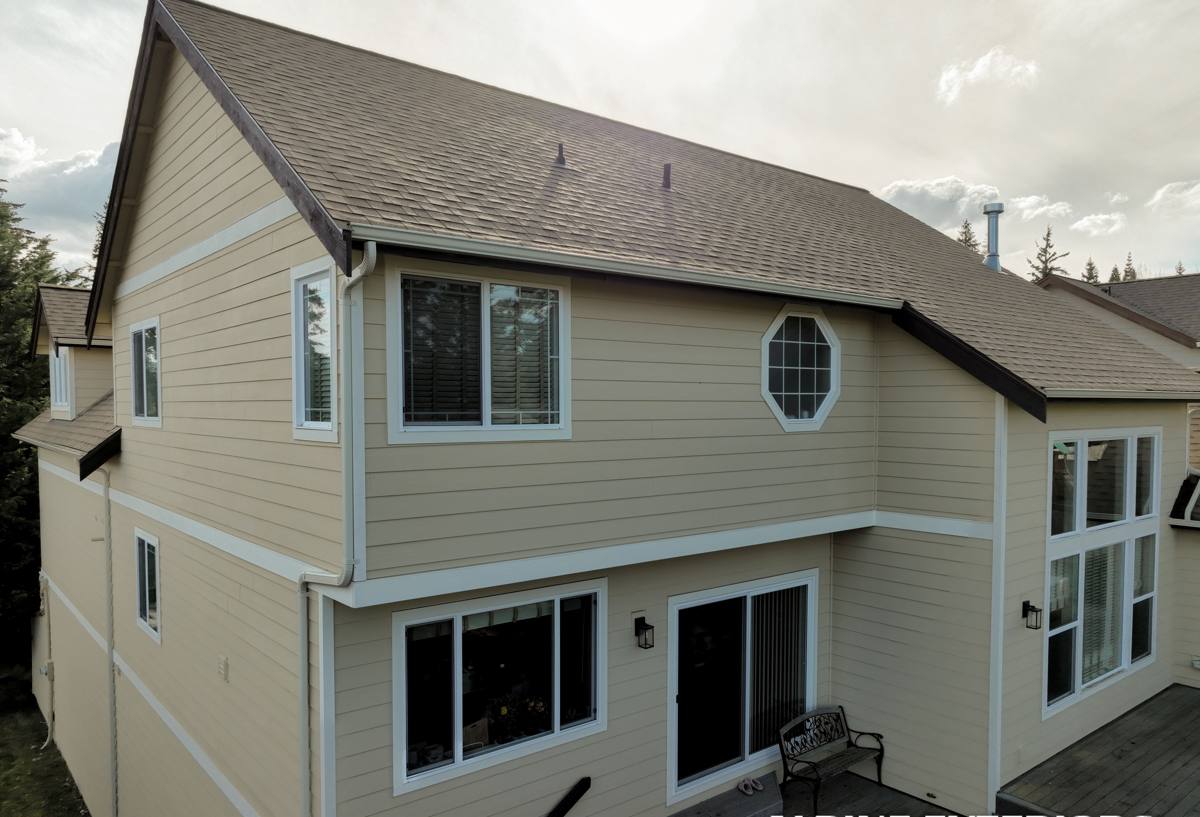
What Salt Air, Driving Rain, and Moss Actually Do to a Wall System
Salt Air
Salt-laden moisture is corrosive and it's persistent — it doesn't just affect metal fasteners and flashing, it accelerates the breakdown of lower-grade siding materials and finishes. Paint and coatings that aren't formulated to hold up in a marine environment tend to fail faster near the coast than they would ten or twenty miles inland.
Driving Rain
Wind-driven rain doesn't fall straight down — it gets pushed sideways into laps, seams, and butt joints. Siding that relies on tight-fitting seams and minimal weather-resistive barrier detailing is exactly the kind of product that lets water find its way behind the cladding during a hard westerly storm. Once moisture gets behind the siding, the sheathing and framing underneath pay the price, often silently for years.
Moss Season
Shaded, north-facing, and tree-lined walls in Bellingham can stay damp for weeks at a time. Moss and algae take hold on surfaces that hold moisture at the surface, and on organic or absorbent siding materials that growth can work its way into the material itself, not just sit on top of it. That's a maintenance burden most homeowners underestimate when they choose siding.
Why We Install Only James Hardie Fiber Cement
We don't offer vinyl, LP SmartSide, Cemplank, Allura, primed spruce, or cedar. That's a deliberate standard, not a limitation in what we're capable of installing. Each of those products has real strengths, but each also has a trade-off that shows up specifically in a climate like Bellingham's:
- Vinyl expands and contracts with temperature swings and can warp or crack in high-wind, driving-rain conditions; it also relies on lap seams that aren't sealed, which isn't ideal where wind-driven moisture is common.
- Wood species like cedar and primed spruce are organic materials — they're naturally more susceptible to moisture absorption, rot, and moss/algae growth in a wet, shaded marine climate, and they demand far more repainting and maintenance to hold up.
- Engineered wood siding (LP SmartSide) holds paint well and is more affordable, but as a wood-based product it still depends heavily on caulking, flashing, and finish maintenance being kept up perfectly to resist moisture over decades near the water.
- Other fiber cement brands (Cemplank, Allura) are legitimate fiber cement products, but we've standardized on one manufacturer's system — engineering, factory finish, and warranty — so every job we do is built to the same known spec, with one point of accountability.
James Hardie fiber cement is non-combustible, dimensionally stable, and factory-finished with ColorPlus technology, which bakes the color into the board instead of relying on a job-site paint job to hold up against salt air and UV. For a coastal Whatcom County home, that combination directly addresses the three stresses above: it doesn't rot, it holds its finish longer than field-applied paint, and it's engineered as a system rather than assembled from mismatched parts.
Choosing the Right Hardie Product Line for a Bellingham Home
James Hardie makes climate-engineered "HZ" product lines specifically because siding performs differently in a wet coastal climate than it does in a dry inland one. For Bellingham, that means selecting the HZ5 line, engineered for regions with more moisture, freeze-thaw cycling, and humidity — as opposed to the HZ10 line built for hot, dry climates. Getting this right isn't cosmetic; it affects how the product handles moisture at the joints and how it's recommended to be installed.
| Hardie Product | Common Use | Why It Fits Bellingham |
|---|---|---|
| HardiePlank Lap Siding (HZ5) | Primary wall cladding | Most common siding profile; factory-finished, engineered for wet/humid coastal exposure |
| HardiePanel Vertical Siding | Accent walls, gables, modern facades | Clean vertical lines with the same moisture-resistant fiber cement core |
| HardieTrim Boards | Corners, window and door trim, fascia | Matches expansion behavior of the field siding, reducing gaps that let water in |
| HardieShingle Siding | Accent gables, Craftsman and cottage styles | Shingle look without the moisture-absorption and moss issues of real wood shakes |
What a Correct Installation Actually Involves
Fiber cement siding is only as good as the wall assembly behind it. Most of the failures we get called out to inspect trace back to installation shortcuts, not the siding material itself. A correct James Hardie installation in a climate like ours includes:
- A continuous weather-resistive barrier installed correctly behind the siding, lapped shingle-style so water sheds outward rather than working its way in
- Proper flashing at every window, door, deck ledger, and roof-to-wall transition — the details where driving rain finds gaps
- Correct fastener type and placement per Hardie's published installation instructions, since improper fastening is one of the most common causes of premature failure and voided warranties
- Manufacturer-specified clearances between the bottom of the siding and the ground, roofline, decks, and patios, so splashback and standing moisture don't sit against the board
- Factory-primed or factory-finished cut edges sealed as specified, since exposed raw edges are a common entry point for moisture
- Caulking only where Hardie's details call for it — over-caulking joints that should be left to drain can trap water rather than shed it
None of this is exotic work, but it requires a crew that installs Hardie regularly enough to treat these steps as routine rather than an afterthought.
Our Process for a Bellingham James Hardie Project
We keep the process straightforward and communicate clearly at each stage:
- On-site assessment: We look at your home's exposure — how much direct weather it takes, shaded/moss-prone sides, existing moisture damage, and current siding condition.
- Product and color selection: We walk through the appropriate HZ5 profile and ColorPlus color options for your home's style and exposure.
- Written estimate: A clear scope covering removal of existing siding, any sheathing repair needed, weather barrier, flashing, and the Hardie installation itself.
- Tear-off and inspection: Once old siding is off, we inspect the sheathing for hidden rot or moisture damage before anything new goes up — this is often where problems from the old siding surface.
- Installation to spec: Weather barrier, flashing, and Hardie boards installed per manufacturer instructions, not shortcuts.
- Final walkthrough: We review the finished work with you and go over basic care.
What Affects the Cost of a Bellingham Siding Project
| Factor | Why It Matters Here |
|---|---|
| Existing wall condition | Homes with hidden moisture damage from prior siding failures may need sheathing or framing repair before new siding goes on |
| Home size and complexity | Multiple gables, dormers, and trim details add labor beyond flat wall footage |
| Product line and profile | Lap width, panel vs. plank, and trim choices affect material cost |
| Color selection | Standard ColorPlus colors vs. custom finishes can shift pricing |
| Access and site conditions | Sloped lots, tight setbacks, and mature landscaping common in the area can affect labor time |
We give a written, itemized estimate before any work begins so you know exactly what you're paying for and why — no vague lump-sum numbers.
Living With Hardie Siding Through Bellingham's Moss Season
Correctly installed Hardie siding dramatically reduces the maintenance burden compared to wood or engineered wood alternatives, but no siding is entirely maintenance-free in a wet marine climate. A short seasonal checklist keeps it looking right for the long haul:
- Rinse siding periodically, especially on shaded north- and west-facing walls where moss and algae are most likely to establish
- Keep gutters clear so overflow doesn't run down the siding face and feed moss growth
- Trim back vegetation and tree cover that keeps a wall damp and shaded longer than necessary
- Inspect caulking at trim and penetrations annually, since caulk (not the Hardie board itself) is typically the first thing to need attention
- Address any impact damage or chipped finish promptly so the underlying board doesn't stay exposed to moisture
Why Hiring a Crew That Already Works Bellingham Matters
Installation quality is the single biggest variable in how long siding performs — more than the product itself. A crew that regularly works Bellingham and greater Whatcom County already understands which walls take the worst of the driving rain, which sides of a house fight moss the hardest, and how to detail flashing and clearances for a marine climate rather than a generic installation manual written for anywhere in the country. That local repetition is what turns "correctly installed per spec" from a checklist into a habit.
If you're weighing a siding replacement or new construction siding for a Bellingham home, we're happy to walk the property with you, explain what we're seeing, and put together a straightforward, no-pressure estimate using the form below.