 Birch Bay Exterior
 Cottonwood Beach Decks Live in a Tougher Environment Than Most
Cottonwood Beach sits close enough to the water that every deck out here deals with conditions a lot of composite decking never has to handle inland: near-constant salt-laden air, driving rain that comes in sideways off the Strait, and a moss season that can run eight or nine months of the year in Whatcom County's mild, wet climate. None of that is a reason to avoid composite decking. It's the reason to install it correctly, with the right materials and the right substructure, from the start.
We've worked on enough decks in this neighborhood to know the failure patterns before they show up: fastener corrosion where salt air gets at exposed metal, moss creeping into board grooves where drainage was never planned for, and framing that rots out from underneath a perfectly good-looking deck surface because nobody addressed ventilation. Composite boards solve the surface problem. They don't solve the rest of it by themselves.
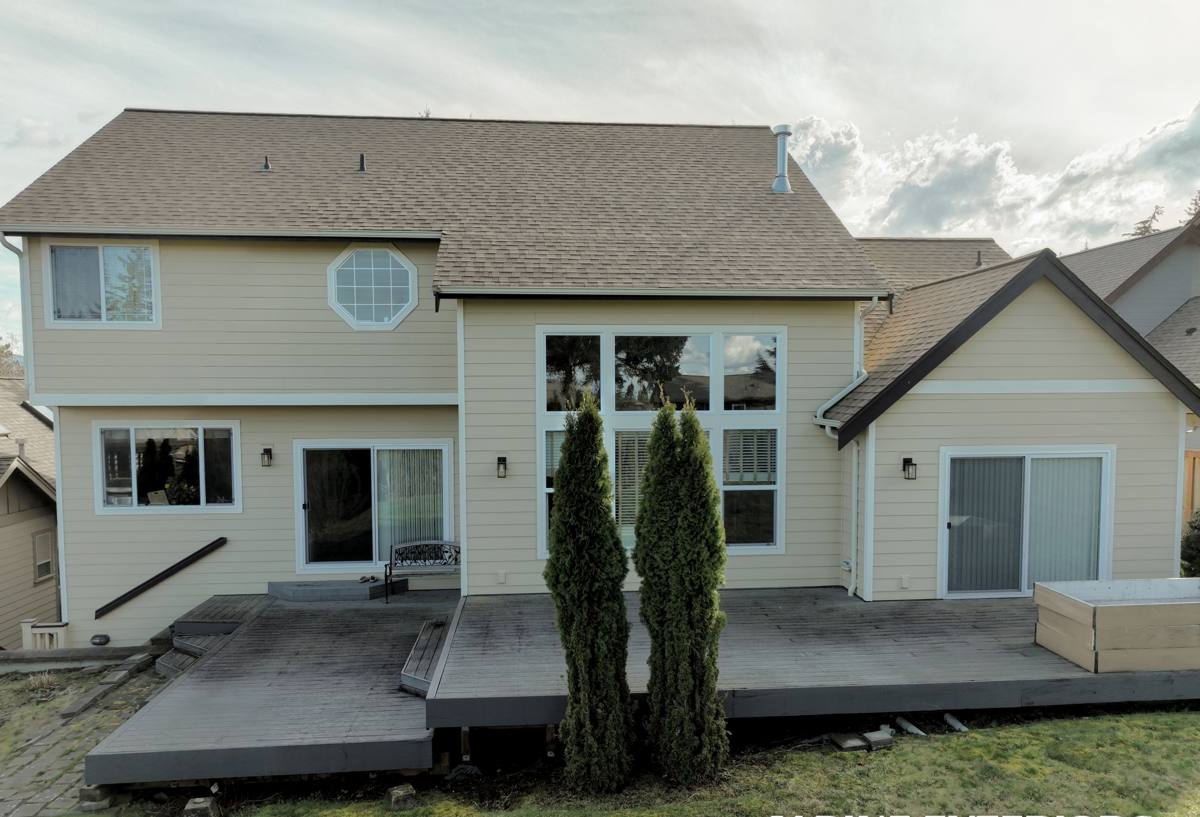
Why Composite Makes Sense for This Specific Location
Wood decking in a salt-air, high-moisture environment needs regular sealing, sanding, and staining to hold up, and even then it's fighting a losing battle against cupping, splintering, and rot in shaded, damp corners. Composite decking — made from wood fiber and recycled plastic, usually with a protective cap — doesn't absorb moisture the way solid wood does, doesn't need annual staining, and resists the kind of surface decay that salt air accelerates in untreated lumber.
That said, composite isn't maintenance-free, and we tell every homeowner that upfront. It still needs to be cleaned periodically, especially here, because moss and algae will grow on any decking surface — composite included — if organic debris and shade create the right conditions. The advantage isn't zero upkeep. It's that the upkeep is cleaning, not structural repair.
What Salt Air Actually Does to a Deck
Airborne salt is corrosive to exposed metal — screw heads, joist hangers, railing brackets — and it accelerates oxidation on anything not rated for coastal exposure. It's a slower, quieter problem than moss, but it's the one that causes structural issues years down the road if the wrong fasteners went in during construction.
What Moss Season Actually Does to a Deck
Moss needs shade, moisture, and organic material to root in. A deck with tight board spacing, poor airflow underneath, or debris trapped in grooves gives it exactly that. Once moss establishes itself on a walking surface, it also becomes a slip hazard — a real concern on stairs and ramped sections common on waterfront and hillside lots in this area.
What a Correct Composite Decking Installation Involves
A composite deck is only as good as what's underneath it. Homeowners often assume the board material does all the work, but in our experience, most premature composite deck problems trace back to substructure and installation decisions, not the decking material itself.
Substructure and Framing
Joists and beams need to be sized and spaced for the specific composite product going down — composite boards generally require tighter joist spacing than solid wood, and manufacturer specs vary by product line. We check existing framing on any deck rebuild for rot, undersized members, and ledger board attachment before a single composite board is ordered.
Drainage and Airflow
Given how much rain this area sees, a deck's ability to shed water fast matters more than it does in drier climates. That means correct board spacing, a substructure that doesn't trap standing water, and — where a deck sits low to grade or over a patio below — proper flashing and, when called for, a drainage system underneath to keep the space below usable and dry.
Fasteners and Hardware
In a salt-air environment, we use corrosion-resistant, coastal-rated fasteners and hidden clip systems rather than standard hardware. This is one of the cheapest parts of the job in material cost and one of the most consequential if it's skipped — corroded fasteners are a common reason composite decks develop movement or squeaking years after installation.
Board Selection and Layout
Board direction, picture-framing at the perimeter, and expansion gaps all need to account for temperature swings and moisture. Composite expands and contracts less than wood but still moves, and it needs room to do it without buckling.
Capped vs. Uncapped Composite: What We Recommend and Why
Composite decking generally falls into two categories, and the difference matters a lot in a climate like this one.
| Feature | Capped Composite | Uncapped Composite |
|---|---|---|
| Moisture resistance | Protective polymer shell resists water absorption | More susceptible to moisture uptake over time |
| Moss and mildew resistance | Smoother, denser surface is easier to clean off | More porous surface can hold organic growth |
| Fade and stain resistance | Better long-term color retention | More prone to fading and staining |
| Upfront cost | Higher material cost | Lower material cost |
| Our recommendation for this area | Standard choice given rain and salt exposure | Considered only for covered, low-exposure areas |
Our default recommendation for Cottonwood Beach and the broader Birch Bay waterfront is capped composite, simply because the environment gives uncapped product a harder time holding its appearance and performance over the years. We'll walk through specific product lines, colors, and warranty terms during an in-person estimate rather than guessing at what fits your home over the phone.
Our Process, Start to Finish
- Site assessment: We look at existing framing (if replacing a deck), grade, drainage patterns, sun/shade exposure, and proximity to salt spray.
- Design and material selection: Board style, color, railing, and fastener hardware chosen to match the specific site conditions, not a generic spec sheet.
- Permitting: We handle the Whatcom County permitting process for structural work where required.
- Demolition (if applicable): Old decking and any compromised framing removed and hauled off.
- Substructure work: Framing repaired or built to spec for the composite product being installed, with attention to joist spacing and ventilation.
- Decking installation: Boards installed with coastal-rated fasteners, correct spacing, and proper transitions at stairs, borders, and house attachment points.
- Final walkthrough: We go over care and cleaning with you before we consider the job done.
Maintaining a Composite Deck in This Climate
Composite decking cuts down on maintenance significantly compared to wood, but "low maintenance" isn't "no maintenance," especially this close to the water. A little seasonal attention goes a long way toward keeping a deck safe and good-looking for its full service life.
- Sweep debris (leaves, needles, seed pods) off the surface regularly — trapped organic matter is what feeds moss growth
- Rinse salt residue off with plain water periodically, especially after storms with onshore wind
- Clean with a soft-bristle brush and a composite-safe cleaner once or twice a year, more often in shaded areas
- Avoid pressure washing at close range or high PSI, which can damage the cap layer on capped boards
- Check railing hardware and fastener points annually for corrosion, particularly on older installations
- Keep gutters and downspouts clear so runoff isn't dumping extra water directly onto the deck surface
- Address any moss growth promptly — it's easier to remove when it's a light film than once it's established
What Affects the Cost of a Composite Deck Project
| Factor | Why It Matters |
|---|---|
| Deck size and layout complexity | Curves, multiple levels, and picture-framing add labor and material |
| Substructure condition | Repairing or rebuilding rotted framing adds cost before decking even goes down |
| Board tier (capped vs. uncapped) | Capped composite costs more upfront but holds up better in this climate |
| Railing and hardware choice | Composite, aluminum, and cable rail systems vary widely in price |
| Site access | Waterfront and hillside lots can complicate material delivery and staging |
| Drainage systems | Under-deck drainage adds cost but protects space used below the deck |
We give firm, itemized quotes after seeing the site in person — not ballpark numbers based on square footage alone, since the substructure condition and access on Cottonwood Beach properties vary a lot from lot to lot.
Why It Matters That We Already Work This Neighborhood
A contractor who's only worked inland decks in drier parts of Whatcom County may not think twice about fastener grade, drainage detailing, or board selection — because they've never had to. We've seen firsthand what salt air and a long moss season do to decking that wasn't built for it, and we build accordingly by default, not as an upsell. That includes knowing which products actually hold up here, what substructure choices actually matter, and what maintenance routine is realistic for a homeowner to keep up with.
It also means fewer surprises during the project itself. We're familiar with the site conditions common to this stretch of Birch Bay — proximity to water, typical soil and drainage patterns, and the county's permitting process — so estimates tend to hold up once work actually starts.
Get a Straight Answer on Your Project
If you're weighing a new composite deck or a replacement for one that's not holding up in Cottonwood Beach's climate, we're happy to take a look and give you a clear, no-pressure estimate. Use the form below to get started — we'll talk through what your specific property needs, not a generic package.