 Birch Bay Exterior
 Birch Bay Village Decks Face a Different Kind of Wear
Decks in Birch Bay Village don't fail the way decks do further inland. Sitting near the water in Whatcom County, homes here deal with a steady mix of salt-laden air, driving rain off the Strait, and a moss season that can stretch for most of the year in shaded, tree-lined lots. That combination doesn't just make a deck look tired — it works on the wood and hardware in ways that are easy to miss until a board flexes underfoot or a railing post starts to wobble.
Salt air accelerates corrosion on fasteners, brackets, and any exposed metal hardware, even on decks that are covered or partially sheltered. Driving rain finds its way into joints, ledger connections, and end grain faster than a straight-down rain would, especially on decks that face open water or take wind off the bay. And moss doesn't just sit on the surface — it holds moisture against the wood, keeps boards from drying out between storms, and creates a slick, slippery walking surface long before anyone notices rot underneath.
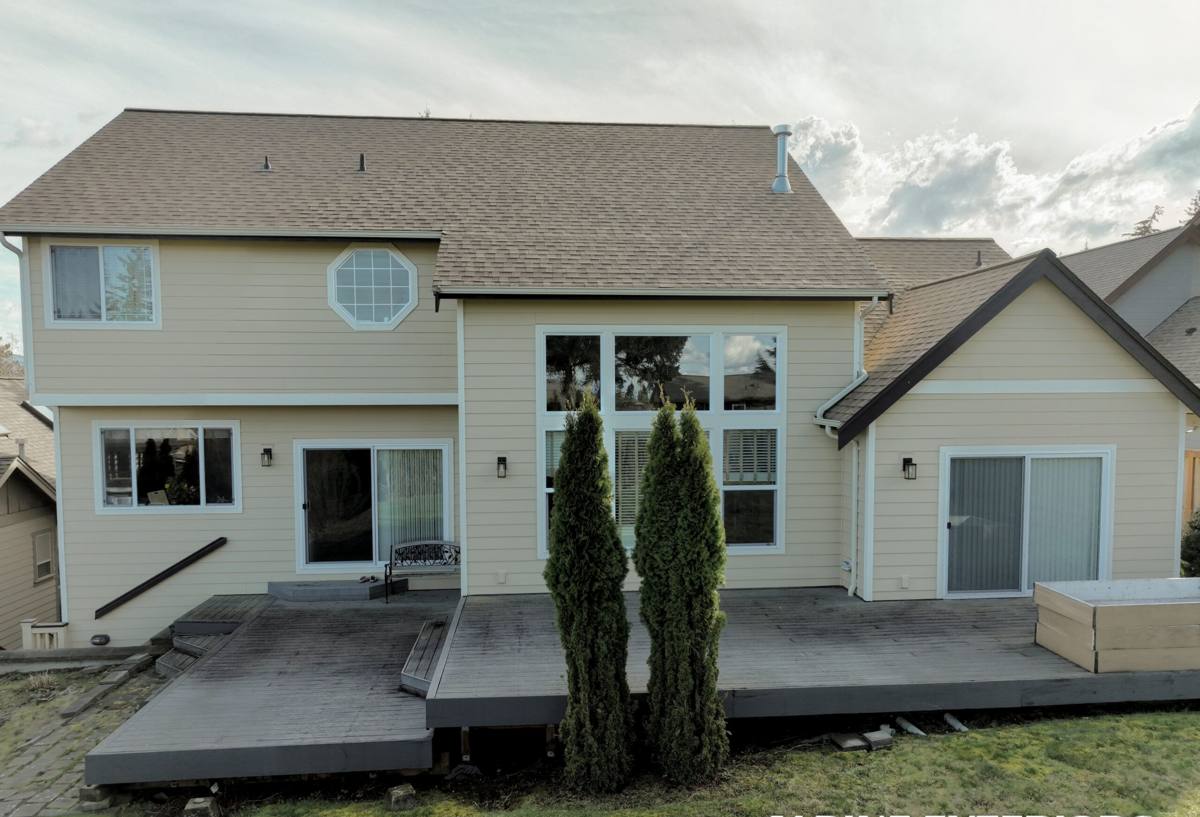
Signs Your Deck Needs Repair, Not Full Replacement
Most decks we look at in Birch Bay Village don't need to be torn out. They need targeted repair to the specific areas that took the damage — which is usually a smaller list than homeowners expect. Here's what we look for:
- Soft or spongy spots when you walk across the deck, especially near the house or along the perimeter
- Boards that have cupped, split, or pulled away from their fasteners
- Rust streaks running down from screws, nails, or joist hangers
- A railing or post that moves when you push on it — this is a safety issue, not a cosmetic one
- Dark, persistent staining or moss growth in the same spots every year, which usually means water isn't draining or drying properly there
- Gaps or separation where the deck meets the house (the ledger board connection)
- Visible daylight or soft wood where support posts meet footings
If what you're seeing is limited to a few boards, a railing section, or a ledger connection, repair is almost always the right call. Full replacement makes sense when the framing itself — the joists and beams under the surface — has widespread rot, which is less common but does happen on older decks that were never properly flashed.
What a Correct Deck Repair Actually Involves
It Starts Underneath, Not on Top
A repair that only replaces the visible boards without checking what's underneath is a repair that doesn't last. Before we touch decking boards, we check the ledger board attachment, the condition of the joists, and whether flashing is doing its job at the point where the deck meets the house — that's the single most common place we find hidden water damage on decks in this area.
Fastener and Hardware Condition Matters More Here
Because of the salt air near the bay, hardware that would hold up fine 20 miles inland can corrode faster here. Part of a correct repair is checking whether existing fasteners, joist hangers, and post brackets are rated for the exposure they're actually getting, not just what was code-minimum when the deck was built.
Drainage and Airflow Get Fixed, Not Just Covered
If moss and standing moisture caused the damage in the first place, replacing a board without addressing why water was sitting there just buys a few more years before the same spot fails again. We look at board spacing, gaps between decking and adjacent structures, and whether debris is trapping moisture underneath.
Common Problem Areas We See on Birch Bay Village Decks
| Area | What Typically Goes Wrong | Why It Happens Here |
|---|---|---|
| Ledger board (deck-to-house connection) | Water intrusion behind the ledger, hidden rot in the rim joist | Driving rain pushed against the house wall, aging or missing flashing |
| Fasteners and hardware | Rust staining, weakened joist hangers, loosening screws | Salt air corrodes standard-grade metal faster than inland exposure |
| Decking boards | Cupping, splitting, soft spots, moss buildup | Extended damp season keeps boards from fully drying between rains |
| Railings and posts | Loose connections, wobble, wood movement at post base | Repeated wet-dry cycling loosens fasteners over time |
| Support posts and footings | Rot at the base where post meets grade or footing | Splash-back and poor drainage keep the post base damp longer than it should be |
Repair vs. Replace: How We Make the Call
We don't default to replacement because it's a bigger job — we default to whatever actually solves the problem for the least disruption and cost. That said, there are honest trade-offs worth knowing before you decide:
- Repair makes sense when damage is localized, the framing underneath is sound, and the deck is structurally solid overall. It costs less, takes less time, and lets you keep a deck you may already like the layout and size of.
- Replacement becomes the better option when rot has spread through multiple structural members, when repeated repairs are happening in the same spots year after year, or when the deck was undersized or under-flashed from the start.
- Age alone isn't the deciding factor. We've repaired older decks that were well-built and just needed hardware and board updates, and we've recommended replacement on newer decks where the original construction didn't account for this area's exposure.
Our Deck Repair Process
- On-site assessment. We check the deck from the framing up — not just the surface — including the ledger connection, posts, footings, and hardware condition.
- Honest scope. We tell you plainly what needs to be fixed now, what's worth watching, and what doesn't need touching. No upsell to a full rebuild if a repair will hold.
- Address the cause, not just the symptom. If moisture or drainage caused the damage, that gets corrected as part of the repair, not left for next year.
- Repair with appropriately rated materials. Fasteners and hardware are matched to the exposure the deck actually sees, not just whatever's cheapest.
- Walkthrough when finished. We show you what was done and what to keep an eye on going forward.
Materials We Use and Why
For hardware near the water in Whatcom County, we lean toward stainless or high corrosion-resistant fasteners and connectors rather than standard galvanized, particularly in areas exposed to direct weather or salt-laden air. Standard hardware isn't wrong everywhere — it's often fine on sheltered, inland decks — but on a deck like the ones common in Birch Bay Village, spending a bit more on hardware upfront is far cheaper than reopening the same repair in a few years.
For decking boards themselves, both quality wood and composite materials have a place, and the right choice depends on the specific deck. Wood is easier to spot-repair board by board and blends with older construction, but it needs more regular maintenance to shed moisture and resist moss in this climate. Composite decking generally resists moisture and moss buildup better and needs less upkeep, but it comes with a higher upfront cost and, on repairs, matching an existing composite line years later isn't always possible. We'll walk through both honestly based on what your deck needs rather than pushing one material by default.
Keeping a Repaired Deck in Good Shape
A properly done repair should last, but a little seasonal attention goes a long way in this climate. Here's a simple checklist worth running through a couple of times a year:
- Sweep debris and leaves out from between boards and off the surface, especially heading into fall
- Rinse or gently scrub moss and algae off the surface before it gets a foothold — don't let it sit through a full wet season
- Check fasteners and railing connections for looseness or rust staining
- Look at the ledger board connection where the deck meets the house for any gaps, staining, or soft wood
- Keep gutters and downspouts near the deck clear so runoff isn't draining directly onto or under it
- Reapply sealant or finish on wood decking on the manufacturer's recommended schedule, not just when it looks faded
Why It Matters That We Already Work in Birch Bay Village
A deck repair done by a crew unfamiliar with this specific stretch of coastline tends to treat the job like it's anywhere else — same hardware, same materials, same assumptions about how fast wood dries out. That approach doesn't hold up well against Birch Bay's salt air and extended moss season. Working regularly in this community means we already know which problem areas show up again and again on local decks, what hardware actually holds up here, and how to build a repair that accounts for the exposure rather than just patching what's visible.
If you're noticing soft spots, loose railings, moss buildup, or just want an honest read on whether your deck needs repair or something more, we're happy to take a look. Reach out for a free, no-pressure estimate using the form below — we'll tell you plainly what we find and what it would take to fix it right.